A new era of precision oncology
For more than a century, the defining tension in cancer therapy has been between efficacy and toxicity—the need to eliminate malignant cells without harming healthy tissue. Chemotherapy, though life-extending, remains blunt in its selectivity. Monoclonal antibodies improved that precision by targeting surface proteins specific to cancer cells. Yet even biologics often fall short of complete tumor eradication.
Enter antibody-drug conjugates (ADCs)—engineered bioconjugates that unite the targeting accuracy of monoclonal antibodies with the potency of cytotoxic drugs. These molecular hybrids are reshaping oncology, offering targeted cancer therapy that maximizes tumor cell death while minimizing systemic damage.
As of 2025, more than a dozen ADCs are FDA-approved, with hundreds in development across indications from breast and lung cancers to lymphomas and solid tumors. Their rise represents not just a new drug class, but a paradigm shift: chemotherapy that thinks like an antibody.
What are antibody-drug conjugates?
Antibody-drug conjugates are targeted biopharmaceuticals designed to deliver highly potent cytotoxic agents directly to cancer cells. An ADC consists of three essential components:
A monoclonal antibody (mAb): Provides target specificity by recognizing an antigen expressed primarily on tumor cells.
A linker: Chemically connects the antibody to the drug and controls its release.
A payload (drug): A small-molecule cytotoxin capable of killing cells at picomolar concentrations.
This architecture allows ADCs to function as guided missiles in oncology—homing in on cancer cells, internalizing upon antigen binding, and releasing their lethal cargo intracellularly.
The concept dates back to the 1980s, but the technology matured only in the past decade with advances in linker chemistry, site-specific conjugation, and antibody engineering. Today’s ADCs balance stability in circulation with controlled intracellular release, dramatically improving therapeutic windows (Nat Rev Drug Discov, 2023; 22:715–730).
Mechanism of action
ADCs mark a milestone in oncology’s progression from killing cells to controlling information
ImageFX (2025)
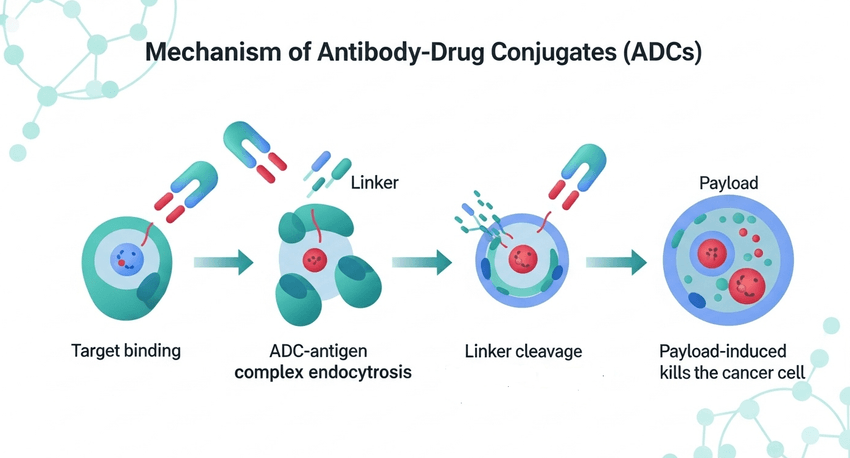
ADCs operate through a multistep, highly orchestrated process that couples target recognition with intracellular cytotoxicity.
1. Target binding
The monoclonal antibody selectively binds to a tumor-associated antigen such as HER2, TROP2, or CD30—proteins overexpressed on cancer cells but limited on normal tissues.
2. Internalization
Once bound, the ADC–antigen complex is internalized by endocytosis, entering the cell’s lysosomal compartments.
3. Linker cleavage and payload release
Inside the cell, cleavable linkers—sensitive to pH, enzymes, or reduction potential—release the cytotoxic payload. Stable linkers minimize premature release in plasma, enhancing safety.
4. Cytotoxic effect
The released payload—often a microtubule inhibitor (e.g., monomethyl auristatin E, DM1) or a DNA-damaging agent (e.g., calicheamicin, duocarmycin)—kills the target cell by triggering apoptosis or mitotic arrest.
Summary of ADC mechanism:
- Binding → Internalization → Linker cleavage → Payload release → Apoptosis
This mechanism allows chemotherapy-like potency with the precision of biologics, expanding the frontier of targeted cancer therapy (Clin Cancer Res, 2024; 30(1):12–25).
The evolution and clinical pipeline
The early generations of ADCs were plagued by instability, off-target toxicity, and manufacturing complexity. Early failures, such as gemtuzumab ozogamicin’s withdrawal in 2010, underscored the difficulty of balancing potency and safety. But with improved linkers and antibodies, ADCs have re-emerged as one of oncology’s fastest-growing therapeutic classes.
Clinical milestones
Modern ADCs such as trastuzumab deruxtecan (Enhertu®), brentuximab vedotin (Adcetris®), and sacituzumab govitecan (Trodelvy®) have achieved remarkable efficacy in breast, gastric, and lung cancers, often where conventional therapies failed.
Trastuzumab deruxtecan, in particular, expanded HER2 targeting to HER2-low breast cancer, a population once thought untreatable by anti-HER2 agents (Lancet Oncol, 2024; 25(3):145–157). This achievement signaled a conceptual shift: ADCs could succeed where naked antibodies or small molecules faltered.
Pipeline expansion
As of 2025, more than 400 ADCs are in various stages of development. Leading companies like Daiichi Sankyo, AstraZeneca, Seagen, and Pfizer are exploring novel targets (TROP2, Nectin-4, and HER3) and payload classes, including topoisomerase I inhibitors and immune-modulatory agents.
ADC innovation is now driven by three main technological pillars:
- Improved conjugation chemistry ensuring uniform drug-to-antibody ratios.
- Linker design that balances plasma stability and intracellular release.
- Payload diversification, expanding beyond microtubule inhibitors to new DNA- and RNA-targeting mechanisms.
As one industry review noted, “ADC design has evolved from art to science, where each component can be optimized for clinical performance” (Nat Rev Clin Oncol, 2023; 20:845–862).
Challenges and toxicities
Despite their precision, antibody-drug conjugates face significant biological, pharmacokinetic, and clinical challenges. Each component—the antibody, linker, and payload—contributes to the delicate balance between efficacy and safety. Understanding these limitations is critical to optimizing patient outcomes and guiding next-generation ADC design.
1. On-target, off-tumor toxicity
The most fundamental limitation of ADCs arises from the very feature that makes them powerful: antigen specificity. Even when a target antigen is “tumor-associated,” small amounts of expression in normal tissues can lead to on-target, off-tumor toxicity.
For instance, HER2—widely exploited in breast and gastric cancers—is also expressed at low levels in cardiac tissue and epithelial cells. This partial overlap can lead to adverse effects such as pneumonitis, neutropenia, and hepatotoxicity in patients receiving HER2-targeted ADCs like trastuzumab deruxtecan (Nat Rev Clin Oncol, 2023; 20:845–862).
To mitigate these effects, researchers are developing conditional ADCs that activate only within the tumor microenvironment (e.g., pH-sensitive or protease-cleavable linkers) and exploring tumor-restricted antigens such as Nectin-4 or TROP2 to enhance selectivity.
2. Drug resistance
Like all targeted therapies, ADCs face the evolving challenge of tumor resistance. Cancer cells can escape ADC-induced cytotoxicity through multiple mechanisms:
- Antigen downregulation or loss, reducing ADC binding and uptake.
- Altered intracellular trafficking, shunting ADCs to non-lysosomal compartments where linkers fail to cleave.
- Upregulated efflux transporters (e.g., MDR1/P-glycoprotein), which expel released payloads before they can exert cytotoxicity.
In HER2-positive breast cancer, for example, long-term exposure to trastuzumab emtansine (T-DM1) can result in reduced HER2 expression or disrupted lysosomal processing, leading to therapeutic failure (Cancer Cell, 2024; 42(4):501–520).
Addressing resistance involves both better target selection and payload diversification. The newest ADCs employ bystander-capable payloads or dual-antigen targeting antibodies to maintain cytotoxic activity even against heterogeneous tumors.
3. Bystander effects
One of the most intriguing—and controversial—features of ADC pharmacology is the bystander effect. After internalization and payload release, certain cytotoxins can diffuse across cell membranes, killing neighboring cells regardless of antigen expression.
This phenomenon can be beneficial in tumors with heterogeneous antigen density, where some cells may not express the target. However, when diffusion extends beyond the tumor microenvironment, it can lead to collateral toxicity in healthy tissues.
Payloads such as topoisomerase I inhibitors (e.g., deruxtecan, SN-38) exhibit strong bystander activity. Managing this balance requires precise linker tuning—too stable, and the payload never reaches its target; too labile, and systemic toxicity rises (Clin Cancer Res, 2024; 30(1):12–25).
Current strategies include tumor-activated linkers, controlled-release kinetics, and membrane-impermeable payload analogs to harness beneficial bystander activity while minimizing harm.
4. Narrow therapeutic window
Perhaps the most challenging limitation of ADCs is their narrow therapeutic index—the fine line separating clinical benefit from unacceptable toxicity.
Because ADCs deliver ultrapotent cytotoxins—often 100–1000 times more toxic than conventional chemotherapy—even minor fluctuations in dose, conjugation ratio, or clearance can significantly alter safety profiles.
Common dose-limiting toxicities include neutropenia, thrombocytopenia, interstitial lung disease, and hepatic dysfunction. Many are not purely off-target but stem from systemic exposure to prematurely released payloads or impaired drug metabolism.
Pharmacokinetic optimization—through site-specific conjugation, homogeneous drug-to-antibody ratios (DARs), and longer-circulating linkers—has improved predictability. Still, careful dose titration and biomarker-driven patient selection remain vital to maximizing benefit while minimizing risk (Nat Rev Drug Discov, 2023; 22:715–730).
Addressing the challenge
To overcome these toxicological hurdles, the field is converging on multi-parameter optimization—where the antibody, linker, and payload are co-engineered rather than independently optimized. Machine learning models are being used to predict linker cleavage rates and antigen expression profiles, enabling ADCs that are both safer and more effective.
As one Science Translational Medicine commentary summarized, “Next-generation ADCs will rely less on luck and more on logic—the rational design of conjugates that behave predictably in complex human biology” (Sci Transl Med, 2023; 15:eabo6933).
Future outlook: next-generation ADCs
The future of ADCs lies in integration—with other modalities and across treatment paradigms.
Bispecific and immune-modulatory ADCs
New designs couple antibodies that engage multiple antigens or stimulate immune effector cells, broadening therapeutic reach.
Combination therapies
ADCs are being combined with checkpoint inhibitors and PARP inhibitors, leveraging immune activation and DNA repair inhibition for synergistic effects.
Convergence with bioconjugates
The line between ADCs and bioconjugates is blurring, as chemical and protein engineering enable new payloads, including RNA modulators, protein degraders, and radiotherapeutics (Sci Transl Med, 2023; 15:eabo6933).
Expanding beyond oncology
Although cancer remains the primary focus, researchers are investigating ADC-like constructs for autoimmune and infectious diseases, suggesting the platform could extend well beyond oncology.
As Nature Reviews Drug Discovery observed, ADCs “represent the culmination of decades of bioconjugate chemistry—where precision targeting meets therapeutic power” (Nat Rev Drug Discov, 2023; 22:715–730).
The next decade will determine how far that precision can go.
Conclusion: the promise of intelligent chemotherapy
Antibody-drug conjugates embody a long-sought synthesis: the precision of targeted therapy with the potency of chemotherapy. They are not a replacement for traditional cytotoxics but an evolution—guided missiles replacing carpet bombs.
As oncologists increasingly view ADCs as a pillar of cancer therapy, their continued success will depend on chemistry as much as biology. Advances in linker design, payload diversity, and conjugation control promise to refine this already transformative class.
ADCs mark a milestone in oncology’s progression from killing cells to controlling information—the molecular intelligence of medicine realized.
This article was created with the assistance of Generative AI and has undergone editorial review before publishing.