- Introduction: The new frontier in drug discovery
- What are emerging modalities?
- Why emerging modalities matter
- Key categories of emerging modalities
- Emerging modalities: Market outlook and investment trends
- Scientific promise and therapeutic potential
- Manufacturing and scalability challenges
- Regulatory and clinical landscape
- Ethical, safety, and societal considerations
- The future of emerging modalities
- Conclusion: The modalities that will define the future
Introduction: The new frontier in drug discovery
The field of drug discovery is undergoing a profound transformation. Traditional small-molecule and biologic therapeutics — long the backbone of modern medicine — are now joined by a new generation of emerging modalities. These include gene and cell therapies, RNA-based drugs, protein degraders, and other cutting-edge approaches designed to target disease mechanisms once considered undruggable.
The rise of these modalities represents not only a scientific revolution but also a paradigm shift in how diseases are treated, pipelines are built, and regulatory frameworks evolve. For researchers, investors, and clinicians alike, understanding the science, promise, and challenges of these new modalities is essential to navigating the next era of therapeutics.
What are emerging modalities?
Emerging modalities are novel classes of therapeutics that extend beyond traditional chemical and biologic drugs. While small molecules generally modulate protein function through binding and biologics such as antibodies act through extracellular or immune-mediated pathways, emerging modalities often target the genome, transcriptome, or proteome in fundamentally new ways.
These therapies are typically characterized by:
- Novel mechanisms of action: For example, degrading target proteins rather than merely inhibiting them.
- Precision targeting: Modulating gene expression or editing the genome directly.
- High specificity: Leveraging engineered nucleic acids or cellular components.
- Personalization: Often tailored to an individual’s genetic or molecular profile.
Examples include gene and cell therapies, RNA therapeutics (mRNA, siRNA, antisense oligonucleotides), gene editing technologies (CRISPR/Cas9, base editors, prime editors), targeted protein degraders (PROTACs, molecular glues), and engineered proteins or peptides.
Why emerging modalities matter
These new modalities can address the 85% of the human proteome that remains “undruggable” by conventional means. Traditional therapeutics often fail when targets are intracellular, lack binding pockets, or involve complex protein-protein interactions. Emerging modalities overcome these limitations by acting at different biological levels — DNA, RNA, or via induced protein degradation.
From a clinical perspective, these therapies hold the promise of disease modification or even cures rather than symptomatic treatment. Gene therapy, for example, offers the potential to correct the root cause of genetic disorders, while mRNA technology has demonstrated its scalability and versatility during the COVID-19 pandemic.
From an R&D standpoint, emerging modalities expand the therapeutic toolkit and open new commercial and scientific frontiers. The global market for such modalities is growing exponentially, attracting unprecedented investment and reshaping the pipelines of nearly every major pharmaceutical company.
Key categories of emerging modalities
1. Gene therapy
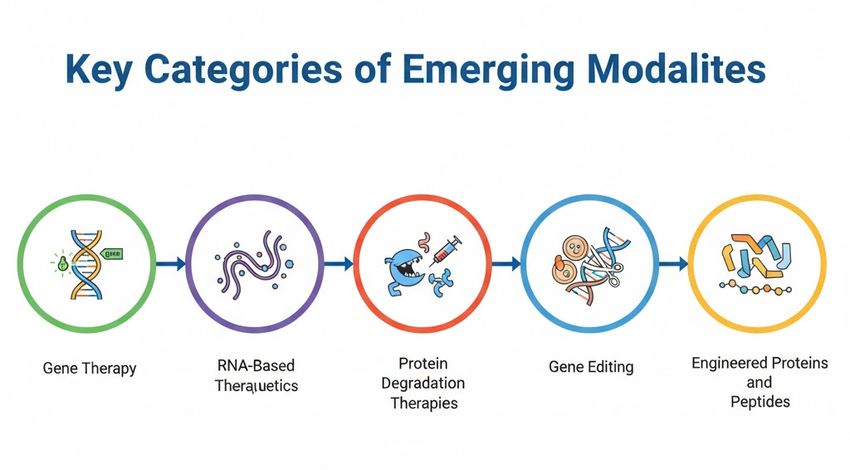
Emerging modalities represent the next leap in therapeutic precision.
Gemini (2025)
Definition: Gene therapy involves introducing, removing, or altering genetic material within a patient’s cells to treat or prevent disease.
Mechanisms:
- Gene addition or replacement: Delivering a functional gene to replace a defective one.
- Gene silencing: Using vectors or RNA interference to suppress harmful gene expression.
- Gene editing: Making precise alterations using tools such as CRISPR/Cas9.
Applications:
- Inherited disorders (spinal muscular atrophy, hemophilia)
- Oncology (CAR-T and oncolytic viral vectors)
- Ophthalmology (retinal dystrophies)
Key advances:
Adeno-associated virus (AAV) vectors have become the leading delivery system, but challenges remain — especially in vector manufacturing, immune responses, and long-term durability of gene expression. Next-generation systems, including nonviral delivery and self-amplifying RNA, are under active development.
2. RNA-based therapeutics
Definition: RNA therapeutics manipulate RNA molecules to modulate gene expression, protein translation, or immune response.
Main classes:
- mRNA therapies: Deliver genetic instructions to produce therapeutic proteins.
- siRNA and miRNA: Silence specific mRNA targets to reduce pathogenic protein production.
- Antisense oligonucleotides (ASOs): Bind RNA transcripts to modify splicing or translation.
Applications:
RNA drugs are now approved for conditions such as transthyretin amyloidosis, spinal muscular atrophy, and hypercholesterolemia.
Impact:
The success of mRNA COVID-19 vaccines (Moderna and Pfizer-BioNTech) validated the modality at scale, accelerating investment into mRNA-based cancer vaccines, rare disease therapies, and regenerative applications.
Challenges:
Instability, off-target effects, and delivery barriers — especially to nonliver tissues — remain significant. Lipid nanoparticles (LNPs) are the leading delivery vehicles, but new polymers, peptides, and extracellular vesicle systems are under investigation.
3. Protein degradation therapies
Definition: Protein degraders are small molecules or chimeras that harness the cell’s degradation machinery to eliminate disease-causing proteins.
Types:
- PROTACs (proteolysis targeting chimeras): Bifunctional molecules linking a target protein to an E3 ligase for ubiquitin-mediated degradation.
- Molecular glues: Small molecules that stabilize the interaction between a target and an E3 ligase.
Applications:
Effective against previously undruggable targets, especially transcription factors and scaffolding proteins.
Clinical outlook:
Multiple PROTAC candidates are in Phase 2 and 3 trials, addressing cancers, neurodegenerative diseases, and inflammatory conditions. Companies such as Arvinas, C4 Therapeutics, and Nurix are leading development efforts.
Challenges:
Pharmacokinetics and tissue distribution remain hurdles. Ensuring specificity without degrading homologous proteins is another challenge.
4. Cell-based therapies
Definition: Cell therapies involve administering live cells that are engineered or expanded to perform a therapeutic function.
Types:
- Autologous therapies: Using the patient’s own cells (for example, CAR-T).
- Allogeneic therapies: Universal donor-derived cells engineered for broader use.
- Stem cell therapies: Using pluripotent or progenitor cells to regenerate tissue.
Applications:
CAR-T therapies (Kymriah and Yescarta) revolutionized oncology by redirecting T cells to target tumors. Meanwhile, stem-cell-based treatments are advancing for diabetes, Parkinson’s disease, and cardiac repair.
Challenges:
Manufacturing complexity, cost, and regulatory oversight make scaling difficult. Emerging solutions include automated cell manufacturing and gene-edited universal donor lines to reduce rejection risk.
5. Gene editing
Definition: Gene editing technologies such as CRISPR/Cas9, TALENs, and zinc finger nucleases allow direct modification of DNA sequences.

Applications:
- Correcting pathogenic mutations (sickle cell disease, beta thalassemia)
- Enhancing cell therapies (CAR-T optimization)
- Functional genomic screening for target discovery
Recent breakthroughs:
The 2023 FDA approval of Casgevy (exagamglogene autotemcel) marked the first CRISPR-based therapy approved for clinical use, treating sickle cell disease — a milestone that validated gene editing as a viable therapeutic platform.
Next steps:
Base and prime editing technologies aim for more precise, less disruptive DNA modifications, broadening the potential therapeutic landscape.
6. Engineered proteins and peptides
Definition: Engineered proteins, peptides, and scaffolds expand therapeutic possibilities through enhanced stability, selectivity, and delivery.
Examples:
- Bispecific antibodies: Target two antigens simultaneously.
- Antibody-drug conjugates (ADCs): Combine antibody targeting with cytotoxic payloads.
- Peptidomimetics: Small peptides engineered for improved pharmacokinetics.
Market growth:
The ADC market alone is projected to exceed $25 billion by 2030, driven by oncology indications and improved linker technologies.
Emerging modalities: Market outlook and investment trends
The emerging modalities market is growing at an extraordinary pace. Analysts project that by 2030, nearly one-third of all new drug approvals will derive from advanced modalities.
Key figures (2025 estimates):
- Global gene therapy market: $20–25 billion
- RNA therapeutics market: $15–20 billion
- Cell therapy market: $30–40 billion
- Protein degradation and gene editing combined: $10–15 billion
Pharmaceutical pipelines now feature more than 2,000 active programs in advanced modalities, with a surge in preclinical RNA and gene editing assets. Major pharmaceutical companies — including Novartis, Roche, Pfizer, and AstraZeneca — have restructured their R&D divisions to prioritize these technologies, while smaller biotechs continue to drive innovation.
Strategic investment partnerships such as Roche’s investment in GenEdit signal the industry’s commitment to gene editing and delivery platforms.
Scientific promise and therapeutic potential
Emerging modalities represent the next leap in therapeutic precision. By targeting diseases at their molecular root, these technologies have the potential to cure rather than manage chronic conditions.
Areas of promise:
- Genetic disorders: Single-dose gene replacement or editing therapies.
- Oncology: Immune-based therapies and targeted degradation for undruggable drivers.
- Neurological diseases: RNA and protein-based tools to address complex CNS pathologies.
- Infectious diseases: mRNA and siRNA therapeutics for rapid response.
The expansion of multiomic data, AI-driven design, and automation has accelerated discovery, enabling predictive modeling of RNA structures, guide RNA specificity, and degradation kinetics — all essential to optimizing next-generation drugs.
Manufacturing and scalability challenges
Despite their promise, emerging modalities face significant chemistry, manufacturing, and controls (CMC) challenges. Many are biologically complex, personalized, or require stringent cold-chain logistics.
Key challenges:
- Vector and LNP production: High cost and batch variability.
- Analytical characterization: New quality control frameworks are needed to ensure potency and safety.
- Regulatory harmonization: Diverse global standards complicate approvals.
- Automation and AI: Increasingly essential for process standardization and cost reduction.
The industry is moving toward modular, closed-system manufacturing to scale therapies safely and efficiently.
Regulatory and clinical landscape
Regulatory agencies worldwide are adapting rapidly. The U.S. Food and Drug Administration (FDA), European Medicines Agency (EMA), and Japan’s Pharmaceuticals and Medical Devices Agency (PMDA) have all issued frameworks for advanced therapy medicinal products (ATMPs) and novel drug modalities.
Recent developments:
- The FDA’s Office of Therapeutic Products consolidates expertise in cell and gene therapies.
- Accelerated pathways, including RMAT and Breakthrough Therapy Designation, support early access for transformative therapies.
- EMA’s Advanced Therapies Regulation provides harmonized EU guidance for gene, cell, and tissue-based products.
Uncertainty remains in areas such as off-target editing assessment, long-term follow-up, and immunogenicity testing. Collaboration between regulators, sponsors, and industry consortia is essential for timely, safe approvals.
Ethical, safety, and societal considerations
With immense potential comes equal ethical responsibility. Emerging modalities challenge long-standing norms about what medicine should do. Gene editing, cellular reprogramming, and AI-assisted design raise questions about human intervention in biology, data governance, and equitable access.
Germline modification and heritable change
The most significant ethical debate centers on germline gene editing — altering DNA in reproductive cells or embryos in ways that can be inherited. Somatic editing (nonheritable) is accepted for severe diseases, but germline modification remains prohibited in most countries.
The 2018 case of He Jiankui, who announced the birth of CRISPR-edited babies in China, reinforced the global consensus that scientific capability outpaces ethical readiness. In response, the World Health Organization (WHO) and the International Commission on the Clinical Use of Human Germline Genome Editing established governance frameworks emphasizing scientific justification, transparency, and long-term follow-up.
Equitable access and global health disparities
Advanced therapies can cost more than $2 million per treatment, raising issues of affordability and access. Without deliberate policy interventions, they risk widening global health inequities. Initiatives like the WHO Global Observatory on Health R&D and the Bespoke Gene Therapy Consortium are developing open-access vector platforms and shared manufacturing infrastructure to reduce barriers.
Value-based and outcomes-based pricing models, tying payment to long-term patient outcomes, are also emerging as potential solutions.
Data ownership, privacy, and algorithmic bias
Emerging modalities rely on genomic and phenotypic data from global biobanks. As AI becomes central to designing CRISPR guides and RNA sequences, questions of ownership, consent, and bias intensify.
Frameworks such as the EU General Data Protection Regulation (GDPR) and the U.S. NIH Genomic Data Sharing Policy have addressed some issues, but global harmonization is lacking. Federated learning — training AI on distributed datasets without exposing personal data — offers a promising model.
Informed consent and long-term follow-up
Long-acting therapies challenge traditional informed consent. Patients must understand not only immediate risks but also long-term uncertainties, including off-target effects and durability. Regulators now require postmarket surveillance lasting up to 15 years for gene therapy recipients, supported by patient registries and real-world evidence frameworks.
Public trust and ethical governance
Public trust underpins the success of emerging modalities. Transparent communication of risks and benefits and inclusive policymaking are essential. The National Academies of Sciences, Engineering, and Medicine and the WHO’s Expert Advisory Committee advocate for multistakeholder governance, involving ethicists, scientists, and patients.
Ethical innovation is not a constraint on progress — it is the foundation of responsible scientific advancement.
The future of emerging modalities
Over the next decade, emerging modalities will converge. Hybrid approaches — such as RNA-guided protein degraders, gene-edited cell therapies, and mRNA-encoded antibodies — show that traditional modality boundaries are dissolving.
Integrated example: AI-driven nanoparticle engineering meets multiomics in precision oncology
A recent study by Sheikh and Jirvankar et al. (2024) demonstrated how AI, multiomics data, and nanoparticle design can be integrated to create personalized cancer therapeutics
Researchers used AI models trained on tumor-specific genomic, transcriptomic, and proteomic profiles to predict optimal nanoparticle formulations for drug delivery. The models identified receptor patterns unique to tumor subtypes, guiding ligand functionalization and surface charge optimization for targeted uptake.
Preclinical testing confirmed that AI-optimized nanoparticles achieved superior tumor penetration and reduced systemic toxicity compared with controls. This integration of AI, nanotechnology, and omics-based profiling exemplifies how computational, molecular, and materials science can converge to yield more precise, effective treatments.
Conclusion: The modalities that will define the future
Emerging modalities are not extensions of existing drug classes — they represent a new era of medicine defined by molecular precision, curative intent, and biological innovation. From CRISPR cures to programmable RNA vaccines, these technologies are reshaping human health.
As clinical successes accumulate and regulatory frameworks mature, the industry will continue to shift toward modality-agnostic platforms — focusing less on the molecule and more on the mechanism. For scientists and developers, the challenge is clear: harness the power of biology itself to transform medicine.
This article was created with the assistance of Generative AI and has undergone editorial review before publishing.