- Introduction: rewriting disease at the source
- What are gene therapies?
- Viral vectors: adapting nature’s delivery machinery
- Non-viral delivery platforms
- Challenges shaping the field
- Future outlook: the convergence era
- Conclusion
- This article was created with the assistance of Generative AI and has undergone editorial review before publishing.
Introduction: rewriting disease at the source
For much of modern medicine, treatment has focused on managing symptoms or slowing disease progression rather than addressing the underlying biological cause. Gene therapy represents one of the most impactful emerging modalities—a rapidly advancing class of treatments designed to intervene at the level of DNA and RNA, where disease originates. Rather than modifying downstream protein pathways or compensating for dysfunction, gene therapies attempt to correct disease at its source by repairing, replacing, or silencing the genetic instructions that guide cellular function.
The premise is straightforward: if a disease arises from a defective gene, correcting or supplementing that gene may halt or reverse the disease. Turning that principle into durable, safe therapy, however, requires delivering genetic material to the right cells, at the right dose, for a meaningful duration, while ensuring immune compatibility and safety. This challenge has shaped the evolution of both viral and non-viral delivery strategies. Today, delivery is not a supporting tool—it is the central determinant of what is clinically possible in genetic medicine and one of the key factors distinguishing successful emerging modalities from theoretical ones.
What are gene therapies?
Gene therapies modify cells to restore healthy function. They may:
- Replace a missing or defective gene
- Add a gene to increase protein output
- Silence or suppress harmful gene expression
- Edit the gene itself using CRISPR, base editing, or prime editing
Because these therapies intervene upstream of protein function, they can produce long-lasting or curative effects, particularly in monogenic diseases.
Viral vectors: adapting nature’s delivery machinery
ImageFX (2025)
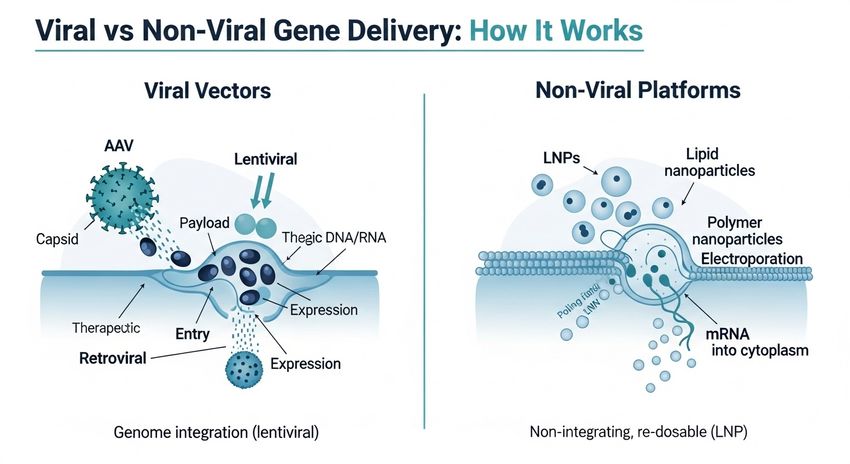
Viruses naturally evolved to transfer genetic material into host cells. Gene therapy repurposes this capability by disabling viral replication and using viral shells to deliver therapeutic DNA or RNA.
Adeno-associated virus (AAV)
AAV is a small, non-pathogenic virus that naturally infects humans but causes no known disease. In gene therapy, AAV’s viral genes are removed and replaced with therapeutic DNA, while the capsid remains to mediate cell entry. Because AAV does not integrate into the genome, it produces long-lasting gene expression in non-dividing tissues such as retina, muscle, and neurons. This makes AAV the primary platform for in vivo gene delivery.
AAV is widely used in therapies targeting muscle, retina, liver, and CNS, offering low immunogenicity and durable expression. The SMA therapy onasemnogene abeparvovec (Zolgensma®) demonstrated transformative clinical impact (N Engl J Med, 2017; 377:1713–1722).
Constraints include a 4.7 kb payload limit, pre-existing immunity, and dose-related hepatotoxicity.
Lentiviral vectors
Lentiviruses are retroviruses capable of integrating genetic material into dividing cells, making them ideal for hematopoietic and immune cell engineering via ex vivo therapy. Because integration enables durable genetic correction, lentiviral vectors have been central to functional cures in β-thalassemia and sickle cell disease and to CAR-T cell therapy manufacturing.
Modern self-inactivating designs significantly reduce insertional oncogenesis risk (Nat Rev Genet, 2022; 23:5–20).
Retroviral vectors
Retroviral vectors were foundational to early gene therapy and remain in use for T-cell engineering workflows. Lentiviral systems have largely replaced them due to improved versatility and safety, but they remain relevant where regulatory familiarity and manufacturing stability are advantageous.
Non-viral delivery platforms
Limitations of viral vectors—including immunity, redosing barriers, and manufacturing scale—have accelerated interest in non-viral systems.
Lipid nanoparticles (LNPs)
Following the success of mRNA COVID-19 vaccines, LNPs are now being developed for mRNA therapeutics, CRISPR delivery, and siRNA modulation. They are re-dosable and non-integrating but currently target the liver preferentially (Nat Nanotechnol, 2022; 17:108–115).
Polymer and peptide carriers
These systems offer tunable chemistry but currently have lower intracellular uptake efficiency relative to viral vectors.
Physical delivery
Techniques such as electroporation and ultrasound-mediated transfection enable localized gene transfer and are widely used in cell therapy manufacturing.
Challenges shaping the field
Gene therapy has reshaped clinical thinking—from symptom management to biological correction. But as the science matures, the field now faces questions of safety, repeatability, and equity.
Key challenges include:
- Immune responses can reduce therapeutic benefit and prevent repeat dosing.
- Tissue targeting remains uneven; the liver is accessible, but CNS, cardiac, lung, and renal delivery remain more complex.
- Durability depends on cell turnover; stable in retina and muscle, diluted in dividing tissues.
- Manufacturing and cost (often $1–3M per patient) limit global accessibility.
These challenges reflect a field shifting from proof of possibility to scalable clinical implementation.
Future outlook: the convergence era
Rather than choosing between viral and non-viral systems, the field is moving toward delivery convergence—combining platforms based on biological need. AAV may deliver gene replacement, while LNPs deliver CRISPR repair templates, and lentiviruses engineer immune cells later modulated in vivo. Meanwhile, AI-guided capsid evolution, receptor-targeted nanoparticles, and compact editing enzymes are expanding therapeutic reach.
Emerging directions likely to shape the next decade include:
- Base and prime editing for precise gene correction
- Self-amplifying RNA to reduce dosage burden
- Organ-targeted nanoparticles for CNS, cardiac, and pulmonary delivery
- Computationally designed capsids optimized for re-dosing and cell specificity
The future of gene therapy depends not only on what we deliver, but how precisely we deliver it.
Conclusion
Gene therapy has crossed from conceptual development into clinical reality, offering durable treatment options for conditions once considered irreversible. As delivery platforms continue to improve, gene therapy is poised to expand from rare disease treatments into broad clinical practice. The more precisely we deliver genetic instructions, the closer we move toward curative medicine.