- Key takeaways
- The CDMO landscape: types, capabilities, and specializations
- How do you make the make-vs-buy decision at each development stage?
- CDMO selection: evaluating fit beyond GMP certification
- What does effective technology transfer actually require?
- Quality agreements: the regulatory and operational foundation of the partnership
- How do you manage the CDMO relationship through commercial transition?
The decision to outsource biopharmaceutical manufacturing is rarely made once. Most programs begin with a CDMO for clinical supply, revisit the make-vs-buy decision at each phase transition, and arrive at commercial manufacturing with a strategy shaped by years of CDMO partnership. Getting that strategy right requires understanding what CDMOs are, what they are not, and what a well-structured outsourcing relationship looks like from first engagement through commercial supply.
Key takeaways |
|
|
|
|
|
For the broader bioprocessing context in which CDMO relationships operate, including scale-up strategy and platform manufacturing, see the related article on bioprocessing scale-up and Pharma 4.0. For the specific manufacturing challenges of advanced therapy modalities that drive specialized CDMO selection, see the related feature on manufacturing cell, gene, and mRNA therapies.
The CDMO landscape: types, capabilities, and specializations
Contract development and manufacturing organizations have evolved from generalist toll manufacturers into a differentiated ecosystem that ranges from full-service providers capable of taking a molecule from cell line development through commercial supply, to single-modality specialists that exist specifically because the manufacturing complexity of certain product classes requires dedicated infrastructure and deep technical expertise. Research on the critical role of CDMOs in the biopharmaceutical ecosystem confirmed that the standardization of monoclonal antibody manufacturing has made outsourcing for that class particularly tractable, because shared platform processes across the industry mean that a CDMO experienced in mAb manufacturing can apply well-characterized process knowledge to a new program. The same standardization logic does not apply equally to specialized modalities.

Full-service CDMOs offer a manufacturing continuum from early process development and analytical method development, through clinical Phase I-III GMP supply, to commercial manufacturing at full scale. For programs that need a single external partner to carry a molecule through its entire manufacturing lifecycle, a full-service CDMO with the appropriate modality capabilities eliminates the technology transfer steps that would otherwise be required when moving between development-stage and commercial-stage providers.
Modality-specific CDMOs have emerged to serve the manufacturing requirements of product classes that general biologic CDMOs cannot readily support. The viral vector CDMO sector serves gene therapy programs that require GMP-grade HEK293 triple transfection at clinical and commercial scale, along with the specialized analytical capabilities for capsid characterization, potency testing, and empty-full capsid ratio determination. The ADC conjugation CDMO sector serves programs that require containment-qualified facilities for handling cytotoxic payloads. The cell therapy CDMO sector serves autologous and allogeneic programs with process-specific closed-system manufacturing and chain-of-custody infrastructure.
Emerging capabilities at the frontier of CDMO specialization include continuous manufacturing, where CDMOs are building the integrated upstream-downstream processing infrastructure to support intensified perfusion-based production, and mRNA manufacturing, where dedicated IVT and LNP formulation capacity has been established at several CDMOs following the COVID-19 vaccine demand surge. Understanding which CDMO tier and specialization matches a program's current and anticipated manufacturing requirements is the prerequisite for an effective CDMO selection process.
How do you make the make-vs-buy decision at each development stage?
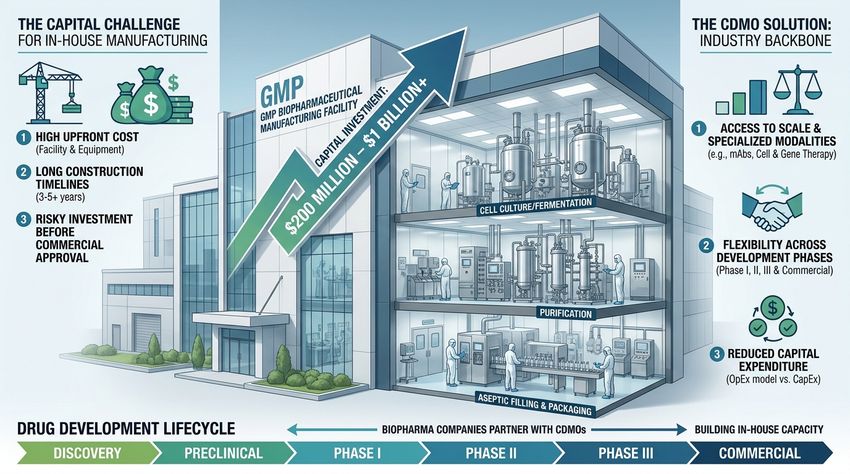
The make-vs-buy decision for biopharmaceutical manufacturing depends on five variables that change across the development lifecycle: the technical complexity of the manufacturing process relative to available internal capability, the batch frequency and scale required for the current development stage, the capital investment required to build internal capacity, the timeline pressure of the clinical program, and the strategic value of owning the manufacturing process directly.
At the early clinical phase, the make-vs-buy calculation almost universally favors outsourcing for biotech companies without established manufacturing infrastructure. The capital required to build a GMP-qualified bioreactor suite, fill-finish facility, and quality system from scratch cannot be justified by a single early-phase program, and the timeline to build, qualify, and validate internal manufacturing capacity is typically longer than the time available before the first Phase I batch is needed. CDMO manufacturing for Phase I and Phase II supply is therefore the default path for most programs.
The make-vs-buy decision becomes genuinely contested at commercial manufacturing transition. A program approaching BLA or MAA filing has sufficient clinical evidence of efficacy and safety to begin modeling the commercial manufacturing business case. At this stage, the batch frequency projection, capital cost of dedicated versus shared internal capacity, CDMO per-batch cost at commercial scale, and the strategic value of manufacturing control each factor into a multi-year financial analysis. Programs that model this transition beginning at Phase II, rather than waiting until the commercial filing stage, have more time to execute the infrastructure decisions that the analysis recommends.
For complex modalities including viral vectors, cell therapy, and mRNA, the make-vs-buy analysis has an additional dimension: whether any CDMO can provide the specific technical capabilities required, at the required scale, within the required timeline. Viral vector CDMOs are supply-constrained, with limited GMP capacity relative to the number of programs competing for slots. Programs that do not secure CDMO manufacturing agreements early in clinical development may find that no suitable partner is available when they need them.
Flow (2026)
CDMO selection: evaluating fit beyond GMP certification
GMP certification, whether from FDA, EMA, or other regulatory authorities, is a threshold requirement for a manufacturing CDMO but is not a differentiating factor in selection. Every credible CDMO for Phase II and Phase III supply will have current GMP certification. The differentiating factors are the CDMO's specific experience with the manufacturing platform required, the depth and availability of their analytical capabilities, the track record of successful regulatory interactions and facility inspections, and the quality and responsiveness of the project management structure.
Platform experience matters in proportion to the novelty of the manufacturing process. For a standard mAb program using conventional CHO cell culture, Protein A capture, and ion exchange polishing, the range of CDMOs with relevant experience is broad, because these platform processes are shared across much of the biopharmaceutical industry. For a gene therapy program requiring HEK293 triple transfection, empty capsid separation, and specialized potency testing, the range of CDMOs with genuine experience is narrow. Evaluating a CDMO's prior GMP manufacturing experience specifically with programs similar to the one being outsourced is more informative than evaluating their general GMP track record.
Evaluation dimension | What to assess | Red flags |
Modality-specific experience | Number and stage of GMP batches produced for programs similar to the one being outsourced; track record with the specific platform (mAb, viral vector, cell therapy, ADC, mRNA) | Claims of experience without GMP batch records to substantiate; general biologic experience offered as equivalent to specialized modality experience |
Regulatory track record | FDA and EMA GMP inspection history and outcome (483 observations, Warning Letters, import alerts); history of successful IND and BLA/MAA inclusions; familiarity with relevant regulatory framework | Uninspected facility; recent Warning Letter or consent decree; inability to provide references from regulators or sponsor programs that have submitted successful filings |
Analytical capability | In-house analytical methods relevant to the product class; ability to transfer and validate sponsor methods; experience with product-specific potency assays; access to specialized instrumentation | Reliance on third-party laboratories for critical release testing; no established method development capability; lack of experience with product-specific potency assays |
Capacity and scheduling | Manufacturing suite availability within the program timeline; realistic batch slot reservation process; contingency capacity for failed batches; supply chain for critical raw materials | No concrete commitment to schedule; overcommitted capacity across multiple competing programs; no contingency plan for failed batches or equipment downtime |
Project management and communication | Dedicated project manager with relevant technical background; clear escalation path; meeting cadence and reporting expectations; willingness to accept sponsor oversight | Opaque project structure; resistance to sponsor technical involvement; absence of defined communication protocols; changes in project management personnel without sponsor notification |
Financial stability | Evidence of financial health sufficient to complete the contracted manufacturing program; insurance coverage; contingency in the event of a quality failure requiring repeat manufacture | Recent ownership change or significant management turnover without strategic continuity; inability to provide financial references; thin client base making the company dependent on one or two large programs |
What does effective technology transfer actually require?
Technology transfer is the formal process of moving a manufacturing process from a development organization to a new manufacturing site, and it is reliably the most underestimated step in CDMO engagement. Published experience from early CDMO outsourcing strategy discussions in the biologics field identified that CDMOs are generally reluctant to run a GMP batch without an initial engineering run, and that the sponsor must communicate process priorities, risk tolerance, and critical quality attributes early and clearly to enable the receiving organization to configure the manufacturing process appropriately. Programs that arrive at a CDMO with poorly documented processes, inadequate analytical method packages, or undefined critical quality attributes impose a significant additional process development burden on the CDMO that extends the timeline before GMP manufacture can begin.
The technology transfer package should contain: complete batch manufacturing records in a format compatible with the CDMO's quality system, analytical methods with qualification data sufficient to begin method transfer at the new site, raw material specifications and qualified suppliers, cell bank materials with characterization data, equipment operation parameters and qualification criteria for the key pieces of equipment the process uses, and a process development history document that explains the rationale for current process parameters and identifies the parameters most critical to product quality.
Method transfer, in which each analytical method is demonstrated to perform equivalently at the receiving CDMO site as at the sending organization, is typically the longest component of a technology transfer. Methods that were developed on specific instrument models, reagents, or reference material lots that are not available at the CDMO site require re-optimization before the method can be validated for use in GMP batch release. Planning method transfer activities in parallel with process transfer activities, rather than sequentially, compresses the overall technology transfer timeline.
Engineering runs, non-GMP manufacturing runs performed at the CDMO site before the first GMP batch, serve as the practical test of whether the technology transfer package was complete and whether the CDMO's equipment and process configuration matches the performance expectations from the originating site. Programs that skip the engineering run to accelerate the timeline to first GMP batch often discover process gaps at the worst possible moment: during a GMP run whose outcome is material to a clinical filing timeline.
Quality agreements: the regulatory and operational foundation of the partnership
The quality technical agreement between sponsor and CDMO is required under FDA 21 CFR Part 211.42 and EU GMP Chapter 7, which both address the responsibilities of the contract giver and contract acceptor in outsourced manufacturing. The QTA must specify the quality responsibilities of each party for every function in the manufacturing and quality process, and it must be executed before GMP manufacturing begins. A comprehensive QTA is not merely a regulatory checkbox but the operational document that governs how a quality event, deviation, or out-of-specification result is managed when it occurs. Research on quality management systems for decentralized manufacturing confirmed that clear delineation of quality responsibilities, digital quality management systems, and integrated data management are critical enablers for maintaining manufacturing control across geographically distributed production sites.
The QTA must assign clear responsibility for batch record review and approval, deviation investigation and CAPA management, out-of-specification investigation, change control management, stability program execution and reporting, complaint handling and adverse event reporting to regulators, audit and inspection management, and regulatory submission support including the preparation of manufacturing sections of IND amendments, BLA filings, and annual product reviews. Gaps in the QTA's assignment of these functions do not remain theoretical: every function that is not assigned becomes the sponsor's problem to resolve under time pressure when a manufacturing event requires it.
QTA element | What it should specify | Responsibility assignment |
Batch release | Who reviews the batch record, who performs QC release testing, who signs the certificate of analysis, and who makes the final release decision for GMP product | CDMO executes; sponsor reviews and approves for clinical use; joint for commercial depending on market authorization |
Deviation management | Who opens the deviation record, investigation timeline requirements, who determines the impact on batch disposition, who drafts and approves the CAPA, and when sponsor notification is required | CDMO leads investigation; sponsor notified within defined timeframe for significant deviations; joint sign-off on CAPA |
Change control | What changes require sponsor notification versus prior approval, what changes require regulatory filing, and who is responsible for updating process documentation | CDMO initiates; sponsor approves material changes before implementation; regulatory filing responsibility assigned by jurisdiction and change type |
Stability program | Which product presentations are on stability study, who stores the stability samples, who performs the testing, who reviews results, and who is responsible for out-of-trend investigations | Typically CDMO performs testing; sponsor reviews and owns trending and reporting to regulators |
Regulatory inspections | CDMO obligation to notify sponsor of scheduled and unannounced inspections, sponsor access to inspection reports and observations, joint management of 483 responses that affect the manufacturing process | CDMO manages inspection; sponsor receives inspection outcome; joint response for manufacturing-related observations |
How do you manage the CDMO relationship through commercial transition?
The commercial manufacturing transition is the highest-stakes stage of the CDMO relationship. It occurs simultaneously with the regulatory approval process, where manufacturing site information is included in the BLA or MAA filing and the CDMO facility may be inspected by regulatory authorities as part of the pre-approval process. It is also the stage at which batch failures have the most severe commercial consequences, because any supply disruption after launch affects patient access and commercial revenue simultaneously.

Programs that plan the commercial transition beginning at Phase III, rather than treating it as a post-approval task, have time to complete pre-approval inspections, resolve any manufacturing site deficiencies identified during inspection preparation, establish commercial-scale batch documentation, execute process performance qualification (PPQ) batches that will be referenced in the BLA, and build the safety stock that provides supply continuity through post-launch demand ramp. Each of these activities has a multi-month lead time that compounds with clinical program timelines if started too late.
Managing the CDMO relationship effectively at commercial scale requires a different sponsor capability than managing it at clinical development scale. Clinical-stage CDMO oversight typically involves one to three dedicated CMC team members managing the technical and quality interaction. Commercial-stage oversight involves dedicated supply chain management, demand forecasting, commercial QA oversight, and contract management functions that most biotechs have not built before their first commercial approval. Resourcing these capabilities early enough to be operational at commercial launch is a common organizational challenge in the transition from development-stage to commercial-stage company.
The question of switching CDMOs, which arises either because the incumbent cannot support commercial volumes, because quality or performance has been inadequate, or because a strategic acquisition creates an internal manufacturing alternative, should always be evaluated against the full regulatory and operational cost of the change. A CDMO change at the commercial stage in a regulated market requires a regulatory submission that may require prior approval, a process comparability exercise that demonstrates product equivalence between the old and new sites, and a complete technology transfer to the new facility before any commercial batch can be released. The minimum calendar time for a planned commercial site change is typically 18 to 24 months from the decision to change to the first commercial release from the new site.
This article was produced under Drug Discovery News' AI Editorial Guidelines.