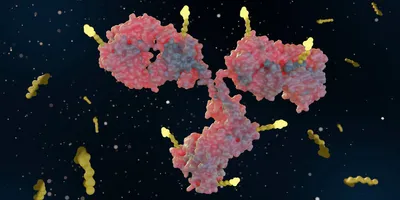
Roche recently announced results from the Phase 2 trial of their anti-amyloid antibody, trontinemab, for Alzheimer’s disease (AD). The data suggested that the drug removes amyloid from the brain more quickly and with fewer side effects than other approved drugs, which have had a mixed response from regulatory bodies. With plans to move the drug into Phase 3 clinical trials, Roche also hopes to show that the drug will make a greater impact on slowing or even preventing cognitive decline compared to its predecessors.
A mixed reaction to early anti-amyloid antibodies
In 2017, Mitzi Gonzales, a neurologist at Cedars-Sinai Medical Center, attended the Clinical Trials on Alzheimer's Disease Conference (CTAD) in Boston. That year, Biogen presented their data on a new anti-amyloid antibody, aducanumab. Drugs of this class target and clear amyloid plaques from the brain. The amyloid hypothesis of AD holds that these misfolded proteins play a central role in the disease’s pathogenesis. Biogen’s data, said Gonzales, received a mixed reception. The drug cut amyloid levels, but its effects on cognition were unclear, and the drug caused tiny brain bleeds that looked like a significant obstacle to approval.
But as Gonzales filed out of the lecture hall, she started talking to a researcher at the end of his career. “He was in his 80s,” said Gonzales. “He had tears in his eyes.” This researcher explained to Gonzales that although Biogen had barely moved the needle on cognition, its effects were more than he had ever seen in 60 years of research.

Just eight years later, there are two more approved anti-amyloid antibody drugs available for AD that modify disease progression — donanemab and lecanemab. While they are not curative, the data supporting these compounds is more resolute than that behind aducanumab.
Eli Lilly’s donanemab and the Eisai/Biogen drug lecanemab have both been approved by the FDA but rejected by the European Medicines Agency. The drugs’ mixed acceptance and related media coverage has irked Bart de Strooper, a dementia researcher at University College London’s (UCL) UK Dementia Research Institute. De Strooper was recognized for his contribution to the amyloid hypothesis when he was awarded The Brain Prize 2018 alongside neuroscientists John Hardy of UCL, Michel Goedert of the Medical Research Council (MRC) Laboratory of Molecular Biology, and Christian Haass of the German Center for Neurodegenerative Diseases. “The discussion around the other antibodies is glass-half-full or -empty. In the press, half-empty people have been quite vocal, because it's always easier to criticize things than to build up something,” he said.
Drug design tweaks speed up trontinemab
Roche hopes their new data will help some regulators change their views on anti-amyloid antibodies. The results of their Phase 1b/2a Brainshuttle™ trial showed that trontinemab, like donanemab and lecanemab before it, had a dramatic and sustained effect on amyloid levels. After 28 weeks, 91 percent of participants had amyloid levels below the consensus 24-centiloid positivity threshold. The centiloid scale is a quantitative measure of amyloid load as recorded on positron emission tomography (PET) scans, where lower values mean lower load.
In contrast, donanemab only hit this marker in 76 percent of patients in its Phase 3 trial — and that was after 76 weeks of treatment. Trontinemab’s safety data was also encouraging, with amyloid-related imaging abnormalities-edema/effusion (ARIA-E) — the brain bleeds that dogged other anti-amyloid antibodies — affecting less than 5 percent of participants. This rate is four times lower than for donanemab. All cases were mild, said Roche in the press release. The company now plans to test the drug’s effect on cognition in a pair of Phase 3 studies later this year, called TRONTIER 1 and 2.
The drug’s enhanced speed and safety are due to small tweaks in its design. Roche based trontinemab’s structure on their previous anti-amyloid antibody, gantenerumab. The latter drug was a high-profile failure in clinical trials, but Roche altered it with their Brainshuttle modification to create trontinemab.
Brainshuttle involves fusing an antigen-binding region (Fab) of an antibody onto a drug of choice — in this case, gantenerumab. The Fab engages the transferrin receptor 1, which usually transports iron across the blood-brain barrier. This binding significantly enhances the antibody’s ability to cross the blood-brain barrier and facilitates amyloid clearance.

The drug’s improved safety data appears to be also a product of its modified delivery into the brain, said de Strooper. “The antibody enters the brain at different sites, in the small capillaries of the brain, which are very close to the amyloid plaques,” he said. De Strooper added that this may allow the drug to avoid removing plaques from the larger blood vessels entering the brain, which is thought to increase ARIA-E rates, while still clearing amyloid from the brain itself.
Why early intervention is still paramount
The real test of the drug will be in its effect on cognition. Previous anti-amyloid antibodies could very modestly slow cognitive decline but not halt or reverse it. De Strooper believes this is due to a failure to administer the drugs early enough in the disease process. That trontinemab appears significantly safer than the other drugs in its class opens up the possibility of using it prophylactically. However, early diagnosis and risk assessment tools must improve to make this possible. The promise of markers like p-tau217 will be key to opening up earlier interventions.
Gonzales said that nowadays, AD conferences have a different atmosphere from the initial indifference to aducanumab at CTAD years ago. “Overall, the mood is really optimistic.” She points to the AHEAD study as an example of the pre-emptive research that will determine the true value of anti-amyloid antibodies. Led by Michael Rafii at the University of Southern California and Reisa Sperling at Harvard Medical School, this work will assess the ability of lecanemab to affect cognition in people yet to develop memory loss but at risk because of their amyloid levels.
De Strooper has also felt the change in the conference halls and Zoom meetings that link scientists. “This field is finally in the area where we all want to be. You don't do basic science on Alzheimer’s just for the fun. You do it also because you want to see something coming out in therapeutic development. And we have it now.”