Seeing in all dimensions
The importance of single-cell technologies to cancer research cannot be minimized. Methodologies like single-cell sequencing and mass cytometry have helped elucidate the scale and implications of tumor heterogeneity, as well as the role of non-tumor cells in cancer evolution and progression. But in isolating these cells to understand their functions and diversities, researchers have lost a critical factor of human disease: context.
“You can't really talk about disease or health in terms of the single-cell population,” said Michael Angelo, Stanford University professor and co-founder of IONpath. “In nature, there really is no such thing as a process that is one-to-one pathognomonically defined by a single cell type in isolation.”
Angelo sees it more as a complex ecosystem where perturbing one part of the system affects other parts. “I don't know how you can really understand how these things work without looking at how they're configured because those things are intimately intertwined,” he continued. “The functional states that the different cell types take on are inextricably connected to what other cells they're next to.”
To address this shortcoming, researchers align those same single-cell technologies with molecular imaging platforms familiar to anyone who has worked with fluorescence in-situ hybridization (FISH) and immunohistochemistry (IHC). In the process, they return that missing contextual component through spatial multi-omics.
"RNA is the world’s best reagent to just throw a wide net. There's nothing like the transcriptome; there's just so much information; and it's so dynamic; but it's incomplete". – Joe Beecham, CSO, Nanostring Technologies
credit: Nanostring Technologies
Tagging transcripts
“I remember when I gave the very first talk on this GeoMx RNA technology that we were developing,” recounted Joe Beecham, CSO of Nanostring Technologies. “It was 2019 at AGBT. I gave a talk, and it was 100 RNAs in space, and that was about 20 times more than anybody had ever done before.”
“The very next year at AGBT, I showed 2000 RNAs in space,” he continued. And at the following AGBT meeting in March, he described 22,000 RNAs, an annual magnitude leap in coverage.
According to Beecham, the protein side has advanced at the same speed, although protein technologies are not yet where nucleic acid detection is.
“When we first started doing proteins, maybe somebody did four, eight, or ten markers,” he recalled. “We now routinely do 100-plex proteins in space.”
Even with relatively modest plexing, Beecham continued, you can be surprised by what you can learn. He described work with MD Anderson investigators examining tumor immunology using a GeoMx DSP panel of 55 to 60 proteins. As T cell biologists, they were surprised to see so many B cell signals in their samples.
“They said all the action in cancer is with the T cells; we don't need this B cell information,” he recalled. “But when they started looking, they found B cell markers were important in the system that they were investigating.”
The work led to a better understanding of the roles of tertiary lymphoid structures in cancer and its response to immunotherapy.
“It was one example of what can happen when you start doing high-plex work, either from the protein side or the RNA side,” Beecham pressed. By including markers of pathways that you don't a priori know may be important, you can make truly unexpected discoveries.
Recent work unraveling the intricacies of the tumor microenvironment is one such example. Growing understanding of the influence of stroma and immune infiltrates on tumor development has sparked more interest in the impact of interactions at the tumor-microenvironment boundary on gene expression.
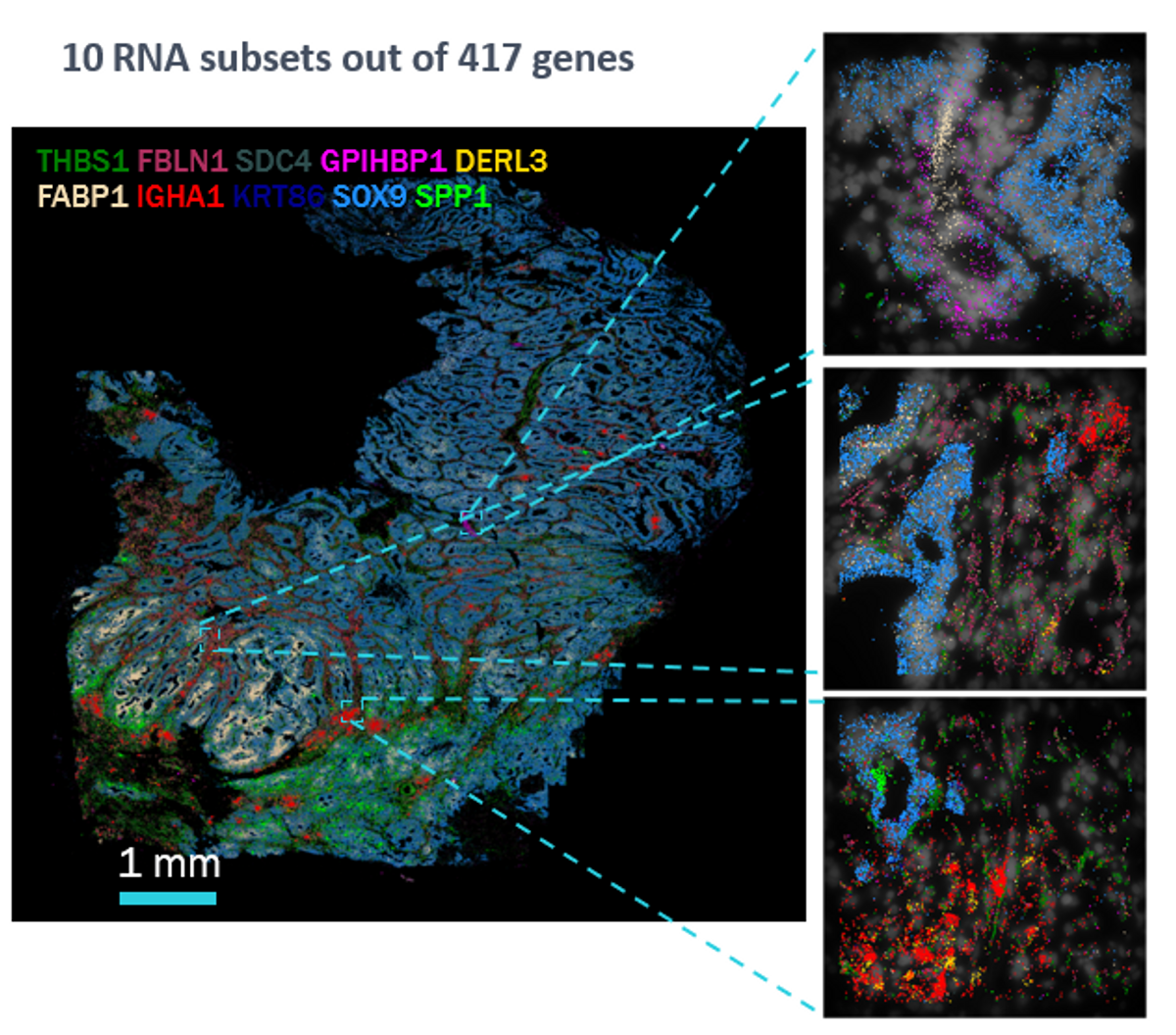
Spatial transcript-omics. Quantitatively resolving RNA transcript abundances and locations across the tumor microenvironment can highlight subtle differences in regions that may look morphologically similar or even identical.
credit: vizgen
In late 2020, Richard White and colleagues at Sloan Kettering and NYU Langone Health described their efforts to perform spatial transcriptomic profiling at this boundary, presenting their findings in bioRxiv (1). Using 10X Genomics’ Visium platform, the researchers examined TME invasion by tumor cells in a zebrafish melanoma model. Scanning frozen sections, they noted transcriptionally distinct clusters of cells localized to the border between tumors and their microenvironments.
Although the cells of the microenvironment were morphologically indistinguishable from their more distant counterparts, their transcriptional profiles correlated more closely with the nearby tumor cells. The researchers confirmed this finding with scRNAseq, determining the presence of two similar but distinct cell types at the interface.
“Although we uncovered many genes, pathways and gene modules that exhibit novel spatial patterns within the tumor and/or TME, there are likely many more interesting biological phenomena in our dataset that we have yet to identify,” the authors noted.
“Recently, deep-learning methods have been applied to histopathology images to uncover spatially-resolved predictions of molecular alterations, mutations, and prognosis,” they suggested. “A logical next step would be extension of these approaches to integrate deep learning and pattern recognition algorithms with [spatial transcript-omics] data, to identify interesting spatial patterns of gene expression and also predict transcriptomes based on histopathology.”
Another challenge in understanding tumor evolution is identifying those rare cells that escape initial treatment, whether due to genomic makeup or seclusion within a niche. This is one area in which Beecham thinks GeoMx DSP offers an advantage because it allows you to survey the entire slice and then hone in to understand the biology of specific events or cells.
“I used to compare it to when you're up in an airplane,” he said. “Ninety percent of the time, you're looking out your window, it's boring down there. A whole bunch of flat space, and it's the winter, so nothing but snow.”
“But then, all of a sudden, you're flying over Manhattan or LA or Chicago, and you have all this information that's clumped in these unique regions of the country,” he pressed. “That's really where you want to spend your time. You really want to go to those unique rare regions.”
A more recent entrant into the spatial transcript-omics space is Vizgen with its efforts to commercialize a technique called multiplexed error robust FISH or MERFISH.
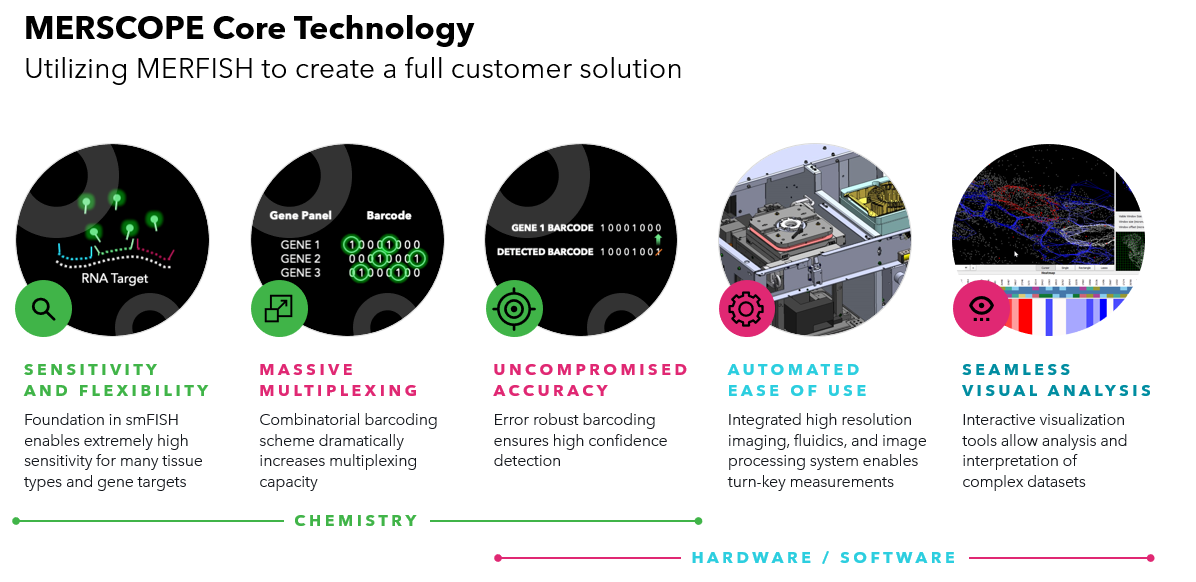
Where GeoMx DSP relies on detection oligonucleotides attached via photocleavable linkers to oligos complementary to the transcript of interest or antibodies against a protein target, MERFISH relies on combinatorial labelling, sequential imaging and error robust barcoding.
Cells are probed with fluorescently tagged oligonucleotides, which either hybridize to a transcript or wash away. The fluorescence is then imaged and the signal extinguished. The process is then repeated with another oligo. By repeating the process several times, a barcode is generated for each RNA species based on its unique pattern of fluorescence (1) and non-fluorescence.

"We directly hybridize these probes onto the targeted transcripts, so there's no enzymatic amplification step. We don't have to ligate anything. We don't have to amplify anything. So, it's a very efficient process". – George Emanuel, Scientific Co-founder, VizGen
credit: VizGen
George Emanuel, Vizgen scientific cofounder and director of technology and partnerships, suggested two ways in which MERFISH measurements stand out from other spatial transcript-omics systems.
“The first is the detection efficiency,” he suggested. “We directly hybridize these probes onto the targeted transcripts, so there's no enzymatic amplification step.”
“We don't have to ligate anything,” he continued. “We don't have to amplify anything. So, it's a very efficient process.”
And because multiple probes attach to the same transcript molecule, the molecule can still be accurately detected even if 100 percent of the probes don’t hybridize.
Emanuel also pointed to image resolution advantages. “When transcripts become too crowded, it becomes difficult to characterize exactly which transcript is where because the signals become mixed,” he explained. “Because we use a very high-resolution, high numerical-aperture objective, the spot size from each of these molecules is smaller than if we were to use a lower magnification, lower NA objective.”
“That allows more spots to fit it within the same volume and lets us profile more highly abundant panels,” he pressed. “It also contributes to our detection efficiency because the higher NA also means the spots are brighter.”
The potential utility of that sensitivity was highlighted in 2018 by Xiaowei Zhuang, creator of MERFISH, and colleagues at Harvard who combined scRNAseq and MERFISH to dissect molecular, spatial and functional organization in the mouse brain (2). As the researchers reported in Science, MERFISH detected six- to eight-fold more copies of targeted gene transcripts per cell, and in some cases, resolved a single scRNAseq-defined cell cluster into multiple clusters, picking up on subtle transcriptional differences.
MERFISH also allowed the researchers to identify rare cell types that were missed by scRNAseq. “These methods identified major cell classes and neuronal subpopulations with correlated gene expression profiles, providing cross-validations for both methods,” the authors concluded. “Moreover, the two methods are complementary: scRNAseq measured more genes than MERFISH and helped define marker genes for MERFISH, whereas MERFISH provided spatial context of cells at high resolution as well as more accurate detection and quantification of weakly expressed genes.”
“As a result, the combined data provided a more complete picture of the transcriptional diversity and spatial organization of individual cells in the preoptic region,” the authors pressed.
More recently, Bogdan Bintu and colleagues at Harvard University adapted MERFISH technology to not only look at transcripts, but also elucidate chromatin structure, which is increasingly viewed as a therapeutic target (3).
Although MERSCOPE largely automates the MERFISH process, VizGen supports the entire workflow from gene panel selection and sample prep, through the time on instrument to downstream analysis.
credit: VizGen
“This approach allows us to place chromatin organization in its native structural and functional context and, thus, to explore the relationship between chromatin organization, transcriptional activity, and nuclear structures in single cells,” the researchers explained in Cell.
By modifying MERFISH for chromatin imaging—dubbed DNA-MERFISH—the researchers imaged 1041 genomic loci, covering all human chromosomes. To contextualize chromatic structure with gene expression and nuclear structures, the researchers performed RNA imaging of 1137 genes. They then enzymatically digested the transcripts and performed DNA-MERFISH before using immunofluorescence to image nuclear speckles and nucleoli.
“Imaging chromatin organization simultaneously with the structures formed by these protein and RNA factors and together with transcriptional output will be a promising avenue to decipher the relationship between chromatin structures, condensate formation, and transcription regulation,” the authors concluded. “In yet another direction, different cell types exhibit different gene expression profiles that are regulated, in part, by 3D genome organization.”
“Thus, imaging chromatin organization together with gene expression profiles of individual cells in tissues promises to provide critical insights into modes of chromatin organization that are important for cell-type-specific gene expression patterns,” the researchers suggested.
Another research area of interest for spatial transcript-omics is disease modeling using 3D cell culture. Emanuel suggested that the simplest application would be to spatially profile a living tissue and then see how well the organoid model replicates that profile. He then took it one step further. “If there are differences, maybe you can start to see what are the transcription factors that you want to start perturbing to get this one to look more similar to that one,” he added.
Since Vizgen launched in late 2019, the company has focused on developing a commercial solution around the MERFISH technology.
“The central part for the solution is the instrument [MERSCOPE], but we do hope to facilitate the whole workflow, all the way from gene panel selection, through sample prep, through the time on instrument, through the downstream analysis,” explained Emanuel.
Although MERSCOPE was formally introduced at the AGBT Conference in March, beta testers have been actively using the system and generating data. Beyond their invaluable feedback to Vizgen, however, Emanuel was excited about the ways in which they have applied the technology.
Although Vizgen launched MERSCOPE at the 2021 AGBT Conference, company co-founder Emanuel is already excited by the applications coming from their beta-tester community.
Image from VizGen
“I think some of them already have MERFISH data that's going into some of their publications that we’ll be really excited to see,” he noted.
And Vizgen itself has also been running service projects with pharmaceutical and biotech clients. “They provide their biological question, their gene lists, their samples, and then we run MERFISH on it and provide the data back and help them understand the data,” Emanuel continued. “A lot of our oncology applications fall within this group of projects because the different service partners are really interested in developing drugs to help with oncology,” he explained.
As noted earlier, however, spatial characterization is not limited to RNA transcripts.
Positioning proteins
“RNA is the world’s best reagent to just throw a wide net,” enthused Beecham. “There's nothing like the transcriptome, there's just so much information, and it's so dynamic; but it's incomplete.”
He offered, as an example, the examination of cell receptors for understanding cell-cell communication.
“You can be at a place where the RNA message for that receptor is gone,” he explained. “There is just no message there. But that receptor is happily doing its job.”
If you only looked at the nucleic acid component, you might never know that the receptors were there.
He also pointed to post-translational modifications, which cannot be picked up at the transcriptional level.
“Cancer signaling is phosphorylation patterns,” Beecham stressed. “So, if you don't have the protein detection, you're going to miss important signaling events that really only happen at the post-translational level.”
Thus, he views transcriptomic and proteomic workflows as complementary.
Angelo echoed the sentiment. “Transcript and protein don't necessarily correlate,” he noted. “You can see that even in scRNAseq, where lineage-defining proteins like CD4 and CD8, which are highly abundant at the protein level, are not necessarily very well represented at the transcript level.”
That discrepancy is important. “By seeing these discordances or seeing where they line up, you're revealing something important about gene regulation, how long is a protein around after it's synthesized, and other sorts of things,” he commented.
For Angelo, the choice is less between transcript-omics and prote-omics, but rather whether to use targeted or untargeted assays. “We use untargeted assays much more on the front end when we're trying to narrow the field of what we want to look at,” he suggested. “And then once we figured that out, we lean more on targeted assays to take the deep dive on this broad number of samples that are usually available in a more quantitative, scalable fashion.”
He offered an example from scRNAseq. “Before [researchers] make those t-SNEs, the first thing they do is essentially principal component analysis,” he explained. “Invariably, you're measuring thousands of transcripts, but if you look at functional modules, the numbers are far less.”
For its part, IONpath has focused its spatial prote-omics efforts on multiplexed ion beam imaging (MIBI) via elementally labelled antibodies and secondary ion mass spectrometry (SIMS).
As Stanford University’s Leeat Keren and colleagues described in late 2019 in Science Advances, researchers stain tissue sections with metal-tagged antibodies and then interrogate with a primary ion stream that they raster across the section (4). This generates secondary ions that are then quantified to produce a high-dimensional image.
Rather than rely on fluorescently tagged antibodies, MIBI-based spatial prote-omics relies on metal tags detection by secondary ion mass spectrometry.
CREDIT: IONPATH
“SIMS is among the most sensitive methods known for elemental analysis, where, depending on the element of interest, as few as five atoms can be detected,” the authors noted. “In addition, SIMS can achieve imaging resolutions as low as 10 nm, exceeding the capabilities of not only laser ablation mass spectrometry by >100-fold but also the light diffraction limit, thus permitting super-resolution imaging.”
The researchers noted that the sensitivity of their MIBI-TOF exceeded mass cytometry by up to 37-fold. And when they stained breast cancer tissues, they quantified metal-tagged antibodies and endogenous elements that varied in abundance by more than six orders of magnitude within the same image.
And just as Beecham noted with spatial transcript-omics, MIBI offers researchers the opportunity to quickly scan the entire tissue sample before focusing on cells of interest. “You're constantly trading resolution for speed,” explained Angelo. “So, the nice thing about doing survey scans is that you can dramatically increase the sample throughput.”
“We can go very fast at a 1- to 1.5-micron resolution,” he continued. “And let's say you're looking for a small niche of tumor cells in a really big tissue section, and you're going to use pan-keratin to try to find those, you can very easily, at that resolution, identify where those are. And then, if you want to go in and see what's going on, the higher resolution imaging makes a lot of sense.”
Earlier this year, Angelo and colleagues described their efforts to use spatial multi-omics to understand the molecular mechanisms behind the progression of ductal carcinoma in situ (DCIS) to invasive breast cancer, presenting their findings in bioRxiv (5). The researchers examined adjacent FFPE slices of healthy and cancerous breast tissue in three ways: tissue pathology with H&E staining; transcriptomic alternations with laser capture microdissection RNAseq; and proteomic changes with MIBI-TOF, using a 37-plex antibody panel.
By characterizing molecular events within and between stroma, tumor, and myoepithelia, the researchers constructed a model showing invasive disease developing through multiple, coordinated interactions. Using 1093 features, they trained a classifier model to identify patients at highest risk of progression based exclusively on diagnostic DCIS tissues, although they cautioned about its general utility at this stage.
They noted that spatial metrics linking phenotype to structure and morphology were highly over-represented vs non-spatial metrics in the classifier model. As well, the most influential features were stroma-related rather than tumor-related.
“Third, high-ranking immune features more often related to myeloid than to lymphoid subsets, particularly those in close proximity with myoepithelium or residing inside the duct,” the authors noted, highlighting “the need to better understand how macrophages promote TME immune suppression, tumor proliferation and local invasion.”
Similarly, Stanford’s Christina Curtis and colleagues used the GeoMx DSP last autumn to evaluate proteomic heterogeneity in archival HER2-positive breast cancer tissues from a clinical trial involving treatment with lapatinib, trastuzumab, or both, followed by surgery (6). As they described in medRxiv, the researchers profiled the expression of 40 tumor and immune proteins in tissue samples taken pre-, on- and post-treatment.
By stratifying tumors based on pathological complete response (pCR), the researchers found many immune markers increased with treatment in pCR cases, whereas levels changed little in non-pCR cases. As well, regional heterogeneity of both tumor and immune markers increased significantly on-treatment, although more in tumor markers within pCR cases, and in immune markers within non-pCR cases.
“Critically, on-treatment and pre-treatment protein expression robustly predicted response in an independent validation cohort,” the authors noted. “Our findings thus address a critical unmet clinical need given the considerable emphasis devoted to identifying subsets of the population in which therapy should be escalated, for example by combining HER2-targeted agents, or safely de-escalated, for example through shortening or omission of chemotherapy and its associated toxicities.”
For any spatial prote-omics effort, increasing the diversity of protein markers will be important. “Right now, we have capability around 40 markers,” Angelo suggested. “I could see that maybe pushing up to 50 or 60 in the next 24 months, hopefully, as well as improving throughput.”
But just as transcripts were insufficient to define a cell, so too are proteins. In many ways, cell identity and function are defined by its metabolism, a subject of renewed scrutiny in cancer research and drug discovery.
To that end, the spatial revolution is slowly extending into metabol-omics.
Measuring metabolism
“I think I'm totally unoriginal in saying that metabolism is going to be important,” Angelo enthused. “We're starting to see over and over again that there are tight links between oxygen status, hypoxia and recruitment of immune tolerogenic states.”
“And if you look at a lot of the targets that people are thinking about, right now, all of these are metabolic enzymes where either the substrates they're chewing up or the products they're making directly drive formation of regulatory versus cytotoxic T cells,” he offered. “There is this intrinsic coupling between metabolism and immune activation or suppression.”
Getting at metabolism in intact tissue, however, has historically been quite a challenge, in no small part because of the size of metabolites. Many of them, like those in the Krebs cycle and glycolysis, are essentially glucose derivatives, Angelo argued, and by virtue of being that small, they distribute rapidly once tissue is cut.
Rather than go directly after the metabolites and derivatives, his Stanford University colleague and IONpath co-founder Sean Bendall and others decided to examine the enzymes that form the metabolic hubs of these pathways, suggesting that the abundance of the enzyme correlates with its activity.
As they described in Nature Biotechnology, the researchers used mass cytometry and a panel of metabolic and phenotypic antibodies to perform a process they termed single-cell metabolic regulome profiling (scMEP) on human cytotoxic T cells (7). Examining isolated cells from colorectal carcinoma and other donor tissues, the researchers grouped CD8+ T cells into 10 distinct metabolic states.
When looking at the tissue distribution of these phenotypes, they found that peripheral T cells primarily consisted of metabolically low scMEP1 cells, whereas tissue infiltrating T cells showed greater metabolic heterogeneity.
To understand what this meant in spatial terms, the researchers adapted the scMEP process to MIBI-TOF and examined FFPE tissue sections from colorectal carcinoma patients and non-malignant controls. They found that not only did scMEP scores vary across donors but also within donors.
“To investigate whether malignant epithelial cells directly modulate neighboring immune cells, we computationally identified a tumor-immune border and compared immune cells close (within 20 μm) to cells located further away from this boundary,” the authors explained.
They found that CD39/PD-1 cells closest to the boundary were metabolically active, whereas those unengaged with the tumor were metabolically suppressed.
“These spatial analyses revealed specific exclusion of metabolic immune cell subsets from the tumor-immune boundary, demonstrating the influence of tissue architecture on metabolic regulation that goes beyond what can be observed using conventional deep phenotyping of cell identity alone,” the researchers concluded.
“The really cool thing in that paper feeds into this other aspect of tumor immunology right now,” Angelo enthused. “We've gotten this view that some PD-1 T cells are bad. But there are lots of different T cells that express PD-1, and most T cells that have been activated, up-regulate it.”
“So, it's one of these things that's correlated with an exhausted T cell phenotype,” he added, “but it's not a one-to-one relationship.”
Despite the technical challenges involved, some researchers continue to press the case for monitoring metabolites directly.
In late January in Science Advances, Georgia Institute of Technology’s Ahmet Coskun and colleagues described their efforts to develop a 3D spatially resolved metabolomic profiling framework (3D-SMF) to map metabolites and proteins in immune cells of human tonsils (8). Using TOF-SIMS, the researchers not only identified metabolites across FFPE sections, but also leveraged a panel of isotope-tagged antibodies to correlate metabolite profiles with cell types and locations.
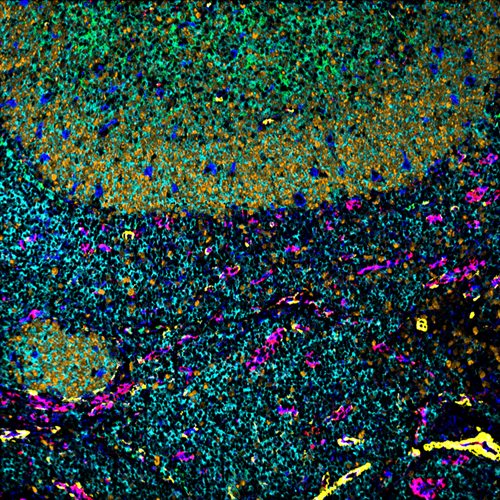
High-resolution. Able to image more than 40 markers at a time, MIBI offers 10-nm resolution and the ability to highlight molecules ranging in abundance over six magnitudes.
Image from IONpath)
Given their interest in immune responses within this tissue, the researchers performed metabolomic profiling on germinal centers (GCs), which regulate antibody production through B cell and T cell interactions. As they explained, the cell-cell communications are regulated by lipid structures functionally linked to ligand and receptor pairs.
“Distinct subsets of lipidomic compounds were identified inside, outside, and at the border of GCs,” the authors noted. “The distinct distribution of the lipidomic signatures correlated with higher concentrations of the B cells inside the GCs and the higher concentrations of T cells outside the GCs.”
By highlighting metabolic cues for such cell-cell interactions, the researchers suggested that the 3D-SMF results could expand the understanding of immune spatial dynamics within the tonsil architecture.
Two years earlier, as they described in PNAS, Chinese Academy of Medical Sciences’ Zeper Abliz and colleagues used ambient mass spectrometry imaging (MSI) to profile metabolic pathways altered in esophageal squamous cell carcinoma (ESCC) (9). After performing spatially resolved MSI to elucidate metabolic differences between cancerous and non-cancerous tissues, the researchers then performed IHC on adjacent tissue sections to understand the spatial expression of potential tumor-associated metabolic enzymes.
“Using this approach, the proline biosynthesis, glutamine metabolism, uridine metabolism, histidine metabolism, fatty acid (FA) biosynthesis, and polyamine biosynthesis pathways were found to be altered in ESCC,” the authors noted.
Correlating with elevated proline synthesis in ESCC tissues, the researchers noted elevated expression of PYCR2 within those same regions. Just as importantly, however, in tumor sections that did not show changes in proline levels, the researchers found no difference in PYCR2 expression.
The authors suggested that these results highlighted the opportunity to discover actionable pathways without a priori defining metabolites or metabolic enzymes of interest, as well as expanding our understanding of cancer metabolic reprogramming.
Such untargeted metabol-omics is not without its challenges, explained Akos Vertes, professor at George Washington University. For one, many of the metabolites have yet to be identified.
“We are struggling with what I call the dark metabolome,” he continued. “Which means that methods that can narrow down the potential interpretation of these peaks are very valuable.”
As an example, he pointed to a study his group described in Analytical Chemistry, coupling f-LAESI with 21T-FTICR mass spectrometry for in-situ analysis of plant cells (10).
“We had 11 peaks that had not been identified,” he recounted. “There was no corresponding entry in any of the major databases.”
“We were able to establish elemental formulas for them because of the isotopic fine structure,” he mused. “It's a $10-million instrument, so you may expect something good to be resolved from it.”
That, he said, is a big distinction between identification and discovery in untargeted metabol-omics. You can end up with a lot of peaks that can be difficult to identify. Not all mass peaks, however, are worth attention.
There may be 9000 unidentified peaks, but 8500 may be irrelevant because they don’t change from one cell or tissue to another. Spending resources to identify all those peaks would be work done in vain, he opined.
“You can typically narrow it down to a couple dozen metabolites that are truly changing in a comparison, both in the statistical sense and in the biological sense,” Vertes noted. “Those then can be targeted for tandem mass spectrometry and in-depth identification.”
As Vertes’ lab shifted toward single-cell analysis, he had first hoped to produce a protein microscope, as he described it, but technical considerations refocused the efforts toward a metabolite microscope.
For Vertes, it was critically important that any in-situ metabolomic profiling be performed on live tissue or, at worst, freshly frozen tissue. This meant not placing the sample in a vacuum and not applying a matrix as both can significantly alter the cellular contents.
This might be less of a concern with proteins and RNA transcripts, he noted, as those are quite large molecules and don’t defuse very quickly. They also have slower turnover rates within the cells.
“So, if I'm in a sample preparation process that takes ten minutes, for proteins, that's nothing,” he reflected. “For metabolites, it can mean a huge difference, because the turnover rates of metabolites [is higher].” He offered the example of ATP in bacteria, which turns over in seconds.
“So, it was very important for us to work with tissue-embedded cells in their natural environment, and preferably still alive,” he added.
The key to that effort, he explained, was to be able to sample live or frozen tissue with a laser that coupled the energy into the water content. Given the high abundance of water in biological systems, its choice as a matrix seemed a good one.
A major challenge of studying single cells, however, is the size of the cell. “In chemical analysis, the metric that matters is cell volume, because that's the amount of material you have available for analysis,” Vertes explained. “If you talk about a yeast cell, that's about 30 fL. If you talk about a cell from Arabidopsis, a model plant, that's about 1 nL.”
“So, we are talking about huge differences in volume, which means huge differences in difficulty for single-cell analysis,” he added.
Once they overcame some of these challenges, however, they discovered insights that might not have been apparent by any other means. “For example, different cells that look the same, have the same genome, may have different metabolite levels, and they may form different subpopulations,” he noted, describing such otherwise invisible features as hidden phenotypes.
Abundance distribution of a particular metabolite in cell subpopulations typically fit a Gaussian or lognormal distribution, he said, but in some cases, his group would see metabolites that had bimodal distributions.
“That means there are two populations here,” he explained. “One that has a lower level of that metabolite, and somehow they're happy with that. And then there’s another population that has a higher level.”
And even in cases where cells don’t divide into subpopulations based on metabolite distribution, Vertes suggested that they may be distinguishable based on metabolic noise, the scatter of a metabolite’s level around a mean value. “I believe, whether it's a wider distribution or a narrower distribution will have to do with the regulation of that metabolite,” he explained. “In the metabolic pathway network, how tightly is that metabolite regulated?”
He drew a parallel with human blood metabolites. “Certain metabolites can have quite different levels, and you don't find any major physiological consequences for it,” he suggested. “Others will result in tragic consequences. I think the same is true for cell populations.”
Vertes acknowledged that it is still very early days for spatial metabol-omics. “Clearly, the single-cell transcript-omics is way ahead, especially nowadays with MERFISH,” he noted. “That is just mind boggling. You get more than 10,000 transcripts from a cell.”
He questioned whether the spatial protein profiling has broad enough coverage yet to be called prote-omics, although he did believe that they were moving in the right direction. “In metabol-omics, the first papers are just coming out,” he added. “We are maybe one of a handful of groups who are pushing in this direction.”
To date, his team has been able to get 100 to 200 metabolites from a single cell, but that was from plant cells. Getting that kind of coverage in human cells is a work in progress.
Whether at the transcript, protein or metabolite level, however, spatial multi-omics profiling is starting to put the cell back in cell biology. Dynamic molecular physiology and cellular communication is enhancing what was once a static diagram of enzymes and metabolic pathways, helping highlight the differences between healthy and cancerous cells, stroma and tumor cells, and between adjacent tumor cells.
“We had the molecules,” Beecham offered. “We knew what they were. We just didn’t know how they were all organized, and now we can address that.”
References
- Hunter, M.V., et al. Spatial transcript-omics reveals the architecture of the tumor/microenvironment interface. bioRxiv DOI: 10.1101/2020.11.05.368753 (2020).
- Moffitt, J.R., et al. Molecular, spatial, and functional single-cell profiling of the hypothalamic preoptic region. Science 362, eaau5324 (2018).
- Su, J.-H., et al. Genome-scale imaging of the 3D organization and transcriptional activity of chromatin. Cell 182, 1641-1659 (2020).
- Keren, L., et al. MIBI-TOF: A multiplexed imaging platform relates cellular phenotypes and tissue structure. Science Advances 5, eaax5851 (2019).
- Risom, T., et al. Transition to invasive breast cancer is associated with progressive changes in the structure and composition of tumor stroma. bioRxiv DOI: 10.1101/2021.01.05.425362 (2021).
- McNamara, K.L., et al. Spatial proteomic characterization of HER2-positive breast tumors through neoadjuvant therapy predicts response. medRxiv DOI: 10.1101/2020.09.23.20199091 (2021).
- Hartmann, F.J., et al. Single-cell metabolic profiling of human cytotoxic T cells. Nature Biotechnology 39, 186-197 (2020).
- Ganesh, S., et al. Spatially resolved 3D metabolomic profiling in tissues. Science Advances 7, eabd0957 (2021).
- Sun, C., et al. Spatially resolved metabolomics to discover tumor-associated metabolic alterations. PNAS 116, 52-57 (2019).
- Samarah, L.Z., et al. Single-cell metabolic profiling: Metabolite formulas from isotopic fine structures in heterogeneous plant cell populations. Analytical Chemistry 92, 7289-7298 (2020).