Something had clearly upset Daisy. Every time her owner, Claire Guest, the founder of Medical Detection Dogs, walked by, Daisy looked at her warily. Unsure of what had gotten into her dog, Guest took her out in the car to go for a walk.
When Guest opened the back of the car and asked Daisy to jump down, she refused.
“She kept bumping me in the chest and staring at me,” said Guest. “I just felt my chest, and I felt what I thought might be a lump. Long story short, I got checked out. I was diagnosed with very early, but very deep-seated breast cancer.”
At Medical Detection Dogs, Claire Guest trains dogs to identify cancer in human samples.
Credit: Medical Detection Dogs
Daisy had been learning how to detect human bladder and prostate cancer from urine samples at Medical Detection Dogs, but not breast cancer.
“My clinicians told me that had Daisy not warned me, my prognosis would have probably been very different,” said Guest. “It was so deep seated that it wouldn't have been found, because I wasn't old enough to have regular mammograms.”
Guest’s experience with Daisy is not the only time a dog has sniffed out cancer. One of the first such reports detailed a dog sniffing persistently at a mole on a woman’s leg, even sniffing at it when she wore trousers (1). The dog, a border collie and Doberman mix, sniffed at the mole for months until one day when the woman wore shorts, the dog attempted to bite it off. After this dramatic episode, she got the mole checked, and it turned out to be malignant melanoma.
It's no secret that dogs are excellent sniffers. Airport security employs them to rout out contraband and explosives, and search and rescue teams trust them to find missing people. But dogs are not the only animals with a keen sense of smell. Mice, insects, worms and many others rely on smell to find food, shelter, and mates as well as to avoid danger.
“We speak with words, and animals speak with smell,” said Flora Gouzerh, a researcher who studies how mice use smell to detect cancer at the French National Center for Scientific Research.
While undetectable to the human nose, all cells release volatile organic compounds (VOCs) as they perform their day-to-day cellular activities. When cells become cancerous, their metabolisms change, so the compositions of VOCs they emit change as well. With their more sensitive noses, animals have no problem smelling these changing combinations of VOCs.
“They're picking up on the full bouquet of the human bodies, and that full bouquet is made of millions and millions of different odorants,” said Andreas Mershin, a physicist and smell researcher at the Massachusetts Institute of Technology (MIT).
Scientists have tried to mimic the animal nose using gas chromatography-mass spectrometry (GC-MS), which identifies every single molecule and its concentration within a particular gaseous sample, but so far they have had little success. This is because it is difficult to detect a clear difference in the combinations and concentrations of molecules in VOCs from healthy cells versus cancerous ones.
When you go to a coffee shop, you smell hazelnut coffee or Colombia coffee. You can just tell which one is which, but you have no idea what chemicals and what concentrations are different between them.
- Debajit Saha, Michigan State University
Debajit Saha, a biomedical engineer who studies insect olfaction at Michigan State University, explained that this is like walking into a café first thing in the morning. “When you go to a coffee shop, you smell hazelnut coffee or Colombia coffee. You can just tell which one is which, but you have no idea what chemicals and what concentrations are different between them,” he said.
Instead, the olfactory receptors in the brain detect the chemicals, which activate certain neurons. In this way, every odor is stored in the brain as a unique pattern of neural activity. When a whiff of hazelnut enters the nose, the molecules that make up the hazelnut smell bind to the olfactory receptors, activate neurons in a characteristic pattern, and the brain knows that it’s smelling hazelnut.
“In just a fraction of second, you can tell this is the coffee I want,” said Saha. But, he added, if you were to try to differentiate between the two different kinds of coffee by studying their chemical compositions from GC-MS data, “you will struggle.”
By taking advantage of thousands of years of animal smell evolution, scientists explore the potential of dogs, ants, locusts, and even worms to identify different cancers, including those that are currently very difficult to diagnose. They are now translating that knowledge into animal and machine learning based tools to identify cancer at earlier stages than ever before.
A dog nose in a cellphone
Long before Daisy warned Guest of her breast cancer, Guest heard about another incident of a dog sniffing out cancer. Guest was working as a behavioral psychologist at the organization Assistance Dog Charity, when her colleague Jill mentioned that her pet Dalmatian would not stop sniffing at a mole on her calf, even when it was covered by her clothes and boots. The mole turned out to be a cancerous melanoma. Around the same time, Jill heard John Church, a medical doctor at Queens Medical Center, talking on the radio about anecdotal accounts of dogs sniffing at moles that turned out to be cancerous (2).
“He was saying, if anybody out there is a dog trainer who'd like to investigate this further, please come forward,” said Guest. Having worked with dogs for so long, Guest had been interested in how they use their senses of smell, so she reached out to Church to collaborate.
Guest and Church’s team trained six dogs to recognize urine samples from people with confirmed bladder cancer, healthy controls, and people with noncancerous urological diseases. They found that the dogs could correctly identify cancer samples at a higher rate than expected by chance (3). Much to the researchers’ surprise, the dogs kept identifying one healthy control person’s urine as being positive for cancer. Concerned, the participant’s doctor ordered additional tests and found that the “healthy control” in fact had very early-stage kidney cancer.
Across the pond at MIT, Mershin pored over Guest’s initial findings, especially the anecdote about the dogs identifying cancer in the control sample.
“I could not shake it. I literally was dreaming about it. I'm like, ‘What did this dog know before we knew it, and how did it know?’” he said.
Andreas Mershin wants to create an algorithm trained on a dog’s nose to detect cancer earlier than ever before.
Credit: Andreas Mershin
Mershin attended a scientific conference about odor detection in the UK, and he and Guest ended up sitting next to each other at lunch. They decided to work together on a project to investigate how dogs detect cancer and to train an artificial neural network to predict a cancer diagnosis based on the dog’s behavior.
“For cancer detection, it's never been about thousands of dogs sniffing in doctor's waiting rooms,” said Guest. “It's always been about how we can convert what we know to a device that can mimic nature.”
Mershin agreed enthusiastically. “Dogs can do this. They can do this with precision, accuracy, and they can generalize and do it early. So, my question to humanity was what the hell are we doing trying anything else other than copying these dogs and stuffing it into our smartphones?”
Guest and Mershin worked with researchers at Johns Hopkins University to collect urine samples from men with confirmed high-grade prostate cancer and from cancer-negative controls. After a rigorous selection process among six dogs trained to detect cancer by Medical Detection Dogs, the researchers chose two dogs — Midas, a seven-year-old Wire Haired Hungarian Vizsla, and Florin, a four-year-old Labrador — to sniff the samples and predict their cancer status (4). In parallel, the researchers used GC-MS to identify the VOCs in each sample and microbiome profiling to characterize the samples’ composition of urinary microbes. They then fed the dogs’ prediction data along with the GC-MS and microbiome results into their artificial neural network.
Guest, Mershin, and their teams identified qualitative differences in the GC-MS and microbiome data that the dogs predicted as cancer positive compared to the cancer negative samples. Rather than picking out specific biomarkers, the dogs recognized a pattern that they associated with cancer. Guest compared it to recognizing a bar of music.
“If I say to you, ‘dun dun dun dunnnn,' you recognize that, even though I'm not a full orchestra. In fact, if you analyzed my notes there in a way that a mass spectrometer would analyze the notes, it probably wouldn't come up with Beethoven,” she said. When it comes to cancer, “it's a complex odor perception that the dog is able to recognize despite different instruments and different keys and different tones.”
While additional studies are needed to bring the accuracy of the artificial neural network up to that of the dogs, Mershin and Guest are confident that it will get there. Once they wrap up their work on prostate cancer, Guest is eager to move onto detecting other cancers, such as colorectal cancer, from urine samples and adding the dogs’ behavioral responses to those samples into the algorithm.
“If a dog can smell it, there's something there we can learn,” said Guest.
No stingers please
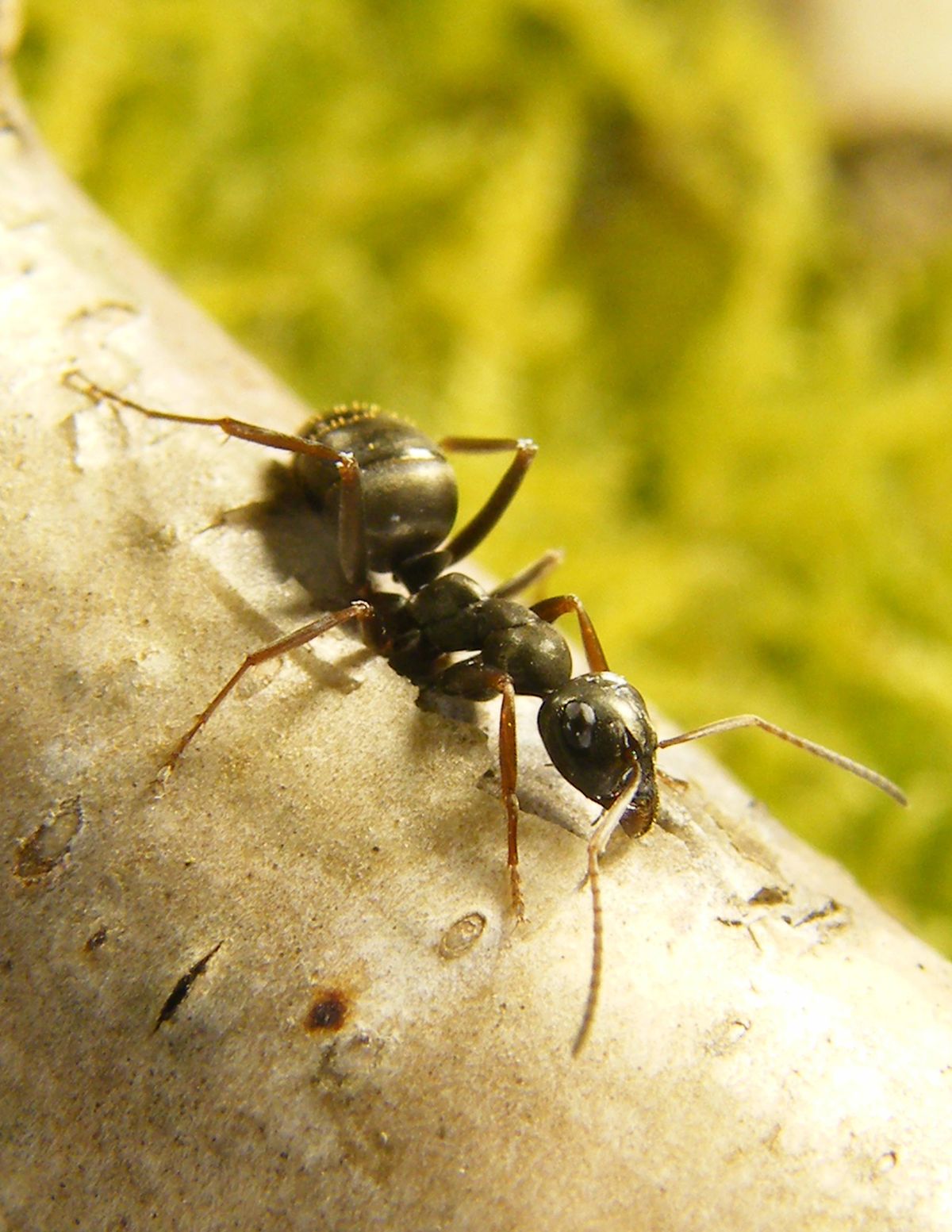
Whether they are ruining a picnic or flitting from flower to flower, it’s clear that insects have very good senses of smell. Pollinating insects like bees use smell to discriminate between flowers with nectar and those without. Ants use smell to find food as well as to communicate with each other in their colonies.
Jean-Christophe Sandoz, a neurobiologist who studies how insects smell at the University of Paris-Saclay, wondered if these sensitive sniffers could differentiate cancer samples from healthy ones. He and his team decided to see if ants were up to the task.
As foragers in a changing environment, ants evolved a highly sensitive sense of smell.
Credit: Paul Devienne/Laboratoire d'Ethologie Expérimentale et Comparée/Université Sorbonne Paris Nord
“They’re foragers. They have to find food in a very complex, changing environment, so they have to learn the blends that are produced by certain types of plants for instance,” he said. “We all thought that if someday these insects can be used for the detection of cancer, it will be much easier if it's not an insect that is stinging.”
Sandoz and his team found that ants are quite easy to train. The researchers simply scooped up an ant on a piece of filter paper as it left its nest and placed it in a petri dish. On one side of the dish, they placed a tube with a cancer sample and a sugar solution, and on the other side there was an empty tube. The ants soon associated the cancer odor with a sugary reward. Once trained, the ants preferentially stayed close to the cancer odor over any other odor. By comparing the amount of time each ant spent near a particular odor, the researchers determined which sample was cancerous.
“Anybody should be able to perform this [test],” said Sandoz. In the future, he imagines that “people at the hospital would be trained in a few days and could perform these experiments.”
The researchers found that the ants could discriminate between healthy and breast cancer cell lines, and when trained to recognize two different breast cancer cell lines, the ants had no problem telling them both apart (5). When they then tested urine from mice implanted with human triple-negative breast cancer tumors and from control mice, the ants discriminated between the samples (6). Sandoz hopes to test the ants’ discrimination ability with human samples next.
“We work with samples that don't have a very strong smell [and] that sometimes can have a lot of compounds in common. So, we're really pushing the limits, and that's what I found really interesting,” he said. “I hope that at one point, we will increase the number of people who are diagnosed early… If simple techniques like this can help, it’s a gain.”
Into the locust brain
Rather than watching critters move toward an odor, Saha skips over studying their behavior and lands squarely in the brain.
He and his team study locusts. Not only is locust neurobiology well understood, but their brains are much larger and more robust than the most common insect model organism, the fruit fly. That is a pretty big advantage when it comes to opening up the top of a locust’s head and peering into its brain.
Debajit Saha uses locusts to study neural activity in response to healthy versus cancer odors.
Credit: Debajit Saha
“Our goal was to pretty much — rather than back engineer — forward engineer the brain,” said Saha.
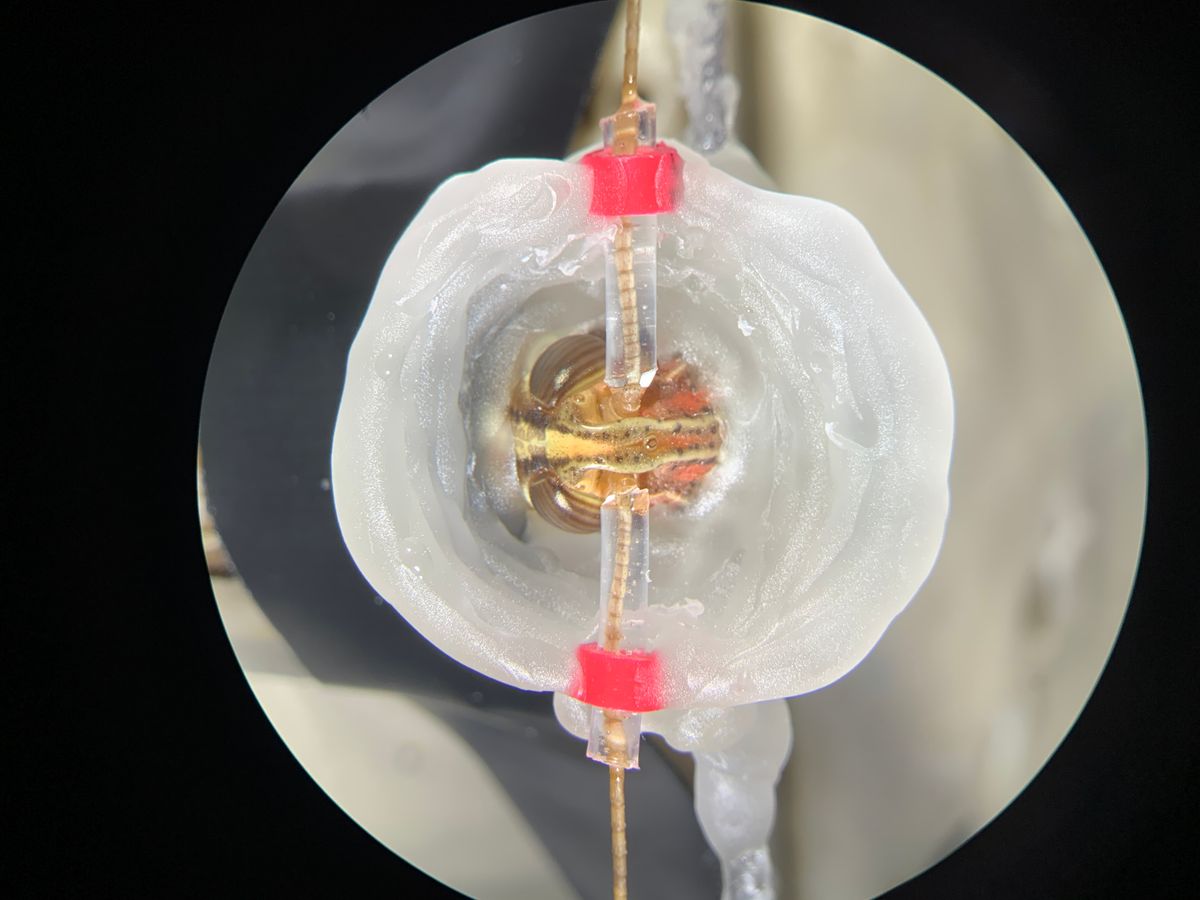
Early in the morning, a graduate student in Saha’s group who is skilled in locust surgery plucked a locust out of the incubator. After a two-hour long surgery to cut a small flap on the top of the insect’s head to expose the brain, the student submerged the brain in a saline solution to keep it alive and attached electrodes to the locust’s antennal lobe, the brain structure that processes smell. The researchers then wafted different odors toward the locust’s antennae and measured which neurons activated in response.
“We can go to the brain, use the neuroscience knowledge that we know of odor coding in these neurons, then from their signal, make a model,” said Saha. He reasoned that a cancer odor would trigger a specific pattern of neural activation in the locust brain. If the researchers floated unknown odors across the locust antennae and saw the same pattern, they could identify it as cancerous.
Saha and his team tested oral cancer cell lines against a healthy cell line, and the neural activation in response to the odors was clearly different (7).
“We were super excited,” said Saha. The graduate student who did the initial neuron recordings told him during a group meeting that individual neurons responded differently to the cancer and healthy stimulus. “I was like, ‘yes, we have an amazing story if it is true.’ So obviously, they did much more recording, and we saw that neurons do respond differently to these mixtures,” Saha added.
They then tested if the locust brains could differentiate between different oral cancer cells lines, which only have small metabolic differences between them and were surprised to find that they actually could.
“That was a bonus find,” said Saha. “For sure, we did not expect that.”
The locust neurons responded to the different odors within 250 milliseconds, meaning that a cancer diagnostic test based on this technology could screen through many potentially cancerous samples in a short amount of time.
Moving forward, Saha and his team are working with breath samples from people with head and neck cancers to see if the locust brain system can identify distinct neuronal patterns. They hope that one day their locust brain-based technology will be used as a standard cancer screening test in the clinic.
Enclosed in wax, a locust’s head and antennae are secure and ready for surgery.
Credit: Debajit Saha
“Rather than going through very tedious biopsies or very expensive imaging, maybe you can go through a recurring breath test that you can do onsite,” said Saha. “It can really be a game changer.”
Wiggling toward cancer
While the roundworm Caenorhabditis elegans may only measure about one millimeter in length, its odor detecting power is on par with insects and dogs. In fact, the little worms devote about five percent of their genes just to their sense of smell (8). As soil dwellers, they are always in search of nutritious bacterial snacks while avoiding pathogens.
After witnessing the impressive cancer detection abilities of dogs, Takaaki Hirotsu, a C. elegans researcher and founder of the Japanese cancer detection startup Hirotsu Bio Science, wondered if worms could differentiate between healthy and cancerous samples too. With their simple diet of bacteria and quick generation time, C. elegans are inexpensive to maintain, making a worm-based test much less expensive than a dog-based test.
At first, Hirotsu placed undiluted urine from a healthy person and from a person with cancer on opposite sides of a petri dish; the worms showed no preference for either sample. Knowing that worms can change their preference for particular odors based on their concentrations, Hirotsu decided to dilute the urine samples. He finally found a concentration where the worms showed a clear preference for the cancerous samples over the healthy ones. Using this experimental setup, he and his team tested 242 urine samples, and the worms discriminated between cancerous and noncancerous samples with 95.8 percent sensitivity (9).
“It was a very exciting moment for me to realize that the results of my basic research to date had been put to good use,” Hirotsu wrote in an email.
I would like more people to know that there is a test that can detect cancer with high accuracy and comprehensively throughout the body simply by submitting urine. We hope people who have shied away from cancer tests will take them.
- Takaaki Hirotsu, Hirotsu Bio Science
Hirotsu and his collaborators at Osaka University then reported that C. elegans could discriminate between healthy and early-stage pancreatic cancer in human urine samples (10). Building off of these positive findings, Hirotsu developed the C. elegans-based cancer detection test, N-NOSE. The test is available to the public in Japan, and the company hopes to expand its availability to the United States this year and eventually to the rest of the world.
While the current N-NOSE test can only tell users whether they have a high risk for cancer or not, the Hirotsu Bio Science team plans to roll out a more specific worm test that will tell users which type of cancer they may have a high risk for.
“I would like more people to know that there is a test that can detect cancer with high accuracy and comprehensively throughout the body simply by submitting urine,” wrote Hirotsu. “We hope people who have shied away from cancer tests will take them.”
Whether they are snouted and whiskered or antennaed and slimy, animals and their sensitive noses are an incredible asset for cancer detection.
“The ancient Greeks talked about sniffing things to try and make a diagnosis, but humans had forgotten it,” said Guest. “We forget sometimes that nature provides us with strong signals. We want to be reminded by nature sometimes how to get things right.”
Worm's Best FriendHumans aren’t the only ones who get cancer. In fact, it’s the leading cause of death in pets. “I realized that while there are many screening tests that are available in the human space, there wasn't anything available in the veterinary space,” said Chan Namgong, an entrepreneur and founder of the startup Oncotect (formerly known as Animal Cancer Dx). Namgong came across Hirotsu’s initial study showing that C. elegans could detect cancer in human urine, and he wondered if the worms could also detect cancer in dog urine (9). Namgong linked up with scientists at North Carolina State University, and together they developed a worm-based cancer detection test. They place worms at the center of a petri dish, and then place urine samples in different quadrants of the plates. By calculating how many worms travel to the cancer odor compared to the control odor, they determine if a dog has a low or high risk of cancer (11). Chan Namgong developed a C. elegans based test to detect cancer in dogs. Credit: Chan Namgong “We actually have about 30 hospitals that we are working with in the Raleigh-Durham area, and we are expanding to other parts of the country,” he said. He and his team are now developing a C. elegans test that can determine what kind of cancer is present. By the end of the year, they plan to have a direct-to-consumer test where people can collect a urine sample from their dog and send it to the company for testing. “We hope to extend our services to cats and horses in the next two years. Collecting feline urine samples is a little trickier than dog canine cancer samples,” he laughed. “They don't pee like dogs do, so that's been kind of the biggest challenge.” While Oncotect plans to stay primarily in the veterinary space, they are working on two small human cancer studies: one on bladder and kidney cancer at Dana-Farber Cancer Institute, and another on prostate cancer at the University of Texas Health Science Center at San Antonio. For now, they want to help pet owners keep their furry friends healthy. “When we talk to pet owners and veterinarians, they just get so excited about our study and work; it makes me excited,” said Namgong. “I really do believe that what we're doing is making a huge impact on the lives of not only the animals, but also the people who depend on them, emotionally or physically.” |
References
- Williams, H. and Pembroke, A. Sniffer dogs in the melanoma clinic? The Lancet 333, 734 (1989).
- Church, J. and Williams, H. Another sniffer dog for the clinic? The Lancet 358, 930 (2001).
- Willis, C.M. et al. Olfactory detection of human bladder cancer by dogs: proof of principle study. BMJ 329, 712 (2004).
- Guest, C. et al. Feasibility of integrating canine olfaction with chemical and microbial profiling of urine to detect lethal prostate cancer. PLoS ONE 16, e0245530 (2021).
- Piqueret, B. et al. Ants detect cancer cells through volatile organic compounds. iScience 25, 103959 (2022).
- Piqueret, B. et al. Ants act as olfactory biodetectors of tumours in patient-derived xenograft mice. Proc R Soc B 290, 20221962 (2023).
- Farnum, A. et al. Harnessing insect olfactory neural circuits for detecting and discriminating human cancers. Biosens Bioelectron 219, 114814 (2023).
- Bargmann, C.I. Chemosensation in C. elegans. WormBook, ed. The C. elegans Research Community, WormBook, doi/10.1895/wormbook.1.123.1, https://www.wormbook.org. (October 25, 2006).
- Hirotsu, T. et al. A Highly Accurate Inclusive Cancer Screening Test Using Caenorhabditis elegans Scent Detection. PLoS ONE 10, e0118699 (2015).
- Asai, A. et al. Scent test using Caenorhabditis elegans to screen for early-stage pancreatic cancer. Oncotarget 12, 1687-1696 (2021).
- Namgong, C. et al. Non-invasive cancer detection in canine urine through Caenorhabditis elegans chemotaxis. Front Vet Sci 9, 932474 (2022).