An open sore that continues to ooze fluid and doesn’t pass through the normal healing stages becomes a chronic wound. For some patients, the wound can last years, leading to constant issues with infections, and often becoming a pesky financial burden.
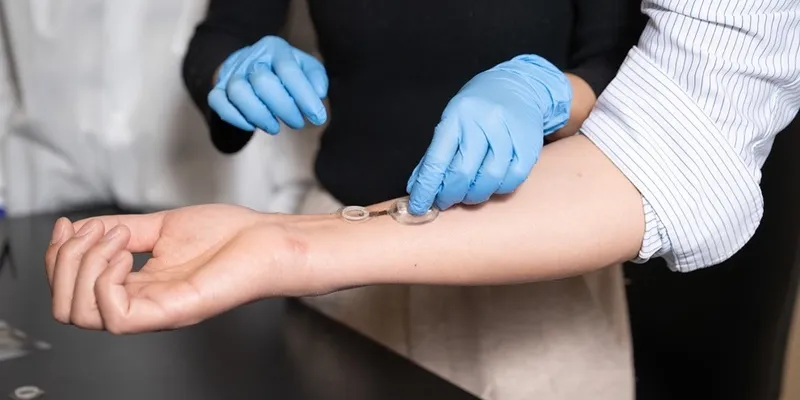
In 2023, California Institute of Technology biomedical engineer Wei Gao led a team that created a smart bandage that could monitor chronic wounds and deliver therapies in a rodent model (1). Now, Gao’s team tested a new version of the smart bandage device, iCares, in humans for the first time (2). Their device uses cutting-edge microfluidic technology to monitor the wound in real-time, providing clinicians with information to help aid treatment decisions. They showed that a machine learning algorithm used the real-time data to successfully classify wound types and healing times, and in mice, the device detected biomarkers of inflammation and infection days before outward visual symptoms appeared.
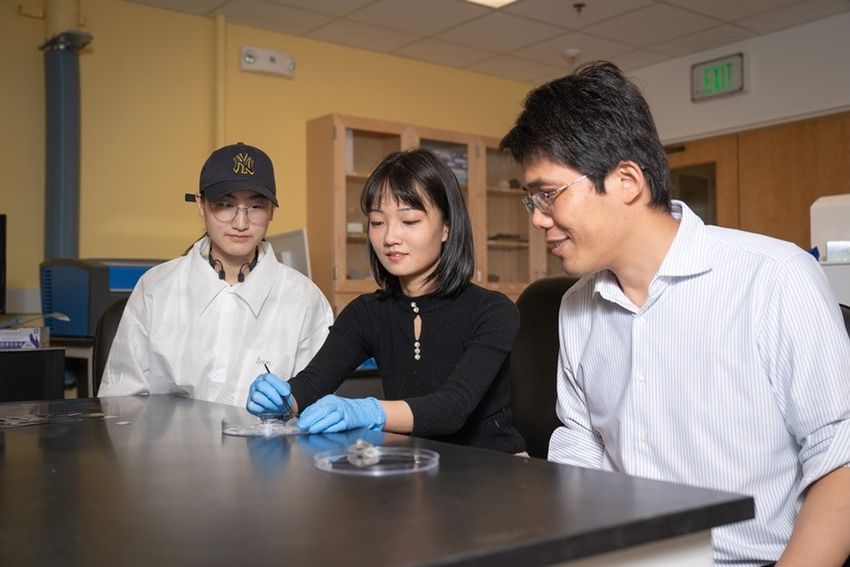
Wei Gao (front right) developed the iCares smart bandage with his team at the California Institute of Technology, including graduate students Kexin Fan (left) and Canran Wang (middle).
Credit: California Institute of Technology
“The technology is pretty incredible to be able to get these biomarkers in such a little device — the microfluidics in the engineering is impressive,” said Dennis Orgill, a reconstructive plastic surgeon at Harvard Medical School and Medical Director of the Wound Care Center at Brigham and Women's Hospital.
Gao’s bioinspired microfluidics design hinges on the use of three modules with a hydrophobic and hydrophilic gradient that allows the device to collect fluid from the wound, transport it to a high-performance sensor that analyzes biomarkers in real time, and refresh fluid back into the wound. Their biomarkers include temperature, pH, oxygen, hydrogen peroxide, and nitric oxide. “The sensors are not directly contacting with the wound … The whole platform becomes very biocompatible,” said Gao.
That biocompatibility means that patients can wear the device as part of their wound dressing and avoid infections by changing out the disposable sensor every time they change the dressing. Gao said it’s crucial to analyze the wound biomarkers in real time because they are not stable, so waiting until the wound fluid has mixed together and then sending it to a lab for analysis could miss information about an early infection brewing. “The real time is obviously very nice for clinicians who don’t have to wait and can make a decision,” said Orgill.
The technology is pretty incredible to be able to get these biomarkers in such a little device — the microfluidics in the engineering is impressive.
– Dennis Orgill, Harvard Medical School and Brigham and Women’s Hospital
Gao’s team first tested the device on diabetic skin wounds in mice. Using blue and red dyed fluids, they confirmed that the fluids did not mix, which meant that the device could pull in new fluid for the real time analysis rather than new and old wound fluid mixed together. Then, by measuring hydrogen peroxide, pH, and temperature, the team could identify telltale signs of infection before any visible changes in the wound. In the future, Orgill said there could also be many other proteins and bacteria that the device could measure, and different biomarkers may be more useful for certain people depending on other diseases they may have as well.
After placing the iCares device on the chronic wounds of 20 people, Gao’s team used a machine learning algorithm to read out a personalized assessment of the wound type and an estimated healing time. They found that by using a combination of biomarkers, the algorithm achieved up to 88.8 percent accuracy in classifying wound types and up to 94 percent accuracy in predicting healing time. “The whole wearable sensor [offers] personalized monitoring based on your own data,” said Gao.
Moving forward, Gao said that he and his team plan to scale up their work in people and ideally start a clinical trial in the next two to three years. But even just with 20 patients for now, Orgill said, “the fact they actually made it work in humans is a great achievement.”
References
- Shirzaei Sani, E. et al. A stretchable wireless wearable bioelectronic system for multiplexed monitoring and combination treatment of infected chronic wounds. Sci Adv 9, eadf7388 (2023).
- Wang, C. et al. A microfluidic wearable device for wound exudate management and analysis in human chronic wounds. Sci Transl Med 17, eadt0882 (2025).