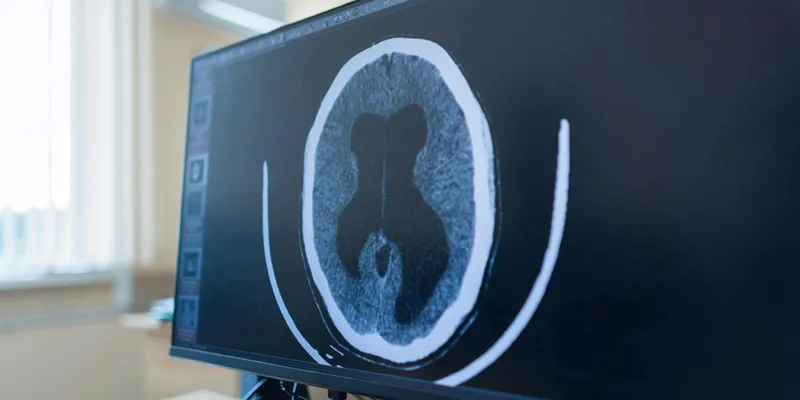
When too much cerebrospinal fluid (CSF) seeps into the cavities of the brain, the result is life-threatening hydrocephalus. As the fluid builds up, it puts pressure around the surrounding fragile brain tissue. The primary treatment option involves an invasive surgery that inserts a shunt to drain the fluid elsewhere in the body, though these can often fail down the line.
New research from Yu Luo’s lab at the University of Cincinnati showed a new way forward that gets directly at the source. By delivering a new AAV gene therapy into CSF that targets the choroid plexus — the network of vascular tissue that produces CSF — the researchers reduced CSF in a mouse model of hydrocephalus.
“It efficiently targets the correct cells and reduces CSF production,” said Aleksandr Taranov, a graduate student in Luo’s lab and lead author on the paper, in the press release.
Targeting CSF production
Luo’s lab was the first to show that targeting the choroid plexus through ablation directly reduces CSF in animal models back in 2024. Now, their new work provides the first proof-of-concept study for a minimally invasive gene therapy approach. Luo and Taranov are already inventors on a pending patent for this approach, according to the press release.

The team now plans to test their gene therapy in larger animal models and human tissues. They will have to pay special attention to one potential risk: Data so far in animal models suggests a reduction in the generation of new neurons in the hippocampus, especially shortly after birth, that could result from reduced CSF. Yet, that must be weighed against current therapy approaches that put patients at risk of lifelong repeated brain surgeries.
“We are eager to contribute to the preclinical development and safety testing of new, cell-targeted approaches to treat this devastating condition,” said Cameron Sadegh, a pediatric neurosurgeon-scientist at the University of California, Davis and coauthor on the paper, in the press release.
Why innovative drug development approaches are needed for hydrocephalus and other conditions
For drug developers, the new work represents an example of a hard-to-treat condition that benefits from novel pharmacological approaches like gene therapy.
Hydrocephalus has traditionally been understood and treated as a structural problem to solve in the brain, rather than one where the production of CSF itself could be targeted. A recent 2026 review showed that the majority of clinical trials for hydrocephalus are testing surgical and procedural interventions, while just 7.8 percent of trials tested pharmacological approaches.
Other recent work from scientists at McGill University earlier this year showed that the use of antisense oligonucleotides targeting the SETBP1 gene in mice successfully prevented hydrocephalus from forming in the first place.
These early results suggest that disorders that appear to be structural in nature do not necessarily need structural cures. Instead, investment in the development of drugs that target the underlying issue at its source is a worthy endeavor for patients and physicians alike.