Infographic: Banking on Biology

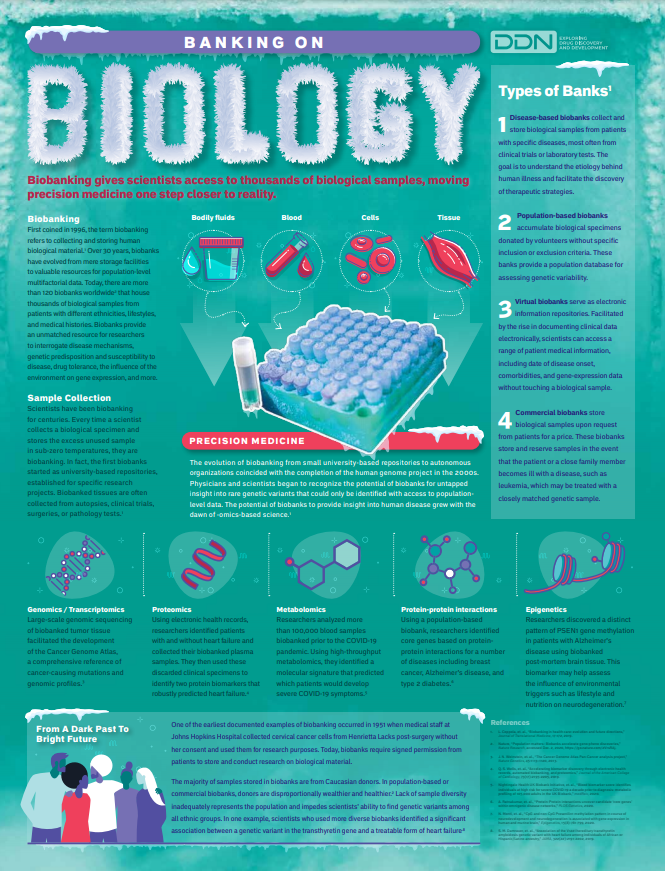
Biobanking gives scientists access to thousands of biological samples, moving precision medicine one step closer to reality.
Tiffany Garbutt, PhD Headshot
| 1 min read

Scientists and physicians often collect bodily fluids, cells, and tissue samples and store them in sub-zero temperatures for later use without a second thought. Now, these locked away samples reveal new insights into population-level mechanisms of disease. Uncover how biobanking helps shape the future of precision medicine.

Download the Banking on Biology infographic here
ILLUSTRATED BY GREGORY BREWER


About the Author

  • Tiffany Garbutt, PhD Headshot

    Tiffany earned her PhD in Genetics from North Carolina State University, where she explored the effect of genetic background on the ability to derive induced pluripotent stem cells. She completed her postdoctoral training at the University of North Carolina at Chapel Hill, specializing in the development of translational approaches to direct cardiac reprogramming and understanding the mechanisms of cardiomyocyte maturation. She has written for multiple medical, nonprofit, and academic peer-reviewed outlets. In March 2020, Tiffany joined LabX Media Group as an assistant science editor for The Scientist. She began working with Drug Discovery News in October 2020.

Related Topics

Loading Next Article...
Subscribe to Newsletter

Subscribe to our eNewsletters

Stay connected with all of the latest from Drug Discovery News.

Subscribe

Sponsored

Scientific illustration of a cell releasing exosomes: small, spherical extracellular vesicles budding from and detaching off the cell’s plasma membrane into the surrounding space, shown as tiny capsule-like structures emerging from the cell surface.
Learn how to distinguish true extracellular vesicles from similarly sized particles using affinity capture and immunofluorescence.
Close-up of a scientist’s hands typing on a laptop next to a microscope in a laboratory setting.
Explore how a needs-driven approach to electronic laboratory notebook selection can improve data integrity, reproducibility, and scientific continuity.
Scientist weighing a laboratory sample using a four-decimal analytical balance in a quality control setting.
Learn the fundamental weighing principles and operational controls that support reliable sample preparation.
Drug Discovery News December 2025 Issue
Latest IssueVolume 21 • Issue 4 • December 2025

December 2025

December 2025 Issue

Explore this issue