G protein-coupled receptors (GPCRs) sit at the center of modern drug discovery. Roughly one-third of FDA-approved drugs act on GPCRs, spanning cardiovascular, metabolic, respiratory, gastrointestinal, and immune diseases. That dominance is reinforced by today’s weight-loss drug markets: GLP-1 receptor agonists alone drive multi-billion-dollar franchises, with leading products generating tens of billions of dollars in annual revenue. Analysts project this market could approach approximately $100 billion per year within the next decade.
Despite their commercial importance, GPCR programs move slower than urgency demands. The bottleneck is rarely identifying the target; it's solubilizing and purifying it. Without a purified GPCR that is active, stable, and assay-compatible, progress stalls across hit finding, pharmacology, and structure-guided design.
Structural coverage remains thin too. GPCR structures account for less than one percent of the Protein Data Bank (PDB). Of the approximately 248,329 total PDB structures, only about 238 unique GPCRs have been solved, leaving many states and complexes without close templates for rational design.
Where time is lost
For decision-makers, the core issue is the expression-to-function gap: Even at high yields, GPCRs can still be misfolded, inactive, or incompatible with downstream assays. Conventional cell-based workflows require extracting receptors from membranes, typically using detergents, followed by exhaustive screening to find a “rescue” buffer that preserves activity. Each step risks destabilization and loss of activity, forcing redesign cycles.
Attrition compounds the problem. In one high-throughput membrane protein production pipeline study, only about 23 percent of targets passed small- and mid-scale selection steps, driving rework and extended timelines. Furthermore, the clock starts running weeks before functional assays. Baculovirus-insect workflows typically require seven days to generate virus stocks, another seven to 10 days for plaque-based titering, and multi-day expression runs before purification and solubilization optimization even begins. Often, this means that teams wait three weeks only to find the protein is non-functional.
Decoupling expression from cell constraints
Cell-free protein synthesis (CFPS) changes the optimization problem by removing the need to keep cells healthy while expressing a difficult target. Because transcription and translation occur within 24 hours in a lysate-based or reconstituted biochemical mix, conditions — like membrane mimetics, stabilizers, chaperones, and redox modifiers — can be tuned without complication.
Strategically, this turns GPCR production into a rapid feedback loop. Rather than hoping a host cell delivers a viable membrane environment, the environment becomes an experimental variable. Teams can screen constructs and conditions in parallel, scaling only the "winners."
Why nanodiscs and their chemistry matter
A critical advantage of CFPS is co-translational insertion. Rather than extracting receptors from membranes using disruptive detergents, CFPS enables receptors to fold directly into defined lipid environments, such as pre-assembled nanodiscs.
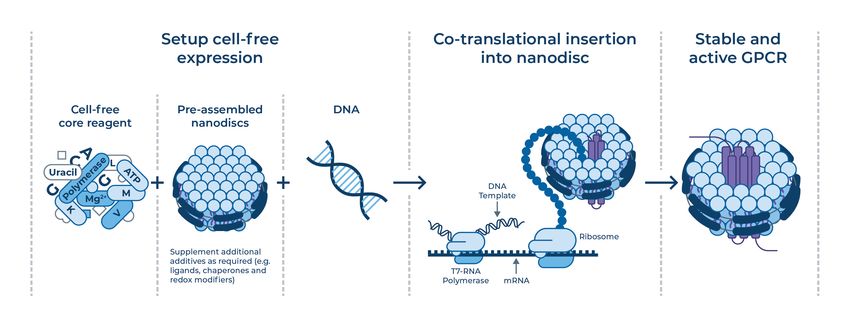
CFPS enables co-translational insertion of GPCRs into defined lipid environments. In cell-free reactions, membrane mimetics such as pre-assembled MSP–lipid nanodiscs can be present during translation, enabling rapid parallel screening of constructs, lipid compositions, and reaction conditions before scale-up.
CREDIT: Nuclera
Nanodiscs are soluble, nanoscale lipid bilayers wrapped by scaffold proteins. Compared with detergent micelles, they provide a more native-like environment, improving membrane protein stability for binding assays, biophysical studies, and cryo-electron microscopy (cryo-EM). Crucially, nanodiscs are a design space where lipid headgroup charge, chain length, saturation, and additives, including cholesterol analogues, can shift conformational equilibria, influence stability, and alter ligand affinity.
Work from Frank Bernhard, a world-leading expert in cell-free membrane protein expression at Goethe University Frankfurt, has established CFPS with co-translational nanodisc insertion as a practical route to functional GPCRs and receptor complexes. Bernhard’s studies demonstrate that nanodisc stoichiometry — ratio of lipid and membrane scaffold protein (MSP) — and lipid composition measurably influences ligand-binding competence. For example, the beta-1-adrenergic receptor (beta-1AR) showed a 12-fold improvement in activity in DEPG (dimyristoyl-phosphatidylglycerol) nanodiscs versus DMPC (dimyristoyl-phosphatidylcholine). In the same study, ligand-binding activity increased and protein aggregation reduced as nanodisc concentration rose to 100µM. In a screening-first workflow, nanodiscs are not just a stabilizer; they become a tunable parameter that can be optimized to produce assay-ready, structurally coherent receptors.
Table 1. Detergent micelles versus nanodiscs for membrane protein stabilization and functional assays.
Feature | Detergent Micelles | Nanodiscs |
Environment | Artificial, often disruptive to native lipids | More native lipid bilayer environment |
Lipids | Removed, leading to potential loss of stability and function | Customizable for proper folding and stability |
Activity | Often poor; functional activity is frequently compromised | High kinetic and thermal stability; preserves function |
Stability | Hours, prone to aggregation | Days to weeks, when stored properly |
Epidermal growth factor receptor (EGFR) retained 28 percent activity after 24 hours | EGFR retained 80 percent activity after 24 hours |
Fine-tuning for function
In addition to nanodiscs, the CFPS environment can be easily modified with factors that are difficult to control in vivo. Ligands can bias conformational equilibria, engineered binders, including nanobodies, can stabilize specific states, chaperones can be added directly to the reaction, and redox chemistry can be tuned for disulfide-dependent receptors such as GPCRs. The point is not that any single additive solves GPCRs, but that CFPS enables rapid, systematic optimization in parallel.
Bernhard’s optimization of the human endothelin B receptor provides a concrete benchmark. A common pain point in GPCR production is that while total receptor synthesis can be high, the functionally folded fraction can be below one percent. By combining receptor engineering, nanodisc lipid screening and redox and chaperone optimization, Bernhard’s team achieved more than 10³-fold improvements in folding efficiency, delivering ligand-binding-competent receptors in less than 24 hours. For discovery teams, this compresses time to functional protein and reduces months-long iteration cycles that often derail GPCR timelines.
From structure back to biology
These workflows feed directly into structural biology. CFPS/nanodisc approaches have produced cryo-EM structures of GPCR complexes, including a full length human beta-1AR/Gs complex resolved at 3.46Å, preserving intracellular regions historically lost in truncated constructs.
Beyond structures, nanodiscs support translation back to biology. Nanodisc-embedded membrane proteins can be transferred into mammalian cell membranes within minutes, with transferred GPCRs retaining functionality — tightening the loop between in vitro optimization, structural insight, and cellular validation.
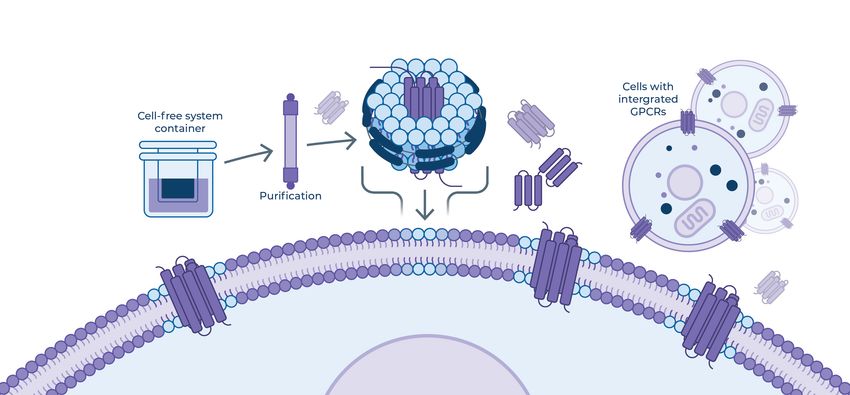
Nanotransfer can bridge in vitro optimization to cellular validation. Nanodisc-embedded membrane proteins can be transferred into mammalian membranes to enable downstream cell-based functional testing following in vitro optimization.
CREDIT: Nuclera
The way forward for GPCRs
GPCRs will continue to dominate drug discovery pipelines, but programs will continue to slip if active receptors are slow to obtain. CFPS paired with nanodiscs offers a rational alternative. Decouple expression from cell viability, insert receptors directly into defined bilayers, and tune stabilization variables systematically. The practical takeaway is simple: Optimize early, and treat the membrane environment as a controllable variable rather than a downstream rescue step.