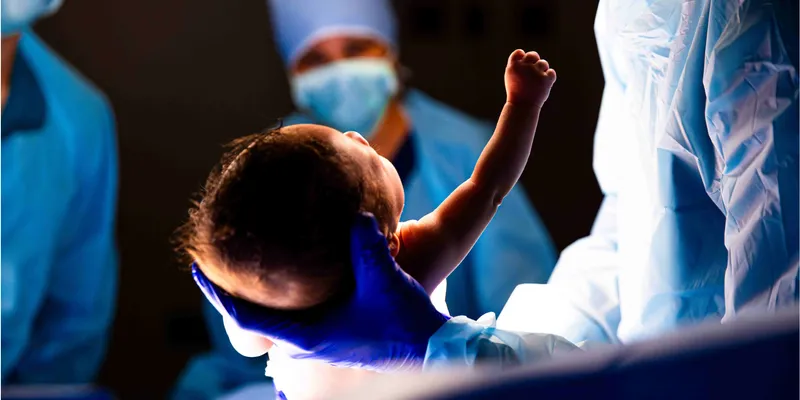
In 2013, a baby girl known as the “Mississippi baby” made headlines when it was announced that she was cured of HIV. She had received antiretroviral therapy (ART) starting just 30 hours of birth up until 18 months, and had no detectable levels of the virus over two years later. But then, when she was almost four years old, her blood revealed the HIV had returned, and she had to start ART once again.
The case dashed the hopes of doctors and scientists around the world who thought that it had become possible for infants born to mothers with HIV to avoid a lifetime of ART. Today, the search continues to find a way to quickly clear the virus in newborns for good.
A recent study published in Nature Microbiology from researchers led by Nancy Haigwood at the Oregon National Primate Research Center at Oregon Health & Science University could offer a new way forward. The team tested a combination of three HIV treatments — ART, broadly neutralizing antibodies (bNAbs), and an experimental monoclonal antibody — in eight infant rhesus macaques infected a few weeks after birth with a cousin of HIV called simian-human immunodeficiency virus, or SHIV. The results showed that the triple therapy effectively squashed the virus completely, cutting off its ability to keep infecting new cells, while untreated infants progressed rapidly to disease.
“No individual or dual combination of the three treatments could fully stop the virus when given at 72 hours after oral virus exposure. In contrast, the triple treatment cleared the virus that was replicating early and we could find no evidence of virus in any tissues,” Haigwood told DDN. The use of the nonhuman primate model was critical to these experiments, which could not be performed in cultured cells or other animal models and would be unethical to do in newborns without evidence of success.
Haigwood’s team is optimistic that the triple therapy could soon be tested in newborns exposed to HIV, given that all three individual components have already been extensively tested in humans.
“This work further supports the idea for intervention in babies as close to birth as possible, and it could mean that children no longer must take drugs for their entire lives,” she said.
A winning combination
In addition to providing a long-lasting cure for newborn babies, Haigwood also pointed out that “these results introduce a new way of thinking about HIV infection.”
She explained that ART essentially turns off the faucet but still allows a drip of the virus to continue spreading to other cells. That’s where the other two drugs come in. The bNAbs neutralize the virus and block new infection, and the monoclonal antibody they used, leronlimab, blocks the surface protein CCR5 (C-C chemokine receptor type 5) on CD4+ immune cells and prevents any HIV from attaching. This combination completely stalls the infection at a critical time before the virus sets up the permanent viral reservoir that makes HIV impossible to cure at present.
Each of the three drugs has a different way of corralling the virus, and it simply has nowhere to go.
—Nancy Haigwood, Oregon Health & Science University
“Each of the three drugs has a different way of corralling the virus, and it simply has nowhere to go,” said Haigwood.
The three-drug regimen could also be tried in newly infected adults. “If the triple treatment works, it could be given each time a person is exposed to HIV,” Haigwood noted. However, she added that because we don’t always know when adults are exposed to the virus like we do with babies, it could be harder to intervene within the right window.
It could be even more challenging to treat adults depending on where they live. “The difficulty remains for delivery of such a treatment in parts of the world where there is limited clinic access, or limited resources for these biologics,” Haigwood said.
Closer to a cure
Though promising, the results are still only preclinical at this stage. “I feel very hopeful, but I know how important clinical testing is,” said Haigwood. Yet, the strength of the results also bolsters hope. “The evidence for viral clearance is very strong, and animals did not mount an immune response, further supporting clearance,” Haigwood emphasized.
One potential positive is that differences between human babies and infant macaques could mean more opportunity to offer the treatment if human babies have a slower spread of the virus early in life. “We need to understand whether waiting a few more days before starting the triple treatment would work as well, or in other words to better understand the window of opportunity,” said Haigwood.
She also suggested that longer-persisting bNAbs could be tested to see if they have a stronger effect, or novel compounds like bispecific antibodies in combination with ART.
For now, the study shows a proof of concept that these three medications could work together to act as a functional cure. “Each of these three treatments has a different mechanism, and we reasoned that the combination would be powerful because we knew we needed to stop the virus from spreading or infecting new target cells,” said Haigwood.
In the future, their discovery could lead to a novel combination therapy that offers the ultimate benefit for the world’s youngest patients with HIV: a chance to be rid of the virus, and never remember a time when they weren’t.