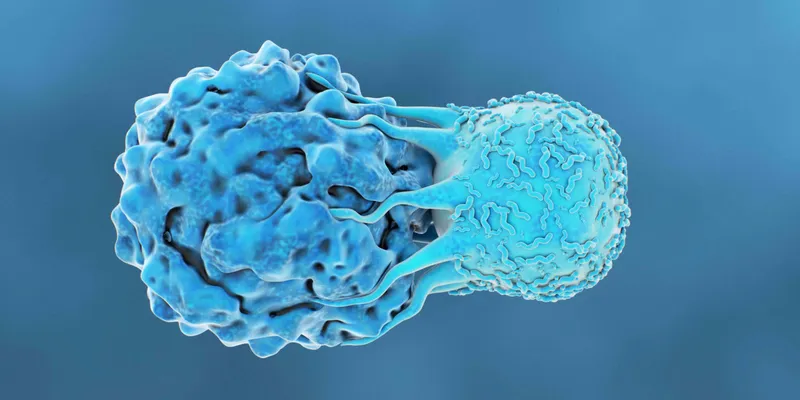
CAR T cell therapies have seen rapid success in treating blood cancers, yet most patients will relapse months or years later. That can be due to “exhausted” T cells that are no longer able to fight off cancer cells.
New work from a team at the Icahn School of Medicine at Mount Sinai, Bristol Myers Squibb (BMS), and the University of Oxford revealed how to give T cells a boost, and possibly prevent relapse in patients as a result. The researchers showed that BMS’ next-generation oral cereblon E3 ligase modulators (CELMoD) drug, mezigdomide, can target and degrade two transcription factors — IKZF1 (Ikaros) and IKSF3 (Aiolos) — that lead to T cell exhaustion through epigenetic control.
Their results were published in two separate papers in Blood, with early-phase clinical trials now in progress to investigate the combination of mezigdomide with T cell therapies.
“In our Blood studies, we found that mezigdomide potently degrades Ikaros and Aiolos in patient T cells, leading to a marked reduction in exhausted T cell populations and a corresponding improvement in the function of anti‑myeloma T cell therapies, including both CAR T and BCMA (B-cell maturation antigen)‑directed T cell engagers,” Samir Parekh, Director of the Center of Excellence for Multiple Myeloma at Mount Sinai and principal investigator on one of the papers, told DDN.
Activating T cells to fight again
The team used multi-omics gene sequencing methods like ATAC-seq, ChIP-seq, Hi-C, and RNA-seq on bone marrow samples from patients. They demonstrated that mezigdomide led to fewer T cells showing markers of exhaustion, like PD-1 (programmed cell death protein 1) and TIGIT (T cell immunoreceptor with Ig and ITIM domains).
Parekh explained that their work showed how Ikaros and Aiolos “directly occupy regulatory elements of exhaustion‑associated genes (for example, TIGIT and other inhibitory receptors) as well as key cytokine loci, so that their degradation by mezigdomide simultaneously downregulates exhaustion programs and restores pro‑inflammatory cytokine production and cytotoxic activity.”
“Functionally, this translates into enhanced proliferation, cytokine secretion, and tumor‑cell killing by T cells in vitro and in preclinical models when mezigdomide is combined with T cell-directed immunotherapies,” he added. The result is T cells that are rejuvenated back into a state that allows them to fight off cancer cells again.
Parekh said that it was surprising just how quickly mezigdomide led to these effects. ”We were struck by the degree to which relatively short pulses of mezigdomide exposure could reprogram exhausted T cells — both at the chromatin level and in terms of cytokine output — resulting in durable functional rescue in our experimental systems,” he said.
Plus, their results showed that the efficacy of anti-myeloma T cell therapy was thoroughly enhanced with the addition of mezigdomide in vivo. “The magnitude of improvement in anti‑myeloma T cell therapy efficacy when combined with mezigdomide, particularly in models that were otherwise relatively resistant, was more pronounced than we expected at the outset,” said Parekh.
Beyond myeloma
Mezigdomide has already been studied in multiple clinical trials in combination with other drugs, like Celgene’s (now a BMS company) Phase 3 SUCCESSOR program with dexamethasone and bortezomib to treat multiple myeloma. The new work provides a rationale for mezigdomide’s added benefits in combination with CAR T and T cell engager therapies to ward off T cell exhaustion.
“It was particularly gratifying to see that these mechanistic insights translated into meaningful improvements in T cell function and anti‑tumor activity in preclinical models, and to envision how an oral small molecule could be layered onto existing immunotherapies to extend their benefit for patients who currently relapse too quickly,” said Parekh.
The team now plans to further elucidate how and when to use mezigdomide with T cell-based therapies — either before, during, or after CAR T therapy or T cell engager therapies. Along these lines, the team has already started a similar trial testing iberdomide, another CELMoD, as a “priming” strategy before therapy. They also plan to identify biomarkers like exhaustion-gene signatures or Ikaros/Aiolos occupancy patterns that predict which patients will respond best to adding on therapies like mezigdomide. “Ultimately, we hope to translate these insights into prospective clinical trials that test tailored schedules and combinations of mezigdomide with next‑generation immunotherapies across different stages of myeloma,” said Parekh.
Furthermore, Parekh also believes that this type of strategy could be useful for CAR T cell therapies outside of myeloma. “The most exciting use seems to be in autoimmune diseases beyond cancer,” he said.