Macrophages — key players of the immune system — swiftly engulf harmful cells and debris, their lesser-known talent lies in healing: they ease inflammation, break down scar tissue, and trigger organ repair (1).
For over a decade, scientists have explored whether these regenerative powers could be harnessed to treat one of the most challenging liver conditions: cirrhosis. This chronic disease, marked by irreversible scarring, severely limits liver function, and remains notoriously hard to manage.
To date, liver transplantation is the only approved treatment for this end-stage liver disease. “Unfortunately, there’s insufficient healthy livers to meet demand, and also it requires lifelong immunosuppression, and also there are occasional complications from the very complex surgery,” said Stuart Forbes, a hepatologist and liver disease researcher at the University of Edinburgh. “So, there is still a gap to be met with patients who have established liver disease,” he added.
Driven by the pressing need for new treatments, Forbes and his colleagues have spent over two decades exploring cell-based therapies for advanced liver disease. By the mid-2000s, macrophages emerged as a promising candidate. Encouraged by strong preclinical data and a Phase 1 trial confirming safety, Forbes cofounded Resolution Therapeutics in 2020 to turn those insights into viable treatments (2). “You reach a point where, within an academic boundary, it’s quite hard to progress beyond a certain point,” he said. Tasks like optimizing manufacturing and genetic manipulation become more efficient within a company solely focused on that goal, he noted.
Sven Francque, a liver researcher at the University of Antwerp, said it makes sense to focus on macrophages, one of the immune system’s most crucial cells, to potentially treat cirrhosis. “Inflammation is a very important driver of disease progression towards decompensation in these patients,” he said. While translating preclinical findings into clinical benefit is always challenging, he added that this approach is worth exploring.
Recently, Resolution Therapeutics has advanced into clinical trials that affirm the therapy’s safety — a promising first step, especially considering past failures and limited clinical success in this field (3-5). Still, proving the therapy’s true effectiveness remains one of the major challenges ahead.
From mice to humans
Multiple mouse studies pointed to the potential of macrophages in treating liver injury. In the mid-2000s, Forbes and others showed that macrophages play a dual role in liver injury: not only do they contribute to scar formation, but they also help resolve it (6). Once the source of injury subsides, macrophages produce matrix-degrading enzymes called matrix metalloproteinases (MMPs), which break down the excess extracellular matrix that defines fibrosis — the scarring that accumulates as the liver attempts to heal itself (7).
In 2013, Forbes and his colleagues observed that injecting macrophages in healthy mice had an intriguing effect on their livers. “It could make those livers expand in size, which was unexpected,” he said. His team traced this effect to the cytokine TNF-like weak inducer of apoptosis, secreted by the transplanted macrophages (8). TWEAK activated a signaling pathway that triggered liver cell proliferation, leading to liver growth in healthy animals.
Encouraged, he and his team turned to a well-established mouse model of liver fibrosis, induced by exposure to the chemical carbon tetrachloride. When they injected these fibrotic mice with macrophages — differentiated from bone marrow-derived precursors of genetically identical animals — they observed clear improvements in both fibrosis and tissue regeneration (9). Notably, the transplanted macrophages appeared to activate the body’s own immune cells, amplifying the repair process.
“A single injection of macrophages could have quite a big effect on those livers in terms of reducing scarring, reducing inflammation,” Forbes emphasized. “We wanted to see if we could move that into a human study.”
So Forbes and his team began isolating monocytes from the blood of patients with liver disease. These patients’ monocytes showed distinct characteristics to those from healthy individuals. “But once they’ve been converted into mature macrophages [in the lab], they could behave in a regenerative manner,” Forbes noted (10).
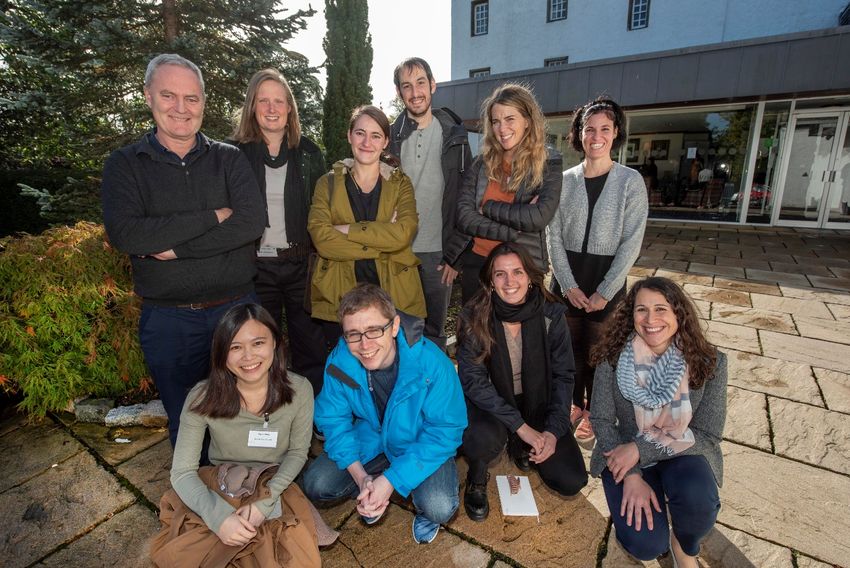
University of Edinburgh’s hepatologist and liver disease researcher, Stuart Forbes and his colleagues are exploring the regenerative properties of macrophages to treat severe liver disease.
Forbes lab group
That insight paved the way for MAcrophage Therapy for liver CirrHosis (MATCH01), a Phase 1 trial testing the safety of macrophage therapy for liver cirrhosis (2). Nine participants received a single infusion of macrophages derived from their own monocytes in escalating doses. All completed a year of follow-up without acute transfusion reactions, confirming the therapy’s safety and feasibility.
Signs of promise, more evidence needed
In the follow-up Phase 2 trial, 27 patients received an infusion of macrophages derived from their own blood and were compared to 24 patients who received standard medical care. Once again, the therapy proved safe (3). Moreover, patients in the treatment arm showed improved 90-day survival predictions based on their Model for End-Stage Liver Disease (MELD) score — a clinical tool that estimates liver disease severity using blood markers like bilirubin and creatinine. However, the MELD-based difference between groups narrowly missed statistical significance (p = 0.06), meaning the trial did not meet its primary endpoint.
Biomedical engineer Kara Spiller at Drexel University, who focuses on new technologies to control macrophages for regenerative medicine, noted that since this comparison is based on a score, the statistics of it can be tricky. “I feel like the fact that they got 0.06 is good,” she said. “If they had done something that was more related to the fibrosis, like imaging or something of the fibrosis, I bet the effects would be stronger.”
Francque noted that it’s a bit premature to draw strong conclusions based solely on the MELD score. In this patient population, he said, it’s essential to track multiple markers that may signal improvement — even as nonsignificant trends. MELD is just one of them.
Another notable clinical outcome emerged over a 360-day follow-up: Five patients in the control group experienced severe adverse events (three of them fatal). In contrast, none of the patients treated with macrophages faced liver complications or died during the study period.
“This is great because it means it’s safe, and also possible,” said Spiller.
More doses, smarter macrophages, and more healing power?
One of the next steps to maximize the therapy’s efficacy is to increase the number of infusions each patient receives. Although the original MATCH01 Phase 2 design included three infusions per patient, only a few received all three due to practical constraints. “At the time, we realized it was going to be very hard to recruit people, to go through three apheresis [blood cell collections] and three infusions in our study protocol, and we were going to struggle to finish in time, and of course then COVID came,” Forbes explained. Ultimately, the team decided to go for a single infusion for most patients.
Since then, the team has improved the process, making multi-infusion trials more feasible. “We’re now much more efficient at isolating the cells and differentiating them: A single apheresis can give rise to multiple frozen aliquots of cells,” added Forbes.
Another major development involves genetically engineering the macrophages to express higher levels of the anti-inflammatory cytokine interleukin-10 (IL-10) and the enzyme MMP9. According to Forbes, these modifications likely boost the macrophages’ anti-inflammatory, pro-regenerative, and scar-resolving capacity, while improving their ability to signal to other inflammatory cells in the liver to improve the response. To test the safety of this approach, Resolution Therapeutics is currently running the EMERALD trial (Evaluating Macrophages Engineered to Resolve Advanced Liver Disease).
“That’ll be interesting because now you’ve got the delivered macrophages and assuming the macrophages stay alive, they are secreting two very powerful factors that have very strong effects in the body,” noted Spiller. “IL-10 is the most potent anti-inflammatory cytokine we know of, MMP9 is the most potent enzyme that we know of that also has signaling effects,” she added.
“I am certainly on the edge of my seat to see what happens with that trial,” Spiller said.
References
- Spiller, K.L. & Koh, T.J. Macrophage-based therapeutic strategies in regenerative medicine. Adv Drug Deliv Rev 122, 74-83 (2017).
- Moroni, F. et al.Safety profile of autologous macrophage therapy for liver cirrhosis. Nat Med25, 1560-1565 (2019).
- Brennan, P.N. et al.Autologous macrophage therapy for liver cirrhosis: a phase 2 open-label randomized controlled trial. Nat Med31, 979-987 (2025).
- Newsome, P.N. et al.Granulocyte colony-stimulating factor and autologous CD133-positive stem-cell therapy in liver cirrhosis (REALISTIC): an open-label, randomised, controlled phase 2 trial. Lancet Gastroenterol Hepatol 3, 25-36 (23018).
- Forbes, S.J. et al. Cell therapy for liver disease: From liver transplantation to cell factory. J Hepatol62, S157-S169 (2015).
- Duffield, J.S. et al.Selective depletion of macrophages reveals distinct, opposing roles during liver injury and repair. J Clin Invest 115, 56-65 (2005).
- Rohani, M.G. & Parks, W.C.Matrix remodeling by MMPs during wound repair. Matrix Biol44-46, 113-121 (2015).
- Bird, T.G. et al.Bone marrow injection stimulates hepatic ductular reactions in the absence of injury via macrophage-mediated TWEAK signaling. Proc Natl Acad Sci U S A 110, 6542-6547 (2013).
- Thomas, J.A. et al.Macrophage therapy for murine liver fibrosis recruits host effector cells improving fibrosis, regeneration, and function. Hepatology 53, 2003-2015 (2011).
- Moore, J.K. et al.Phenotypic and functional characterization of macrophages with therapeutic potential generated from human cirrhotic monocytes in a cohort study. Cytotherapy 171, 1604-1616 (2015).