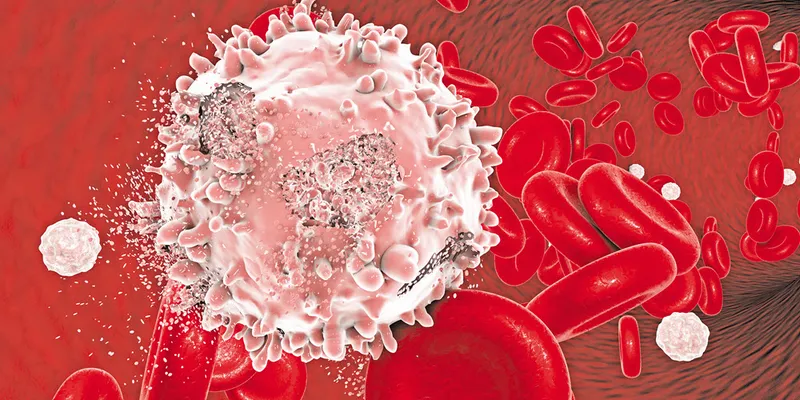
Nearly every patient with the deadliest adult leukemia — acute myeloid leukemia (AML) — will develop resistance to their treatment. Today’s frontline treatment includes venetoclax, a B-cell lymphoma-2 (BCL-2) inhibitor, approved for AML in 2018. It works by blocking BCL-2 proteins that prevent cancer cells from dying, but the story is the same: Most patients eventually develop drug resistance that allows AML cancer cells to escape apoptosis.
“Despite much work, AML remains the most challenging blood cancer to treat in the world,” said Christina Glytsou, a biologist at Rutgers University and the Rutgers Robert Wood Johnson Medical School.
Yet, a new treatment strategy could finally be on the way. In a recent study published in Science Advances, Glytsou and her team discovered that changes to the shape of mitochondria cause drug resistance to venetoclax in AML patients — and showed a new way to reverse the resistance in mice using OPA1 (optic atrophy 1) inhibitors.
“The study is very novel and highly relevant. Targeting mitochondrial metabolism using novel approaches is of high impact and may work for patients resistant to standard of care or venetoclax,” said Marina Konopleva, Professor in the Department of Oncology at Albert Einstein College of Medicine, who was not involved in the new work.

Finding the cause of resistance
By using advanced microscopy and genome-wide CRISPR interference (CRISPRi) screen analyses, the researchers revealed that AML cells that become resistant to venetoclax exhibit high levels of the OPA1 protein, which is responsible for regulating the shape of cristae, or the inner folds of the mitochondrial membrane. In cells from AML patients, they saw that these high OPA1 levels led to more densely packed cristae that easily trap cytochrome c — a molecule that is crucial for triggering apoptosis in the cell.
“Our recent findings underscore the fundamental role of mitochondrial morphology and functions in developing resistance to venetoclax in human AML,” said Glytsou.
To overcome this resistance, Glytsou’s team tested two experimental OPA1 inhibitors developed by their colleagues at the University of Padua: MYLS22 and Opitor-0. In a xenograft model of mice with human AML cells, they showed that treatment with both venetoclax and OPA1 inhibitors led to increased apoptosis of AML cancer cells and significantly prolonged survival.
“The most exciting part of our work was the fact that the novel inhibitors that target a mitochondrial structural protein (OPA1) can reverse these adaptations and can re-sensitize AML cells to venetoclax,” said Glytsou.
Beyond treating AML
The study highlights how mitochondrial dynamics drive drug resistance and supports the exploration of combination approaches to counter it.
Glytsou and her colleagues are now focused on applying this work to types of childhood leukemia. The treatment approach could also be applied to other types of cancer in the future, as the OPA1 protein is also known to be overexpressed in other cancer types like breast cancer and lung cancer.
This approach offers a promising avenue to overcome drug resistance to therapies targeting anti-apoptotic proteins.
– Haijiao Zhang, Oregon Health Science Center
“This approach offers a promising avenue to overcome drug resistance to therapies targeting anti-apoptotic proteins,” said Haijiao Zhang, Assistant Professor in the Division of Oncological Sciences at the Oregon Health Science Center who was not involved in the study.
Yet, Zhang added that because mitochondrial inhibitors are often associated with significant toxicity, it will be essential to focus future work on optimizing their pharmacodynamic and bioavailability profiles to reduce side effects — both within the hematopoietic system and tissues like the heart and nervous system, which are very metabolically active.
“A more detailed dissection of the functional consequences of cristae remodeling and metabolic pathway alterations— aimed at identifying the specific features that most strongly impact drug sensitivity — will be crucial for designing more selective inhibitors with potentially reduced toxicity,” she said.
Glytsou’s team will leave that side of things to the drug developers at the University of Padua, while she and her colleagues focus their work on understanding the mechanisms of actions of the drugs in cancer metabolism and investigating their efficacy to treat patients.
“Our goal is to propose new, precise therapeutics that will improve the patients' outcomes,” she said.