For a child with peanut allergies, navigating a normal day can seem like walking through a minefield. As other children swap snacks with friends, buy treats at bake sales, and devour cake at birthday parties, children with severe allergies must scrupulously refrain, knowing that even a trace of this common food could send them to the emergency room.
In the United States, approximately two percent of children suffer from peanut allergies, with some studies suggesting that peanut allergies have become more prevalent in recent decades (1,2). While some allergic children may break out in hives, others may experience the constriction of airways and severe drop in blood pressure known as anaphylaxis, which can be deadly if not treated promptly (3). Patients and their caregivers often report anxiety, major impacts on health-related quality of life, and dissatisfaction with currently available treatment options (4).
Peanut allergies can substantially reduce quality of life for patients and their families.
credit: istock/triocean
The limitations of existing peanut allergy therapies
In January 2020, the FDA approved the first drug for the treatment of peanut allergies; Palforzia, an oral immunotherapy that reduced allergic reactions, including life-threatening anaphylaxis, in children and adolescents with peanut allergies. Some parents of patients in the trial reported that the treatment removed the pall of anxiety hanging over their families, allowing them to live with a degree of freedom that had been impossible before (5). Many expected the drug to be a game changer for patients and their families; Nestlé bet big on this treatment too, acquiring the Palforzia maker Aimmune Therapeutics for approximately $2.6 billion in 2020 (6).
In reality, however, the drug failed to garner much interest from patients and their families; Bloomberg Businessweek called the treatment “a dud” (6). In one study, only about ten percent of children and families who were offered the therapy chose to pursue it, citing concerns about the time commitment and potential adverse effects (8).
These concerns aren’t without foundation. Similar to other allergy immunotherapies, Palforzia works by administering the allergen in very small doses initially but gradually increasing dosage over time. Because Palforzia is peanut protein, giving it to children who are highly allergic to peanuts requires close supervision by doctors. Patients must visit every two weeks during the six-month dose increase period. Side effects, especially gastrointestinal symptoms, are common during this six-month period (9). Although it's rare, the drug can cause severe anaphylactic reactions “at any time during Palforzia therapy,” according to the company. This includes the indefinite period of maintenance therapy; patients must continue to take 300mg of peanut protein daily to maintain the therapeutic effects.
Furthermore, as Indiana University immunologist Mark Kaplan pointed out, the treatment doesn’t work for everyone. At the end of a Phase 3 clinical trial, about one third of participants were still unable to tolerate 600mg of peanut protein, which is approximately equivalent to two peanuts (10).
Despite low interest in Palforzia, peanut allergy remains a life-altering problem for many patients and their families that researchers around the world are working hard to solve. The Viaskin patch, for example, which delivers immunotherapy through the skin, has recently performed well in a phase 3 clinical trial in children one to three years old (7). However, this treatment suffers from some of the same problems as Palforzia; about one third of patients failed to tolerate a small number of peanuts at the end of the study and about one in twelve children experienced serious adverse events.
Advancing treatment with AAV gene therapy
Fortunately, more treatments are in the pipeline. From liver-targeting nanoparticles to allergen-specific antibody inhibitors, researchers are getting creative to develop safer, more effective treatments for children with peanut allergies.
Teaching tolerance
Andre Nel, originally trained as an allergist and immunologist, is also interested in nanotechnology and its therapeutic applications for medical disorders. Combining these two fields, Nel and his colleagues at the California Nano Systems Institute at the University of California, Los Angeles explore whether nanoparticles can be used to treat peanut-induced reactions and allergic diseases.
Andre Nel is developing a nanoparticle-based treatment for peanut allergies.
credit: CNSI/UCLA
Nel and his research team investigated the effects of an allergenic food protein — the egg white protein albumin — entrapped in nanoparticles that were taken up by the liver. When they administered these nanoparticles to mice, they discovered something surprising.
“We expected to see a possible strong allergic reaction, but in fact, we observed the exact opposite: it switched off the allergic response to egg white protein that could either manifest as anaphylaxis or generation of an asthma-like response in the lung,” said Nel.
“Once we knew that the liver had the capacity to suppress allergic responses, the question became, ‘how does the liver achieve this outcome?’ That required a bit of sleuth work,” said Nel.
In the first experiments, the team had used a polymer nanoparticle that was suitable for uptake by a variety of cell types in the liver. The next step was to figure out which cell type was responsible for this allergy-supressing effect.
Based on previous research, the team hypothesized that cells in the blood vessel lining — liver sinusoidal endothelial cells (LSECs) — might be responsible for inducing tolerance to the allergen. They decorated the nanoparticle surface with ligands designed to interact with LSEC receptors and found enhanced suppression of the allergic response to egg white protein in mice (11).
“An important part of the LSECs’ function is to train regulatory T cells,” said Nel. These regulatory T cells, in turn, can move throughout the body, suppressing the allergic response in other tissues.
After this promising start, the team wanted to expand this platform to treat other kinds of allergies. Nel immediately thought of peanut allergies.
Peanut allergy is not straightforward to treat. There are several peanut proteins, each with many different epitopes, or parts of the protein that are recognized by the immune system. Some epitopes are presented by LSECs to naïve T cells, which turns them into regulatory T cells that are capable of suppressing the response to the allergic epitopes.
Nel and the team first identified the peanut protein T cell epitope with the best ability to generate regulatory T cells. Then they tested liver-targeting nanoparticles loaded with the optimal epitope in a mouse model of peanut allergy. They found that animals injected with the nanoparticles either before or after sensitization to a crude peanut extract were protected from the peanut-induced anaphylactic response (12).
“The amazing piece here,” said Nel, “is that we educated our regulatory T cells against a single epitope, which turns out to suppress the immune response to potentially hundreds of the allergic epitopes present in the crude peanut extract.” How exactly regulatory T cells accomplish this feat is an area of active exploration by many T cell biologists, said Nel.
In a mouse model, a single T cell epitope proved effective, but Nel wondered if this treatment needed multiple epitopes to be effective in humans. It could be tricky to put more than a few of these peptide antigens into a single nanoparticle, especially if they had slightly different physical properties, like solubility. Inspired by the COVID-19 vaccines, the researchers demonstrated that they could replace the peptide with a strand of mRNA to code for the peptide, allowing delivery of multiple epitopes at the same time (13).
Nel said that the next steps will be to figure out how long this effect lasts — whether this is a permanent resetting of the immune system or whether periodic re-education will be needed. Nel doesn’t plan to stop with peanut allergies either; a similar technique could be used to treat other food allergies or perhaps even some autoimmune diseases.
Hiding in plain sight: A new approach to peanut allergy
Kaplan and his collaborator, Başar Bilgiçer, a biophysical chemist at the University of Notre Dame, hope to intervene at a different part of the allergic process. Instead of trying to re-educate the immune system to tone down the response to peanut protein, they want to prevent the relevant parts of the immune system from even noticing the presence of the protein.
Everybody generates a slightly different immune response.
- Mark Kaplan, Indiana University
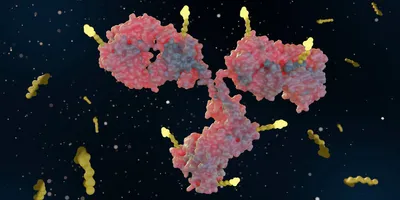
Most of the time, humans produce antibodies that recognize potentially harmful viruses, bacteria, or parasites. People with food allergies, however, make antibodies that recognize usually harmless food proteins, like peanut proteins. These antibodies stick to the outside of mast cells, a type of white blood cell. When the peanut-sensitive antibodies encounter this allergen, they cross-link with one another, which triggers a mast cell meltdown called degranulation. The cells spew a potent cocktail of histamine, inflammatory cytokines, and lipid mediators, which cause the symptoms of allergic reactions like itching and swelling, as well as anaphylaxis in extreme cases (14).
The team wanted to create a drug that stably blocked the antigen binding site on the peanut-sensitive antibodies, preventing them from recognizing the peanut protein and therefore blocking the mast cell response.
This approach wasn’t quite as straightforward as it sounds. “Everybody generates a slightly different immune response,” explained Kaplan. Even though there are just two major peanut proteins, Ara h 2 and Ara h 6, that seem to be responsible for most of the allergic reactions, patients develop antibodies that recognize many different epitopes of these proteins (15). Since patients’ antibodies have many different flavors of antigen binding sites, which vary between and within each patient, it seemed at first like an impossible task to block them all.
The team wondered whether some of the epitopes (and their corresponding antigen binding sites) might be more important for driving the allergic response than others. Their results, said Kaplan, were a little surprising. In a set of experiments led by Bilgiçer, the team identified only two epitopes that appeared to be immunodominant. When they blocked these two epitopes from binding to antibodies on mast cells that had been primed with peanut-allergic patient serum, they abolished most of the degranulation response to peanut extract in samples from fourteen out of sixteen patients. They named these epitope blockers, which also have two other binding domains to help them irreversibly attach to the appropriate antibodies, covalent heterobivalent inhibitors, or cHBIs (16).
Mark Kaplan and his research team are designing covalent heterobivalent inhibitors to prevent fatal allergic responses.
credit: Cynthia Booth
Next, the team wanted to test their therapy in a humanized mouse model. These immunodeficient mice were genetically engineered to express factors to promote the development of mast cells. They were also injected with human stem cells, so that the mice produced fully human mast cells. Researchers then injected the mice with patient-derived antibodies against the peanut protein Ara h 2, rendering the mice fatally allergic to peanuts.
As the team had hoped, a single injection of the cHBI protected mice against subsequent exposure to the Ara h 2 protein. Even better, this protection lasted for around two weeks. Kaplan, however, emphasized that the mice don’t fully recapitulate the human immune system, so this duration might be shorter in actual patients. The treatment would need to be ongoing to confer protection since the human body is continually making new mast cells and new antibodies, so examining long-term safety is crucial.
“We're currently doing toxicity studies with nonhuman primates,” Kaplan said. “We haven't seen any adverse effects yet, so that is promising.”
While neither Kaplan’s nor Nel’s therapies are quite ready to be tested in humans, these treatments, as well as the many others currently in the pipeline, could one day allow children with peanut allergies to enjoy more carefree childhoods.
Frequently asked questions about peanut allergy treatments
What is the main challenge with current peanut allergy treatments?
Current treatments like oral immunotherapy often require a significant time commitment and carry the risk of side effects, including severe allergic reactions. Additionally, these therapies may not be effective for all patients, which limits their widespread use.
How can AAV gene therapy offer a new solution for peanut allergy?
The article describes a liver-targeting nanoparticle approach that can be delivered using mRNA, similar to an AAV gene therapy. This method aims to "re-educate" the immune system to tolerate peanut proteins by training regulatory T cells, potentially offering a long-term or even permanent solution.
What are the new treatments discussed in the article?
The article highlights two innovative approaches in the research and development pipeline. The first uses liver-targeting nanoparticles to induce immune tolerance. The second involves a covalent heterobivalent inhibitor (cHBI) that blocks antibodies from recognizing peanut allergens, preventing an allergic reaction.
Are these new treatments ready for widespread use?
No, the treatments discussed are currently in the research and development phase. They have shown promising results in animal models, but they are not yet ready for human clinical trial or widespread application. Further research is needed to determine their safety and efficacy in humans.
References
- Bunyavanich, S. et al. Peanut allergy prevalence among school-age children in a US cohort not selected for any disease. J Allergy Clin Immunol 134, 753–755 (2014).
- Abrams, E. M., Chan, E. S. & Sicherer, S. Peanut Allergy: New Advances and Ongoing Controversies. Pediatrics 145, e20192102 (2020).
- Peanut allergy - Symptoms and causes. Mayo Clinic at <https://www.mayoclinic.org/diseases-conditions/peanut-allergy/symptoms-causes/syc-20376175>
- Nowak-Wegrzyn, A. et al. The Peanut Allergy Burden Study: Impact on the quality of life of patients and caregivers. World Allergy Organ J 14, 100512 (2021).
- Bartholomew, J. NHS England to offer life-changing drug to children with peanut allergy. The Guardian (2021). at <https://www.theguardian.com/society/2021/dec/23/nhs-england-to-offer-life-changing-drug-to-children-with-peanut-allergy>
- Nestlé’s $6,000 Peanut Allergy Pill Has Been a Dud. Bloomberg.com (2023). at <https://www.bloomberg.com/news/articles/2023-02-08/nestle-nesn-peanut-allergy-pill-palforzia-has-flopped>
- Greenhawt, M. et al. Phase 3 Trial of Epicutaneous Immunotherapy in Toddlers with Peanut Allergy. New England Journal of Medicine 388, 1755–1766 (2023).
- Patrawala, S. et al. Real-world adoption of FDA-approved peanut oral immunotherapy with palforzia. The Journal of Allergy and Clinical Immunology: In Practice 10, 1120-1122.e1 (2022).
- Safety profile | PALFORZIA [Peanut (Arachis hypogaea) Allergen Powder-dnfp]. at <https://www.palforziapro.com/safety>
- AR101 Oral Immunotherapy for Peanut Allergy. N Engl J Med 379, 1991–2001 (2018).
- Liu, Q. et al. Use of Polymeric Nanoparticle Platform Targeting the Liver To Induce Treg-Mediated Antigen-Specific Immune Tolerance in a Pulmonary Allergen Sensitization Model. ACS Nano (2019).
- Use of a liver-targeting nanoparticle platform to intervene in peanut-induced anaphylaxis through delivery of an Ara h2 T-cell epitope. Nano Today 42, 101370 (2022).
- Use of a Liver-Targeting Immune-Tolerogenic mRNA Lipid Nanoparticle Platform to Treat Peanut-Induced Anaphylaxis by Single- and Multiple-Epitope Nucleotide Sequence Delivery | ACS Nano. at <https://pubs.acs.org/doi/abs/10.1021/acsnano.2c12420>
- Oettgen, H. C. Mast cells in food allergy: Inducing immediate reactions and shaping long-term immunity. Journal of Allergy and Clinical Immunology 151, 21–25 (2023).
- Otsu, K., Guo, R. & Dreskin, S. C. Epitope analysis of Ara h 2 and Ara h 6: characteristic patterns of IgE-binding fingerprints among individuals with similar clinical histories. Clin Exp Allergy 45, 471–484 (2015).
- Deak, P. E. et al. Designer covalent heterobivalent inhibitors prevent IgE-dependent responses to peanut allergen. Proceedings of the National Academy of Sciences 116, 8966–8974 (2019).