Over the past decade, advances in DNA editing have propelled it out of the lab and into clinical trials. Now, clever chemical tweaks may help RNA editing catch up.
In a recent study published in Nature Biotechnology, scientists from Wave Life Sciences demonstrated the first successful in vivo RNA editing in non-human primates using enzymes already found in the animals (1). With careful chemical modifications, they made targeted RNA editing more efficient, boosting its therapeutic potential.
“We’re applying a new chemistry toolbox to a whole new area of biology… doing RNA editing in a way that’s sustainable and durable,” said Paul Bolno, president and chief executive officer of Wave Life Sciences.
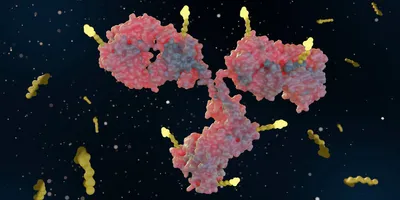
Wave Life Sciences used their oligonucleotide expertise to design a molecule that recruits ADARs to make A-to-I edits in target RNA.
CREDIT: WAVE LIFE SCIENCES
DNA editing isn’t something that human cells do naturally, so CRISPR therapeutics require the injection of bacteria-inspired Cas9 enzymes. But human cells already know how to edit RNA using a family of proteins called ADARs, short for “adenosine deaminase acting on RNA.” These molecules bind to double-stranded RNA and convert its adenosine building blocks into inosine. The exact purpose of this “A-to-I” change still isn’t fully understood; it may help the body make more diverse molecules from its limited set of genomic instructions, or it may help recognize viral RNA.
Existing machinery is just one reason why RNA editing is an appealing alternative to DNA editing for therapeutic purposes. It’s also reassuring that it doesn’t create permanent changes to the central instructions that the cell uses to carry out all of its functions.
“We can avoid permanently editing the human genome and stay focused on the transcript, but not at the expense of durability,” said Paul Bolno, president and chief executive officer of Wave Life Sciences.
In previous studies, researchers have attempted targeted RNA editing by delivering ADAR molecules alongside nucleic acids that bind to the RNA of interest and create a double-stranded RNA molecule for the ADAR to edit (2). But this led to too many ADARs roaming the cell and too much off-target editing. Attempts to harness the ADARs already in the cells have worked well in vitro, but haven’t been efficient in animal models, in part because of difficulties delivering long nucleic acids, a problem that has plagued in vivo DNA editing as well (3).
This is where Wave Life Sciences’ expertise comes in. Oligonucleotides — short nucleic acids that are used for therapeutic purposes — are chains of nucleotides connected by a chemical backbone. At each bond linking consecutive bases, the oligonucleotide can take on different conformations. Chemists at Wave Life Sciences have developed ways to modify and standardize these molecules’ structures.
Chandra Vargeese, chief technology officer of Wave Life Sciences and senior author of the study, and her team became interested in RNA editing because their technology enabled them to design shorter oligonucleotides — just 30 bases long — that could be delivered to cells in vivo more easily, without viral vectors or lipid nanoparticles. They also knew from previous work that oligonucleotides’ conformations influenced their abilities to enter key cellular compartments, such as the nucleus, where ADARs work (4).
Chandra Vargeese leads a team at Wave Life Sciences that spent years developing a flexible platform to deploy RNA editing for therapeutic purposes.
CREDIT: WAVE LIFE SCIENCES
“What you want is a reasonably sized, fully chemically modified molecule that can recruit the endogenous machinery,” Vargeese said. Understanding how modifying the structure affects the molecule’s function was a considerable effort, she said, but ultimately the years spent developing the technology paid off. “We started applying it, and we started seeing changes.”
In in vitro liver cells, their optimized molecules — dubbed “AIMers” — increased the percent of transcripts with targeted RNA editing by approximately 25% compared to conventional molecules with unstandardized structures. More importantly, with a tag that guided them to liver hepatocytes, the molecules achieved nearly 50% editing efficiency in vivo in monkeys, and off-target edits were rare.
The team next designed AIMers that targeted a mutation in the SERPINA1 gene that causes alpha-1-antitrypsin deficiency, a rare condition that can cause lung and liver disease. With the same liver-homing tag, the molecules successfully triggered editing and fixed the mutation approximately 68% of the time.
“It shows that targeting RNA editing ADAR-based systems really has validity all the way up to non-human primates, so the ability to translate that into people is very high,” said Bryan Dickinson, a chemist at the University of Chicago who was not involved in this study. “Anyone thinking about RNA editing technology would, in principle at least, be very encouraged by this result.”
The chemically engineered molecules have other benefits as well. Not only are they easier to deliver — a simple injection of a short oligonucleotide instead of a long oligonucleotide with other ADAR components packaged into a bulky delivery vector — but they also trigger less of an immune response.
Paul Bolno hopes that Wave Life Sciences' work in coming years will demonstrate clinical utility of AIMers for multiple diseases in humans.
CREDIT: WAVE LIFE SCIENCES
The technique is flexible, and it successfully edited multiple transcripts. The team also targeted other organs, such as the brain, kidney, and immune cells, as shown in data presented at a recent investor meeting (5). The effects can last for a considerable time — as long as four months in the brain, for example.
Clinical validation is the next big goal, Bolno said, because it will show whether this RNA editing approach works in humans. The company is planning toxicity studies to vet the molecules’ safety for clinical trials in alpha-1-antitrypsin deficiency, and if all goes well, they hope to see the drug injected into humans next year. One of the next targets on their minds is MECP2, the gene involved in the neurological disorder Rett syndrome.
For Bolno, one goal of this work is to show a different approach to treating diseases. Dickinson is curious to learn the specific contexts where RNA-editing and this chemically optimized approach will be most effective compared to alternatives such as DNA editing and other gene therapies. “I don't think these technologies are in competition with one another,” Dickinson said. “It's really about what the right applications are for a given approach in terms of the needs within the clinic.”
References
- Monian, P., Shivalila, C. et al. Endogenous ADAR-mediated RNA editing in non-human primates using stereopure chemically modified oligonucleotides. Nature Biotechnology (2022).
- Montiel-González, M. F.* Vallecillo-Viejo, I. C.*, and Rosenthal, J. An efficient system for selectively altering genetic information within mRNAs. Nucleic Acids Research 44, e157 (2016).
- Katrekar, D. et al. In vivo RNA editing of point mutations via RNA-guided adenosine deaminases. Nature Methods 16, 239-242 (2019).
- Kandasamy, P. et al. Impact of guanidine-containing backbone linkages on stereopure antisense oligonucleotides in the CNS. Nucleic Acids Research gkac037 (2022).
- Wave Life Sciences Corporate Presentation. March 3, 2022. https://ir.wavelifesciences.com/static-files/4e03e4de-0db7-45c6-8673-b855de4ca6b0