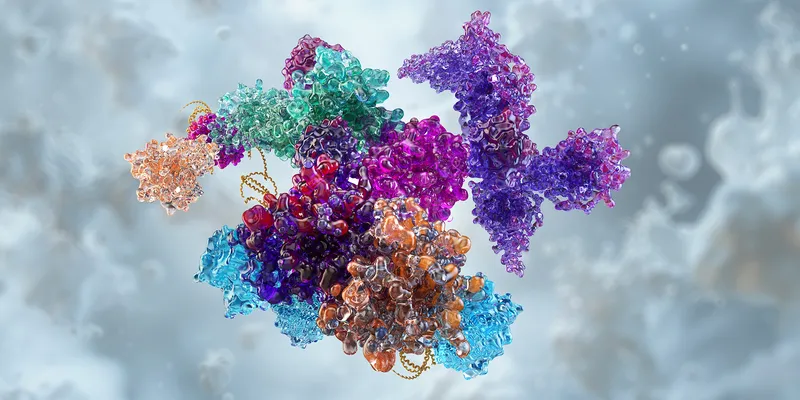
The molecular revolution is entering a new phase.
After two decades dominated by genomics, the field’s attention has shifted toward understanding how genetic blueprints translate into functional, dynamic proteins — and how those proteins interact, fold, misfire, or evolve in the complex environment of living cells. Proteomics is now taking center stage and becoming the connective tissue that links the cell’s instructions to its outcomes.
From inside-cell evolution of peptides to foundation models trained on aging datasets, biotechs are moving toward a multi-omic synthesis where transcriptomic, proteomic, and genomic data flow together to illuminate mechanisms and guide interventions with unprecedented clarity.
Bringing drug discovery inside the cell
Corey Gray, founder and CEO of Bullseye Biosciences, told DDN that the traditional paradigm — beginning drug discovery outside of living systems — misses the essential context where medicines must actually function.
“Traditional drug discovery often begins outside of the cell, with hits generated in biochemical or other high-throughput binding assays,” he explained. “These approaches often yield molecules that falter in complex living systems because they fail to capture the dynamic environment of the target.”
Bullseye’s approach inverts that logic. The company evolves therapeutic starting points directly inside cells, using targeted mutagenesis and ultradiverse libraries to explore billions of molecular variants against intracellular protein–protein interactions (PPIs) within a single campaign. “A living system can evolve enhanced solutions in real time, boosting signal and eliminating the need for iterative panning,” Gray said.

By keeping screening within a living environment, Bullseye captures the physiological context that often determines a molecule’s success or failure. The payoff is speed and precision: macrocyclic peptides discovered in-cell can advance from screening to in vivo oral exposure in under nine months, often with minimal medicinal chemistry optimization. “Better hits equal faster drugs,” Gray summarized.
Functional data as the fuel for machine learning
Evolving drugs inside cells isn’t only about efficiency, the process also generates a new class of functional data.
“Machine learning is only as powerful as the data it’s trained on,” Gray noted. Public peptide datasets are often too small or heterogeneous, lacking meaningful functional annotations such as permeability or activity. To address this, Bullseye generates functionally annotated datasets at scale by coupling evolution, next-generation sequencing, and genetically barcoded libraries. Each experiment produces billions of sequence–function data points, all linked to relevant measures of inhibition or molecular glue activity.
The result is a virtuous cycle where biological insight feeds computational power: Large, biologically meaningful datasets improve models, which in turn refine the next generation of molecular libraries. In this way, proteomics data become both the training ground and the testing ground for machine learning models in peptide drug discovery.
Building causal clarity through multi-omic integration
Where Bullseye starts from the inside of the cell, Integrated Biosciences expands outward — layering multiple omics to map complex biological systems.
Max Wilson, the company’s cofounder and Chief Scientific Officer, described how combining transcriptomics and proteomics sharpens causal inference and clarifies mechanisms of action.
“Integrating transcriptomics with proteomics, and other omics modalities such as chromatin readouts, is one of the powerful routes to accelerate therapeutic discovery,” Wilson said.
In Integrated’s workflow, these layers serve as aligned training targets for multimodal models, improving the ability to link perturbations to outcomes. “Joint embedding of RNAs, proteins, post-translational marks, and other data modalities refines the latent space so that compounds cluster by mechanism rather than by noisy transcript alone,” he explained.
This approach, sometimes called multi-omic fusion, helps researchers move beyond simple correlative signatures. By aligning molecular measurements across modalities, Integrated can identify causal pathways that drive cellular aging and resilience.
“By layering transcriptomic and proteomic readouts across age-stratified cell lines and tissues, we can disentangle aging-specific signatures from general cell-to-cell and human-to-human variation,” Wilson said. Those layered datasets underpin the company’s foundation model for aging, designed to generalize across modalities, perturbations, and biological contexts.
Functional genomics at scale
While proteomics offers mechanistic depth, functional genomics brings unprecedented scale.
Atray Dixit, cofounder and CEO of Oncko, describes large-scale screening as a way to approximate human experimentation — without the logistical and ethical constraints. “In an ideal world, we could run randomized clinical trials for every possible drug and drug combination across every disease,” he said. “In reality, even in areas with the highest R&D investment, such as lung cancer, perhaps only [about] 1,000 drugs have ever been tested in trials. In rare diseases, there may be just a handful — if any at all.”

Functional genomics screens can fill that gap. They quantify the effects of genetic or pharmacologic perturbations across multiple readouts — transcriptomic, proteomic, morphologic, or cell-growth related — at massive scale. “There is growing enthusiasm that these massive datasets could power ChatGPT-style models with real clinical predictive value,” Dixit noted.
Still, he cautioned that data quality, not just quantity, will determine success. His team emphasizes reproducibility and effect size, benchmarking hits against translational goals. “If a hit moves a transcriptional profile only one percent closer to the healthy state, it should be treated with much more skepticism than a hit that shifts it 50 percent,” he explained. The future of functional genomics — and its intersection with proteomics — will depend on setting such translation-oriented standards and ensuring that AI models reflect real biological significance rather than statistical noise.
Proteomics as the quality compass for cell therapies
At Syntax Bio, proteomics plays a different role — one tied to manufacturing quality and regulatory confidence.
CEO John Craighead emphasized that single-cell RNA sequencing (scRNA-seq) has become central to engineered cell therapy development because it allows developers to assess heterogeneity, maturity, and lineage fidelity at unprecedented resolution. “It’s important to confirm in cell therapy discovery that engineered cells match the intended cell type and do not produce unwanted subpopulations,” he explained.
At later stages, scRNA-seq enables batch-to-batch comparison and early detection of deviations from expected transcriptomic signatures — an invaluable safeguard for reproducibility. “In parallel, bulk RNA-seq serves as a scalable [quality control] tool,” Craighead adds. “While it lacks single-cell resolution, it provides rapid, cost-effective assessment of whether targeted genes are robustly activated or repressed by a given engineering program.”
Together, single-cell and bulk RNA-seq form a complementary toolkit, pairing depth of characterization with speed and scalability.
Beyond transcriptomics, Craighead highlights genomic integrity assays as a rising standard for regenerative medicine. Regulators increasingly expect next-generation sequencing, targeted amplicon assays, and chromatin accessibility profiling to be integrated upstream in development rather than as late-stage checks.
“By incorporating genomic stability and integrity assays early in discovery and scale up, developers can mitigate the risk of downstream clinical holds or costly CMC [Chemistry, Manufacturing, and Controls] remediation,” he said. The result is a proteomics-adjacent layer of predictive quality control, ensuring that engineered cell products are reliable by design.
From data layers to living systems
There is a shared philosophy across these efforts in that biology cannot be reduced to a single omic layer. Real understanding and reliable translation comes from integrating the genome’s instructions, the transcriptome’s responses, and the proteome’s execution into a coherent framework.
Together, they signal a field shifting from cataloging biology to controlling it. Not necessarily by simplifying complexity, but by measuring it more intelligently. Proteomics, once viewed as a supporting discipline, is now central to that evolution and helping to bridge the gap between cellular information and actionable intervention.