Most electronic lab notebooks (ELNs) in biopharma R&D share a structural flaw: they capture experimental results without connecting those results to anything else in the organization. A researcher finishes an upstream cell culture run, logs the outcome in the ELN, and manually exports the data for handoff downstream. Six months later, when a process development scientist needs to understand why a purification step underperformed, the institutional knowledge that would answer the question sits scattered across systems that never spoke to each other.
Industry estimates put the number of discrete data silos across biopharma at more than 10 million, spanning aging ELNs, standalone laboratory information management systems (LIMS), and mismatched instrument files. A November 2025 survey of 150 scientists across biopharma R&D, CROs, diagnostics, and pharmaceutical manufacturing found that 45 percent were using public generative AI tools through personal accounts to fill analytical gaps their formal tools could not close. The Pistoia Alliance’s 2025 Lab of the Future survey, published in April 2026, put ELN adoption at 81 percent across life sciences organizations, up from 66 percent the prior year, confirming that the question has shifted from whether labs use ELNs to whether those ELNs connect to anything else.
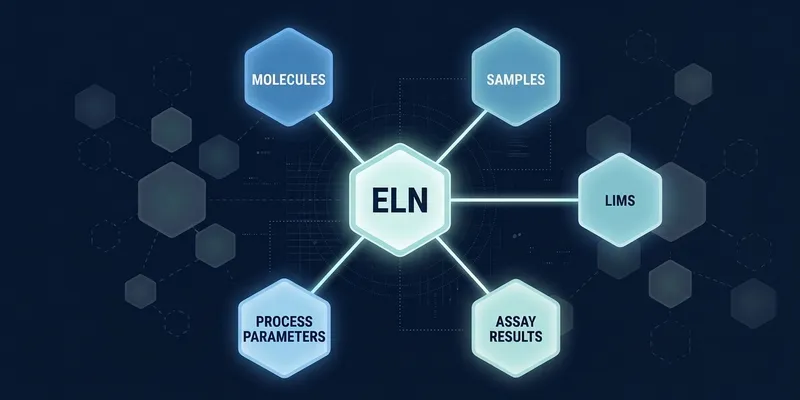
Genedata, a Danaher company and enterprise software provider for biopharmaceutical R&D, launched an ELN embedded natively within its Genedata Biopharma Platform. The company built the ELN directly into its existing data model, connecting experimental documentation to the molecules, samples, process parameters, and assay results already managed across the platform.
ELN data silos hit biologics programs hardest
Biologics programs generate more disconnected records than any other therapeutic modality, making fragmented ELN data a disproportionate burden in that segment of biopharma R&D. A single program spanning antibody screening, cell line development, upstream bioprocessing, purification, and analytical characterization can produce records across five or six separate workflow stages, each managed by a different informatics tool. At organizations that built out their informatics stack incrementally, the result is often multiple ELNs with no shared data model, even across a single site.
The November 2025 industry study found that only 5 percent of scientists could analyze experimental results without specialist support, partly because finding and reusing prior work across disconnected systems is itself a technical task. Fifty-one percent of respondents said they spend excessive time importing and exporting data between tools; among US-based scientists, that figure climbed to 81 percent.
A peer-reviewed ELN integration framework, published in the Journal of Laboratory Automation in 2013, made the case that ELNs deliver the greatest value when structurally linked to LIMS, chromatography data systems, and scientific data management systems. AI tools have since made that case urgent: they require clean, connected data to function, and fragmented ELN records undercut that requirement at the source.
Genedata ELN: architecture over workarounds
Genedata built its ELN into the Genedata Biopharma Platform's underlying data model, not as a bolt-on module linked by APIs, so experiment records share native objects with molecule registrations, sample inventories, and assay results. When a scientist logs a cell culture result, the entry links directly to the relevant sample lineage, upstream process parameters, and downstream assay outputs already in the platform, with no separate export step. Standalone ELNs linked by APIs or middleware require data-mapping at each exchange point, reintroducing the same manual burden the integration was meant to eliminate.
The Genedata ELN spans the full biologics development lifecycle, from molecular design to analytical release, covering these workflow areas:
- Molecular biology and screening: antibody discovery, candidate engineering, and expression development
- Upstream and downstream processing: cell line development, bioprocess development, and purification
- Formulation and analytics: analytical development, formulation, and stability workflows
- External collaboration: laboratory workflow execution across internal labs, CROs, and CDMOs
- Complex modalities: support for ADCs, bispecific antibodies, and cell and gene therapies
- Instrument connectivity: direct links to laboratory instruments, robotics, and IT systems
- Development history: persistent record linking every experiment to the candidate's full lifecycle, from design through characterization
Othmar Pfannes, Ph.D., President of Genedata, attributed the ELN's design to the failure mode of conventional notebooks: "While traditional ELNs operate independently and cause knowledge to be fragmented, we solved that issue by aligning underlying data structures, scientific concepts, and metadata to ensure information can be consistently searched, analyzed, reused, and leveraged by AI applications." He positioned the launch as AI infrastructure rather than a documentation tool: "By natively combining structured data and workflows with experimental context in a single scientific record, the platform delivers a harmonized user experience based on a shared, computationally accessible foundation for AI-driven R&D."
Integration approaches: shared data model vs. connected layers
Most large biopharma organizations run more than one ELN system in parallel, a direct result of adopting tools one modality or department at a time over many years. The central question for R&D informatics teams is whether ELN-to-system integration operates at the data-model level, where records share the same underlying objects, or through a connection layer sitting on top of products with separate data structures. Loosely coupled architectures can still require mapping and transformation at each exchange point, recreating the silo problem in software rather than resolving it.
Four broad integration approaches characterize the current market, each with distinct trade-offs for modality coverage and AI readiness:
| Integration approach | Typical model | Modality focus | AI readiness |
|---|---|---|---|
| Platform-native ELN with shared data model | ELN embedded in existing biologics or bioprocess platform; molecules, samples, and assay records shared natively | Biologics, ADCs, bispecifics, cell and gene therapies | Unified data foundation for AI and machine learning applications |
| Unified cloud platform with co-developed ELN and LIMS | Common architecture across ELN, LIMS, and sample management, built in parallel | Varies by vendor; often broad modality coverage | AI agents or assistants embedded directly in notebook workflow |
| Standalone ELN with API connectors | Separate ELN linked to LIMS and other systems via APIs or middleware; data mapping is manual | Varies by product | Dependent on third-party AI tools and external data pipelines |
| Specialty biologics platform with ELN module | ELN integrated into a biologics discovery workflow tool, with emphasis on molecular biology and screening | Biologics, genomics | AI-assisted design and search tools |
Platform vendors argue that API-connected integrations preserve the original silo problem at the semantic level, because data objects stay defined differently across products even when records transfer successfully. Vendors favoring open best-of-breed architectures counter that specialist tools connected through open standards offer more flexibility for organizations running heterogeneous instrument environments. Neither model dominates; most large biopharma organizations run both, and the practical value of any integration claim rests on how completely it replaces existing workarounds.
Does a shared data model solve the whole problem?
A native shared data model improves retrieval of data already captured within the platform, but it cannot recover knowledge never recorded in structured form. The tacit observations, instrument-specific decisions, and informal reasoning that scientists document inconsistently sit outside any ELN’s reach, regardless of its architecture. Industry surveys consistently show that scientists consider their ELN effective at capturing data but limited at helping them interpret it, a gap that tighter integration narrows without closing.
Whether an embedded ELN meaningfully cuts manual data-transfer time also depends on how thoroughly scientists adopt it as their primary documentation environment, rather than running it alongside incumbent tools. Genedata reports that its customer base includes top-25 biopharma companies; no specific implementations of the new ELN capability have been publicly disclosed, and rollout timelines and pricing have not been announced.
A unified data foundation for biopharma ELN integration: Genedata's approach assessed
Genedata's embedded ELN targets the structural problem that has constrained ELN value in biopharma for over a decade: experiment records stored apart from the molecules, samples, and assays they describe. The launch extends a platform already covering biologics discovery, bioprocess development, chromatography data management, and translational research, widening the surface on which the shared-data-model architecture can be evaluated. How thoroughly it displaces incumbent ELN tools at customer sites, and whether connected records translate into faster scientific decisions, will determine whether native integration delivers its stated promise.
This article is based on a press release issued by Genedata and was produced under Drug Discovery News' AI Editorial Guidelines.