For formulators in food and beverage, cosmetics, specialty chemicals, and advanced materials, regulatory compliance has traditionally functioned as a quality gate applied to a finished recipe rather than built into the process of creating one. That sequencing creates a structural problem. Replacing a restricted colorant or preservative after the recipe is finalized can alter stability, shelf life, texture, and manufacturing profile at a cost far greater than catching the issue during development.
The velocity of regulatory change has made the risk of failing market clearance in late-stage development harder to absorb. Late-stage compliance and labeling failures continue to drive high volumes of costly market withdrawals, enforced by the FDA, annually.
Regulatory change has accelerated across all four industries Uncountable serves. The EU's Omnibus VIII regulation added new carcinogenic, mutagenic, and toxic-to-reproduction substance classifications in May 2026 with no sell-through period. Canada and the US implemented parallel fragrance allergen and ingredient transparency requirements the same year.
Uncountable launched Regulatory Management to embed ingredient compliance screening in its unified product development platform, so formulation teams may see market-specific results as a recipe is built.
Compliance status surfaced at the ingredient row
Regulatory Management surfaces a pass or fail result for every recipe ingredient against each intended target market, inside the same environment where formulators work. Each result carries the jurisdiction, permitted concentration limit, date last checked, and links directly to the official regulatory source. The capability operates within Uncountable's existing platform architecture, which unifies electronic laboratory notebook (ELN), laboratory information management system (LIMS), product lifecycle management (PLM), and quality management workflows in a single structured data model, requiring no export to a separate system.
Uncountable maintains its own regulations database from official sources and updates it independently, removing the burden of manual upkeep from customer teams. Scheduled refreshes preserve any edits a regulatory team has made to reflect their organization's interpretation of a provision. This matters because regulatory guidance documents frequently leave room for judgment on borderline ingredients or novel compound classifications.
Noel Hollingsworth, CEO and Co-Founder of Uncountable, described the shift the capability represents. "For decades the rulebook moved slowly enough that you could check compliance of the finished product and be fine. That assumption has stopped holding," Hollingsworth said. "We think compliance belongs alongside formulation rather than in a review that happens afterward, and the software that people work with every day should reflect that."
Can the same ingredient pass one market and fail another?
Yes, because fragmented international safety standards create a landscape where a single compound's regional restrictions, product category, or application type can derail a global product launch. A preservative permitted at one concentration in a rinse-off cosmetic may face a stricter limit in a leave-on product, while a food additive approved in one category may be banned in another within the same market. In a food and beverage recipe shown in Uncountable's product materials, Sodium Benzoate at 0.02% receives a US market fail and a Canada pass, with the flag triggered and the citation attached the moment the ingredient row is entered.
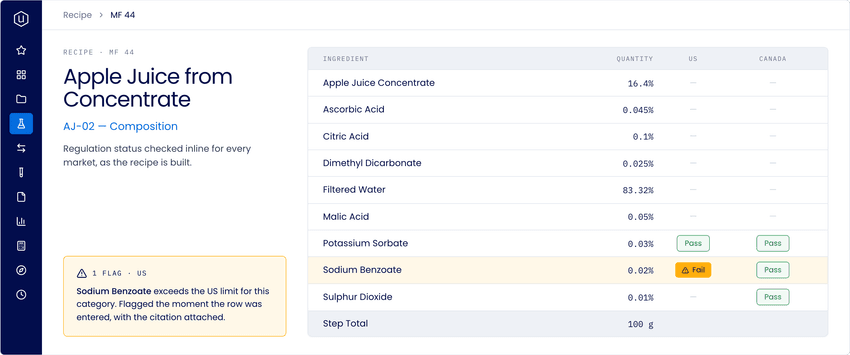
Sodium Benzoate fails US, passes Canada — flagged and cited automatically at 0.02%.
Uncountable
Regulatory Management matches permitted levels to the formulation's specific product category, not to the ingredient alone, which avoids the false-positive clearances a simple banned-substance list produces. Failing determinations can block a recipe from being locked or published, preventing a non-compliant formulation from reaching pilot or production without a resolved compliance status. Regulatory team members can override or edit any determination through an admin layer, and those edits persist through scheduled database refreshes.
Brenda Jaroker, Product Manager at Uncountable, described the audit trail built into each result. "The database was never the hard part. Making the answer defensible was," Jaroker said. "Every ingredient row carries its citation and a link to the register it came from, so a regulatory manager can check our work instead of taking it on faith."
To transform compliance into an active guardrail, Uncountable’s Regulatory Management relies on five integrated mechanisms:
- Per-ingredient market screening: Pass or fail results matched to the formulation's product category, not the ingredient in isolation
- Full regulatory citation: Governing regulation, jurisdiction, permitted level, official source link, and last-checked date for every determination
- Override controls: Admin-level edit functionality that persists through scheduled regulatory database refreshes
- Publication gates: Configurable blocks that prevent a non-compliant recipe from being locked or published without a resolved determination
- Cross-industry coverage: Food and beverage, cosmetics, specialty chemicals, and advanced materials
Embedded compliance outperforms post-formulation review
Formulation teams currently choose between two structural approaches to ingredient compliance: embedding it in the development workflow, or handling it in a separate system once a recipe is complete. The first approach catches problems while reformulation is still inexpensive; the second surfaces them after stability, sensory, and manufacturing work may already be underway.
Available tools reflect this divide. Four broad categories define the current market:
| Approach | Typical integration model | Regulatory coverage | Industries served |
|---|---|---|---|
| Unified R&D platform with embedded compliance | Compliance integrated into ELN, LIMS, PLM, QMS | Multi-market; configurable by product category | Cross-industry formulation teams |
| Dedicated formulation PLM with compliance module | Compliance built into a standalone PLM environment | Varies by vendor; often category-specific | Food and beverage, cosmetics, specialty chemicals |
| Category-specific ingredient screening tools | Standalone database or SaaS; requires data import/export | Broad policy libraries within one product category | Cosmetics and personal care; food and beverage |
| Laboratory-developed compliance tracking | Spreadsheets or internal database maintained by regulatory team | Depends on team expertise and subscriptions | All categories |
Uncountable's approach integrates regulatory screening into the same structured data model that connects its ELN, LIMS, quality management system (QMS), and PLM functions. Compliance status appears alongside experimental data without a separate export step. For any formulation team, the practical question is whether managing an additional compliance tool costs less than the risk of catching a non-compliant ingredient late.
Shifting guidances: the regulatory pressure on formulation teams
Multiple regulatory deadlines and shifting guidances landed simultaneously across the drug development and formulation industries in 2026, raising the cost of manual compliance tracking. Three areas generated the most significant pressure on formulators from the European Medicines Agency (EMA), FDA, and regional regulators:
- TiO2 food additive ban: Commission Regulation (EU) 2022/63 banned titanium dioxide (TiO2) as food additive E171 across all EU-marketed food products, requiring reformulation of thousands of affected SKUs
- TiO2 pharmaceutical excipient review: The EMA's TiO2 excipient review, concluded in August 2025, determined that alternatives are technically inferior and that continued use in solid oral dosage forms is necessary to protect medicine supply
- NDSRI acceptable intake limits: The FDA's NDSRI acceptable intake guidance, finalized in August 2023 with an August 2025 compliance deadline, set dynamic acceptable intake (AI) limits for nitrosamine drug substance-related impurities (NDSRIs), requiring formulators to continuously re-evaluate how active pharmaceutical ingredients (APIs) interact with specific inactive ingredients as limits are updated
Drug developers are also navigating growing regulatory pressure on per- and polyfluoroalkyl substances (PFAS), which directly affects the selection of fluorinated excipients and primary packaging materials across multiple global markets. Each new guidance adds a substance, a recalculated limit, or a jurisdiction-specific threshold that a manual tracking system must absorb. As regulatory scope expands and update cycles shorten, the operational cost of post-formulation review compounds.
Building in formulation regulatory compliance into the tool
Regulatory Management repositions compliance from a project-end checkpoint to a continuous, citation-backed signal shared by formulation and regulatory teams throughout development. The broader shift in formulation informatics toward unified platforms reflects the rising cost of managing experimental, quality, and regulatory data in disconnected systems. As global ingredient regulations grow more numerous and market-specific, the gap between when a formulation decision is made and when its regulatory consequences become visible is the clearest target for platform-level integration.
This article is based on a press release issued by Uncountable and was produced under Drug Discovery News' AI Editorial Guidelines.