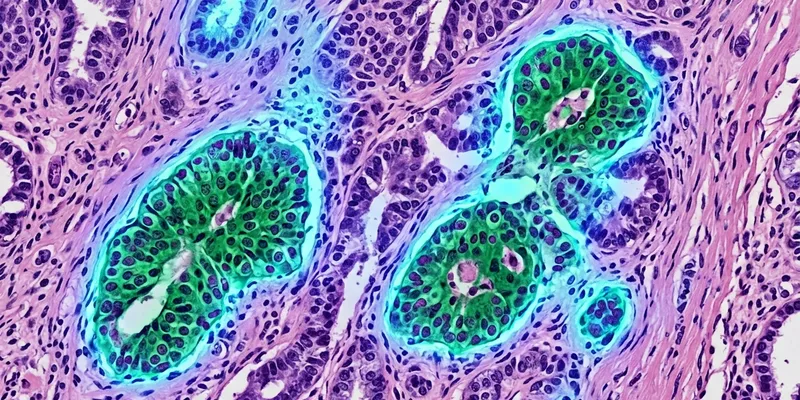
In oncology drug development, producing an AI model that predicts a patient's molecular profile from a digitized tissue image is now achievable. Converting that model into a regulated, globally deployable companion diagnostic (CDx) is not. Analytical validation, clinical trial deployment, and premarket authorization review form the required evidence package, and few AI pathology companies hold all three capabilities on their own.
CellCarta, a contract research organization (CRO) serving the biopharmaceutical industry, and Imagene AI, a precision oncology company, announced an expanded collaboration to close this gap. Active programs with two global pharmaceutical companies are already underway: an AI-powered immunohistochemistry (IHC) CDx development program and a separate program applying Imagene AI's Lung Prediction Panel to non-small cell lung cancer (NSCLC).
What Imagene AI's platform delivers
Imagene AI's Oncology Intelligence (OI) CDx capabilities apply deep learning to digitized biopsy images to quantify biomarker and target expression across IHC assays. The platform covers cell and subcellular analysis, continuous and spatial scoring, and patient stratification. AI-derived quantitation captures spatial or intensity features difficult to reproduce through manual pathologist scoring, a property critical for CDx programs where cross-site reproducibility is a submission requirement.
The Lung Prediction Panel targets NSCLC genomic alterations using H&E-stained tissue. Per Imagene AI, the panel predicts key NSCLC genomic alteration biomarkers directly from routine hematoxylin and eosin (H&E)-stained whole-slide images within minutes, without separate molecular profiling. It runs on CanvOI, Imagene AI's 1.1-billion-parameter foundation model pre-trained on more than 630,000 tissue images across over 100 sites and 40 major organ and tissue types.
The Lung Prediction Panel carries research use only (RUO) designation and is not for use in diagnostic procedures. Within clinical trials, it serves as a sample prioritization tool, with confirmatory molecular testing required before any treatment decision.
H&E morphology as molecular signal
Published computational pathology research supports the use of H&E whole-slide images for molecular prediction in NSCLC. Deep learning models have detected morphological correlates of genomic alterations, including glandular architecture, nuclear pleomorphism, and stromal characteristics, that carry meaningful predictive signal across multi-institutional cohorts spanning multiple scanners and tissue preparation protocols. These findings do not supersede sequencing-based confirmation for clinical decisions, but they establish that H&E morphology encodes substantial molecular information AI systems can extract at scale.
Algorithm performance alone cannot clear the CDx regulatory bar
A high-performing AI model is a necessary but insufficient condition for CDx approval. Any CDx directing patient selection for a specific therapy must complete fit-for-purpose analytical validation: measurable performance at clinically relevant thresholds, with reproducibility documented across sites, operators, scanner types, and staining platforms. For AI-based CDx devices, the FDA's Digital Health Center of Excellence has issued draft guidance on AI device validation covering how algorithm outputs map to predefined endpoints and how sponsors substantiate performance claims across clinical use conditions.
In April 2025, the FDA granted its first-ever Breakthrough Device Designation to a computational pathology companion diagnostic, an AI-quantified IHC scoring device for NSCLC, marking a turning point for the field. The designation confirmed that AI-derived biomarker scoring can meet the FDA's threshold for clinical significance, while underscoring that an integrated development infrastructure is essential to reach it.
Why CDx programs need more than an algorithm to scale
Scaling an AI CDx from a validated assay to an approved, commercially available test requires laboratory accreditation, multicenter deployment capacity, and regulatory submission expertise that sit entirely outside algorithm development. CellCarta provides this infrastructure across the full CDx lifecycle:
- CAP/CLIA accreditation: Dual College of American Pathologists (CAP) and Clinical Laboratory Improvement Amendments (CLIA) accreditation at facilities in Belgium, the US, and Canada; CAP accreditation at the China site
- Analytical validation: Fit-for-purpose validation services for AI-powered pathology assays across multiple scanner types and staining platforms
- CDx Bridge Model: A single-site premarket approval (PMA) strategy built to scale across a global laboratory commercialization network
- Regulatory submissions: FDA premarket authorization support and equivalent filings for international markets
- Global deployment: Harmonized laboratory operations across eight facilities in North America, Europe, Australia, and China
- CDx Commercialization Lab Network: Commercial laboratory partnerships with Sonic Healthcare USA and Tempus AI provide a deployment route from regulatory clearance to physician access and routine clinical ordering
What does it take to bridge AI biomarker tools and CDx approval?
Scaling an AI CDx requires capabilities that algorithm developers rarely hold in-house, which has driven two distinct partnership models to emerge across the industry:
- Pharma-device manufacturer pairing: A pharmaceutical company's proprietary AI algorithm integrates with a diagnostic device manufacturer's staining and scanning hardware, with the CDx developed as part of the drug-therapy program.
- AI pathology company-CRO pairing: An AI pathology company partners with a CRO holding analytical validation capacity, a multicenter laboratory network, and regulatory documentation systems to advance an AI assay from research use to submission readiness within a single engagement. The CellCarta and Imagene AI collaboration follows this model.
Within the CRO pairing model, the table below shows where each active program currently stands across the four CDx development stages:
| Development stage | AI-IHC CDx program | Lung Prediction Panel (RUO) | CellCarta CDx infrastructure |
|---|---|---|---|
| Fit-for-purpose analytical validation | In progress | Research evaluation completed | Available |
| Multicenter clinical trial deployment | In progress | Sample prioritization; confirmatory testing required | Available |
| Regulatory submission readiness | In progress | Not applicable (RUO) | Available |
| Commercialization pathway | Planned | Not applicable (RUO) | Available via CDx Lab Network |
Michael Hreczuck, SVP of Business Development at Imagene AI, said the model is already operating across live pharma programs in both modalities. "Pharma companies need a practical path for translating AI-powered biomarker and image-analysis capabilities into assays that can support clinical development and companion diagnostic programs," Hreczuck said. "We are already applying this model across active pharma programs in both AI-powered IHC and H&E-based biomarker prediction."
Christopher Ung, Chief Scientific Business Officer at CellCarta, described what the collaboration provides in practice. "Bringing AI-powered approaches into global drug development requires more than a strong algorithm — it requires the ability to validate, deploy and scale within the rigor of clinical development," Ung said. "Our collaboration with Imagene AI combines their AI pathology capabilities with CellCarta's global laboratory infrastructure, CDx development experience, and regulatory expertise to validate fit-for-purpose assays, deploy them in global clinical trials, and scale programs toward regulatory readiness and commercialization."
AI CDx development: pathology, validation, and regulatory readiness
The CellCarta and Imagene AI collaboration gives biopharma sponsors a single-engagement path through the stages that separate an AI biomarker tool from an approved companion diagnostic: assay validation, multicenter clinical deployment, and regulatory submission. Both active programs (the AI-IHC CDx and the H&E-based NSCLC Lung Prediction Panel) are running with global pharmaceutical partners, with indication details and timelines to be disclosed in the coming months. CellCarta's accredited global laboratory network, CDx Bridge Model, and CDx Commercialization Lab Network position the collaboration to advance AI-powered CDx programs from research use to physician access.
This article is based on a press release issued by CellCarta and was produced under Drug Discovery News' AI Editorial Guidelines.