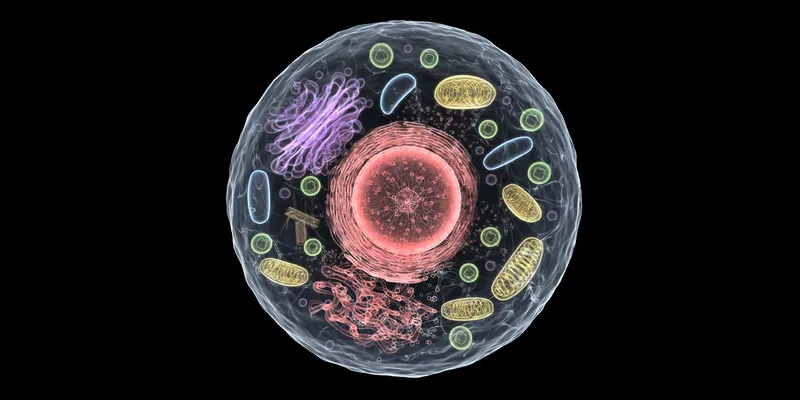
The idea of a virtual cell is not new. In the 1990s, genome scientist J. Craig Venter was already pursuing the idea of simulating an entire cell on a computer. His broader work — from helping pioneer rapid genome sequencing to creating organisms with synthetic genomes — helped lay the groundwork for thinking about biology as something that could be represented computationally.
It took another decade for researchers to publish a whole-cell computational model, built around the bacterium Mycoplasma genitalium. The model incorporated every annotated gene and used different mathematical approaches to represent the cell's various processes. It could approximate cell growth and division, reproduce metabolic measurements, and correlate with experimental gene-expression data.
The work demonstrated that a cell could, in principle, be represented as a computational system detailed enough to generate biological predictions. However, doing the same thing for a human cell is another problem entirely.
M. genitalium has just 525 genes. Human cells have tens of thousands of genes, along with vastly more layers of regulation and interactions between molecules. Scaling a mechanistic whole-cell model to capture that complexity is a far greater challenge.
The goal of the virtual cell, at least the way we see it, is to reduce the number of experiments you’re doing.
—Ziv Bar-Joseph, GenBio AI
Now, GenBio AI is taking on that problem with AI-powered virtual cells designed to simulate how human cells respond to interventions, from genetic changes to small molecules and antibodies. The goal is to turn the virtual cell into a new kind of drug discovery laboratory, where researchers can perturb biology in silico to identify promising targets, predict drug responses, and prioritize the experiments most likely to yield useful results.

“The goal of the virtual cell, at least the way we see it, is to reduce the number of experiments you’re doing,” Ziv Bar-Joseph, cofounder and Chief Scientific Officer at GenBio AI, told DDN.
Building a cell inside a computer
The difficulty is not simply the sheer number of genes in a human cell. It is the number of interactions between the molecules encoded by those genes and the fact that those interactions are constantly changing.
AI models have already become powerful tools for studying individual components of cellular biology. Researchers can use machine learning to predict protein structures, gene expression, and other molecular features. But these models typically focus on a single modality or prediction task, treating different aspects of the cell as separate problems.
GenBio's approach is to model the cell as one interconnected system. Its AIDO Cell platform is built around a type of AI known as a world model, which maintains an internal representation of the cell that can be altered by user-defined interventions. Rather than making one prediction and starting again, the model can simulate how a cell changes after a perturbation and then use that new state as the starting point for the next experiment.
A researcher could, for example, introduce a drug candidate into a virtual cell, observe the predicted consequences across different layers of biology, and then perturb that same cell again to explore what happens next. The aim is to move beyond asking whether a particular molecule affects a particular target toward modelling the chain of biological events that follows an intervention.
“If you knock out a gene and then you treat that knockout cell with a small molecule, you're not treating the original cell,” said Bar-Joseph. “You're treating a cell that has already changed.”
The system is designed to generate multiple experimental readouts from the same underlying cellular state. Researchers could examine changes in gene expression alongside chromatin accessibility, protein abundance, localization, or cell morphology, rather than relying on separate models for each measurement. Because these observations come from the same simulated cell, changes at one level of biology can be connected to effects at another.
That could allow researchers to move between scales of drug action — from a molecular interaction to changes in regulatory pathways and finally to a cellular phenotype. It also opens the possibility of running more complex virtual experiments, such as applying several perturbations sequentially or branching a cell into different experimental conditions and comparing the resulting trajectories.
From known biology to new predictions
GenBio's first release, AIDO Cell 1.0, models two human cell lines, K-562 and Hep-G2. The company selected them partly because they are extremely well-characterized, with extensive multi-omics data and decades of research available to validate the simulations.
But the human body contains hundreds, if not thousands, of different cell types, each with its own biological context. Building a new virtual cell for each one from scratch would require vast amounts of data.
GenBio's answer is to make the virtual cell adaptable. Its AIDO Foundry system takes new experimental data and integrates and fine-tunes models for specific cell types, creating a new instance of the virtual cell rather than requiring the entire system to be rebuilt from scratch.
The company is also testing whether what the system learns from one cellular context can transfer to another. In one experiment, GenBio excluded Hep-G2 from the training data and evaluated the system using drugs that had only been tested in other cell lines. Performance on some tasks improved as more cell lines were included in training, suggesting that the model could use information from one biological context to improve its predictions in another.
If that effect holds as the system expands, well-characterized cells could provide the biological knowledge needed to help the model make better predictions for cells where much less data is available. That could be particularly valuable for biological questions where experimental data are sparse or difficult to generate. A virtual cell cannot replace missing biological knowledge, but it could potentially allow researchers to make better use of the data that does exist.
However, GenBio can only learn from the biological information available to it, and expanding into new cell types will require additional datasets. “The real bottleneck is data,” Bar-Joseph said.
The company is therefore looking beyond public data. Partnerships with pharmaceutical and biotechnology companies could give GenBio access to proprietary datasets from less extensively studied cell types and allow it to build virtual cells around the biological contexts that matter most to individual drug programs. But there is a trade-off. A virtual cell built using a company's proprietary data could be highly valuable to that company, but the resulting model may not be something GenBio can make publicly available.
From cells to whole organisms
While early whole-cell models showed that it was possible to simulate some basic processes within a simple organism in silico, AI could allow researchers to model increasingly complex biological systems without having to explicitly define every process within them.
For GenBio, this extends far beyond the virtual cell. The company ultimately wants to simulate biology at increasingly higher levels of organization: first cells, then tissues and organs, and eventually an entire organism.
“The bigger vision is AIDO, the AI digital organism,” said Bar-Joseph. However, that vision is still several steps away. GenBio is currently focused on expanding and improving its virtual-cell models, while Bar-Joseph estimates that reaching the organism level will take at least two or three years.
But the ambition reflects how far the idea of a virtual cell has come. What began decades ago as an attempt to model the genetics of a cell on a computer could eventually become a way to explore how biological systems respond across multiple scales — from a molecular intervention inside a cell to its effects on an entire organism.
For drug discovery, that could change the role of computational analysis from a retrospective effort focused on understanding experimental results to a prospective, generative tool. Using a virtual cell world model, researchers can shift from predicting individual biological measurements to exploring how a potential therapy behaves within the much more complex system that it is designed to treat.