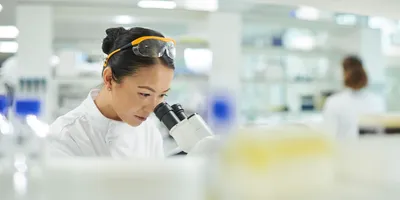


Benedict Cross is a geneticist & biotechnologist and has pioneered the use of computationally engineered mini-proteins to enable new medicine development, including degrader-based drugs.
Credit: Benedict Cross, PhoreMost
Molecular glue degraders (MGDs) are an emerging class of small molecules that redirect the cell’s own protein degradation machinery to eliminate disease-causing targets.
By reshaping the surface of an E3 ligase receptor, MGDs promote novel protein-protein interactions, making them suitable for targeting previously “undruggable” sites. Though similar to proteolysis targeting chimeras (PROTACs), MGDs are smaller and simpler, enhancing their pharmacokinetic properties and making them more amenable to clinical development.
Despite their therapeutic promise and growing clinical interest, discovering molecular glues has been largely a game of chance. Previous examples, including thalidomide and rapamycin, were identified serendipitously, and attempts to rationalize or systematize glue discovery have remained elusive. One major hurdle is that molecular glues often exhibit minimal binary affinity for either of their binding partners, making conventional ligand-based screening approaches ineffective.
A new preprint from PhoreMost introduces GlueSEEKER, a screening platform that rewires effector proteins like E3 ligases to uncover new neomorphic interactions. By performing deep mutational scanning of the E3 ligase CRBN, the authors generated a synthetic protein landscape capable of degrading new targets, including the translational regulator GSPT1. These engineered interactions served as blueprints for structure-based modeling and virtual screening, enabling the rational discovery of novel MGDs.
To explore the implications of this work, Drug Discovery News spoke with Benedict Cross, Chief Technology Officer at PhoreMost and inventor of the GlueSEEKER platform.
Why are molecular glues an important therapeutic modality, and what advantages do they offer over traditional small molecule inhibitors or PROTACs?
Targeted protein degradation (TPD) is expanding the druggable space, opening new possibilities for therapeutic intervention by hijacking the cell’s natural machinery to degrade disease-associated or unwanted proteins, rather than simply inhibiting them. The major modalities within TPD are bivalent degraders (PROTACs) and Molecular Glue Degraders (MGDs).
Both PROTACs and MGDs offer potential improvement over traditional small molecule inhibitors, but glues in particular hold vast promise. Their unique mechanism of action sidesteps many of the traditional rules around druggability, allowing researchers to target proteins that were previously considered out of reach. Rather than requiring high affinity binding to block activity, glues work by recruiting the cell’s natural protein destruction machinery to eliminate disease targets. Unlike PROTACs, they do this without compromising on ideal pharmacology properties, making them more likely to yield success in clinical development.
Why has rationalizing their discovery been so challenging?
Despite the interest and huge promise, the discovery of novel MGDs remains a significant challenge. The search space is vast and requires a detailed mechanistic understanding of the E3 ligase, the target of interest, and the potential complexes or interfaces they might form. MGD discovery can be likened to a biological three-body problem or a needle-in-a-haystack, arguably even more complex than traditional drug discovery, due to the many unknown and interdependent variables.
MGD discovery can be likened to a biological three-body problem or a needle-in-a-haystack, arguably even more complex than traditional drug discovery, due to the many unknown and interdependent variables.
- Benedict Cross
While computational approaches may eventually aid in navigating this complexity, the necessary data to support them is currently lacking, both from a biological and a chemical perspective. Ongoing funding constraints also represent a significant challenge, further compounding the difficulties faced by researchers.
This knowledge gap has opened clear opportunities in the market for innovative drug discovery platforms that enable the rational, systematic, and efficient discovery of novel molecular glues, helping to de-risk pipeline progression and improve overall R&D efforts.
Can you describe how the GlueSEEKER platform works and how it enables the systematic discovery of molecular glue degraders?
GlueSEEKER exploits the fundamental premise of molecular glues, which is that they alter the binding surface or shape of a protein when they bind to the target. These geometric and pharmacochemical changes cause a “gluing” event, sticking the two proteins together and triggering a desired mechanistic outcome such as degradation.
GlueSEEKER uses vast libraries of engineered effector proteins (e.g. E3 ligases) to create new binding events and degradation of therapeutically relevant protein targets. This provides a direct blueprint to build new small molecule degraders and the data to enable next-generation computational drug design.
How does the GlueSEEKER approach account for off-target degradation events?
GlueSEEKER minimizes off-target effects through parallel counter screening and multiple measurements during the screening and validation stages. This ensures that the end result aligns with the desired therapeutic outcome.
By incorporating phenotypic screening, the approach gains a uniquely broad and flexible discovery window. Similar to reverse chemical genetic screening, where hits are defined by their effect rather than their starting mechanism, phenotypic screening allows GlueSEEKER to go beyond predefined targets. This means that any degradation event leading to a desirable outcome is of interest, even if it's not initially associated with a specific target.
In the paper, you describe testing 1500 compounds after computationally modeling the CRBN:GSPT1 interface. How long did this screening process take, and how many compounds emerged as viable molecular glues?
The in silico modelling, virtual screening of 5 million molecules, and profiling of 1500 compounds took approximately three months in total. From this, we identified 11 molecules with cellular degradation activity, with the lead molecule, PMC-066, having the most potent effect.
How generalizable is the GlueSEEKER platform beyond CRBN and GSPT1? Do you envision applying this approach to other E3 ligases or therapeutic targets?
The platform has already demonstrated its applicability to other ligases and proteins of interest, and we are now beginning to understand which ligases are most active and amenable. Molecular glues offer so much potential and we are keen to be part of realizing their benefits for therapeutic areas outside of oncology, as illustrated in our recently published manuscript.
How close are we to making molecular glue discovery as programmable and routine as traditional high-throughput screening for small molecule inhibitors?
With the development of GlueSEEKER, we are now a step closer. The outputs from the platform are processed in a similar way to most drug discovery campaigns and have shown a remarkably high success rate.
As noted earlier, the synergy between GlueSEEKER and AI-based drug discovery is very striking. One reason AI approaches have struggled in some areas is the lack of novelty in the target space. MGDs present ideal challenges for computational approaches to tackle — we just need the right starting point, which is what GlueSEEKER can provide.
This interview has been condensed and edited for clarity.