Over the last several decades, a new mystery has emerged surrounding the rates of colorectal cancer (CRC). In people over 65, rates have been dropping, but they are steadily rising in younger adults — with the fastest rise happening in those under 55. In 2019, adults 54 and younger made up 20 percent of new CRC cases, compared to 11 percent in 1995 .
“It's still a largely unanswered question. The leading hypothesis is that it's on the heels of the obesity epidemic,” said Aasma Shaukat, a gastroenterologist and researcher at New York University Langone. “The generation that's now experiencing high colon cancer rates, they were part of the obesity epidemic as children, adolescents — so that prolonged trajectory with obesity, metabolic syndrome, diabetes, actually accelerates the pathway to colon cancer.”
The increased incidence makes screening for CRC even more important, but current methods have low rates of compliance. The gold standard test to detect CRC remains the invasive colonoscopy procedure. Other methods use stool collected at home, including the fecal immunochemical test (FIT) and Cologuard, which was FDA approved in 2014. Yet nearly 40 percent of eligible adults aged 45 to 75 have not been screened with either option.

Shaukat said that many of her patients are not satisfied with the current screening options. They frequently tell her they don’t want to deal with a stool test or sign up for a colonoscopy, and many will not show up or cancel their appointments.

Aasma Shaukat treats patients at NYU Langone Health as a gastroenterologist and leads clinical trials assessing the capabilities of blood tests to detect colorectal cancer.
Credit: NYU Langone Health
“Some patients have asked, don't you have something simpler, like a blood test?” she said.
It turns out that blood tests to detect cancer — a form of liquid biopsies — are finally a reality for CRC and have the potential to make the detection earlier and easier for patients. In July of last year, the FDA approved Guardant Health’s Shield test as the first blood test to screen for CRC in adults 45 and older. Other companies are not far behind in creating their own version, including Freenome, who submitted their CRC blood test data to the FDA for approval on August 6th.
However, the earliest versions of these tests still can’t match the accuracy of colonoscopies, and will need improvements. Still, they represent a much-needed new option in the CRC space.
“Obviously, any screening is better than no screening,” said Shaukat.
Following the DNA
Guardant Health’s Shield test works by scanning a patient’s blood to check for DNA fragments shed by a CRC tumor, called circulating tumor DNA (ctDNA). The FDA’s approval was based on results of the ECLIPSE study, which enrolled over 20,000 patients across the world. In results published in The New England Journal of Medicine from over 10,000 patients, the Shield test successfully detected CRC in 83.1 percent of patients who had confirmed CRC through a colonoscopy, and resulted in a negative blood test for 89.9 percent of patients who did not have CRC. However, the use of the Shield test to detect precancerous lesions before the onset of CRC was limited, with positive blood tests only occurring in 13.2 percent of patients who had advanced precancerous lesions successfully picked up by a colonoscopy.
Thus, the Shield test appears to offer a viable screening method to identify patients who already have a cancerous tumor in the colon but do not want to undergo a colonoscopy. But the test needs to become much more sensitive to early-stage lesions before it could be used as an early screening method to identify patients at risk of developing the cancer.

At Guardant Health, Craig Eagle and his team are working towards deploying their FDA-approved Shield test for colorectal cancer in hospitals all over the world.
Credit: Guardant Health
Since its approval, the Shield test has been added to the National Cancer Network’s screening guidelines for CRC, and it’s currently covered by Medicare. “We're now working, obviously, with other groups, including the private payers, and many of these will follow the guidelines as well,” said Craig Eagle, Chief Medical Officer at Guardant Health. “We're going through all those steps right now to create that greater access for people.”

In September, Guardant Health announced a partnership with the pathology services company, PathGroup, that will bring the Shield test to more than 250 hospitals across 25 states.
Other options could soon follow. Freenome entered into a license agreement with Exact Sciences to commercialize their CRC blood test in a deal worth up to $885 million, with the expectation that their FDA approval and commercial launch will happen in 2026. Aaron Elliott, CEO of Freenome, said that their blood test also picks up ctDNA from colorectal tumors, but they focus on looking at DNA at the level of base pairs rather than fragment level.
“That gives us some nice advantages when it comes to early-stage detection, being more sensitive for those stage 1 cancers. It also [provides the ability] to detect very, very small lesion sizes compared to some of the other assays that are out there that aren't at that base pair resolution,” said Elliott. In support of this claim, Elliott pointed to data from Freenome’s PREEMPT CRC clinical trial with over 27,000 patients that showed that their blood test detected early high-grade dysplasia and carcinoma in situ (often considered “stage 0 cancer”) at a rate of 30 percent.
However, when those two categories are not analyzed separately and included with other adenomas, the results were similar to Guardant Health’s data on precancerous lesions, with a rate of 12.5 percent. Freenome’s blood test detection of CRC confirmed with a colonoscopy was also similar to Guardant Health’s test, with a CRC detection rate of 79.2 percent for positive colonoscopies and 91.5 percent accuracy in giving a negative result when a colonoscopy showed no CRC.
Room to improve
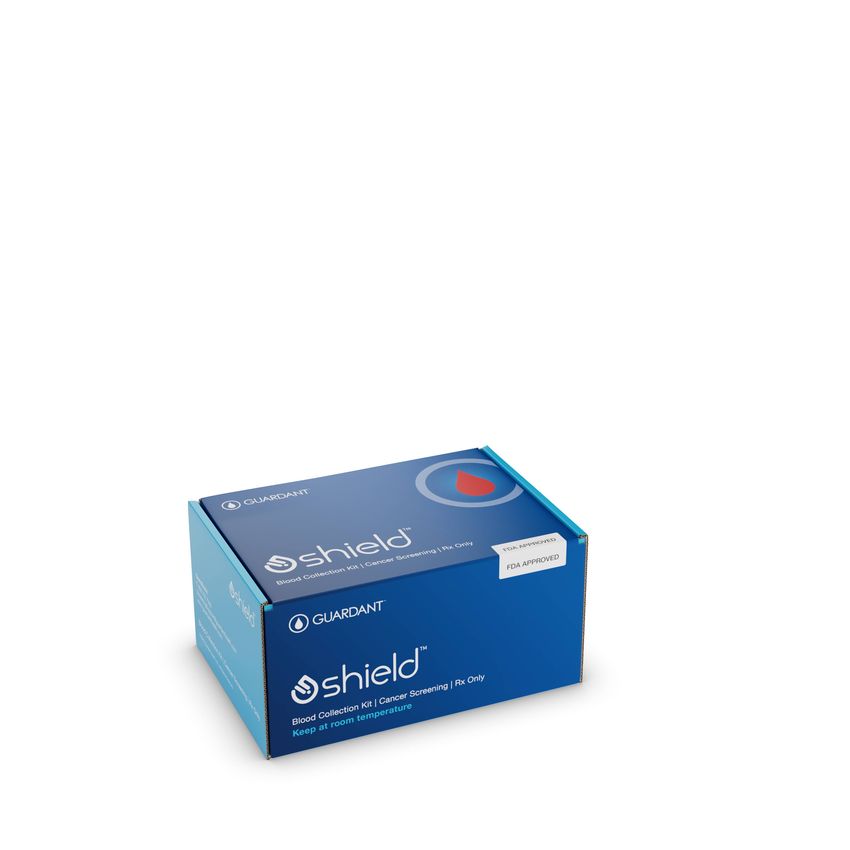
Guardant Health’s Shield test was approved by the FDA in July 2024.
Credit: Guardant Health
Shaukat was a lead investigator on Freenome’s PREEMPT CRC trial, which was published in the Journal of the American Medical Association in June. She emphasized that it was smooth sailing to incorporate the blood tests into clinical practice, with most patients arranging to do the blood draw at their institution’s clinic or with a mobile phlebotomist. Moving forward, she said that patients would ideally be able to visit a Labcorp or Quest lab at their convenience.
However, Shaukat said that she and others hoped for better results from both the Freenome and Guardant Health data. “We were hoping that the detection rate of these advanced adenomas, or these advanced precancerous lesions, would be higher than that of stool tests,” she said, adding that the current detection rate of advanced adenomas from stool tests is around 45 percent.
“That message has been sent to all test developers loud and clear that we would like to see higher sensitivity in future iterations,” said Shaukat.
This is what makes it exciting: one tube, one cancer today. One tube, multiple cancers tomorrow.
– Craig Eagle, Guardant Health
Both Eagle and Elliott said that their companies are committed to continuing to improve the tests. “These are the first versions coming out … they're only going to get better over time,” said Elliott.
Yet, with the current numbers, Shaukat said that she and other providers aren’t sure exactly where these blood tests fit in, though they think it may work best to offer them to individuals who have not signed up for either a colonoscopy or stool test. For other patients, “we actually don't know if we should offer them ahead of a colonoscopy or stool test,” she said. The concern is that for early precancerous lesions that aren’t detected as frequently on blood tests compared to colonoscopies or a stool test, they may be missed more often in patients that only do blood tests as their CRC screen.
“All screening programs require multiple screening efforts, because no screening program is 100 percent,” said Eagle. He explained that if the result from the blood test is positive, patients would need to have a colonoscopy done at that point. But if it’s negative, patients could wait until their next blood test screen is due. “We're currently working on a three-year screening interval, but these are areas that we're still trying to understand.”
A single blood test for many cancers
In the future, the use of blood tests to screen for CRC will likely be part of a more expansive screening panel. Both Guardant Health and Freenome are developing multi-cancer tests that could detect markers of many different types of cancers. Guardant Health’s Shield test was selected to be included in a National Cancer Institute study to assess detection of 10 types of cancer, along with ClearNote Health’s Avantect MCD Test, which measures the epigenomic biomarker 5-hydroxymethylcytosine (5hmC) to target the deadliest cancers like pancreatic cancer.
“This is a technology based on DNA being released from cells. So, colon cancer is our first step, and obviously this now opens up the same concept to other cancers,” said Eagle. The FDA recently granted Guardant Health’s multi-cancer device test a Breakthrough Device designation to move the technology forward.
“This is what makes it exciting: one tube, one cancer today. One tube, multiple cancers tomorrow,” said Eagle.

As CEO of Freenome, Aaron Elliott and his group are looking to get their colorectal cancer blood test approved by the FDA and launched commercially next year.
Credit: Freenome
Elliott agreed, adding, “In diagnostics, this is the holy grail of testing. This ability to screen patients for a wide variety of cancer types all at once, and the impact that that can have — I mean, it's really hard to find that.” The liquid biopsy market reflects this excitement, with projections that it will grow to up to $22.88 billion by 2030.
For now, the widespread adoption of these blood tests to detect CRC alone appears to be the closest to reality, even if the tests aren’t ideal for the earlier stages just yet. “Having a test to actually screen with is more important than trying to have the perfect test,” said Eagle, adding that currently there have been decades of screening with colonoscopies and stool tests but CRC is still the second leading cause of death from cancer. “Most of those cancers are actually in people who aren't up to date with screening,” he said.
Eagle also pointed to real-world data supporting blood-based tests as a much more compliant screening method. Guardant Health’s team analyzed their first 20,000 orders and found that over 90 percent of people completed the screening.
There may also be other less invasive ways to detect CRC earlier coming to the market, without the need for any blood. Shaukat pointed to colon capsules that house a tiny, pill-sized camera that takes pictures as it moves through the colon. These are now being tested in clinical trials as a potential screening method or even potential replacement for a colonoscopy, though with current versions the capsule often gets stuck and does not complete its full journey through the colon, especially in females.
With FDA approval for Guardant Health and the continued investment in the technology, blood tests are already moving the needle in the screening of CRC, with other cancers soon to follow. “For the first time in decades, the innovation and speed with which we can change this early detection and get ahead of the cancer curve is quite significant, and I'm excited to be part of that shift,” said Eagle.