Regulated scientific laboratories sit at a difficult intersection: compliance frameworks governing pharmaceutical, clinical, and industrial data (FDA 21 CFR Part 11, ICH Q10, ISO 17025) require auditable, validated environments where any software change clears rigorous verification before deployment, yet AI tools iterate far faster than validation cycles can absorb. Embedding autonomous agents directly into a validated laboratory information management system (LIMS) risks destabilizing the compliance record; leaving AI out entirely means surrendering automation that could flag quality deviations, route samples, and surface instrument-data patterns before scientists ever open a dashboard. Most vendors have resolved this tension incompletely, defaulting to one extreme or the other.
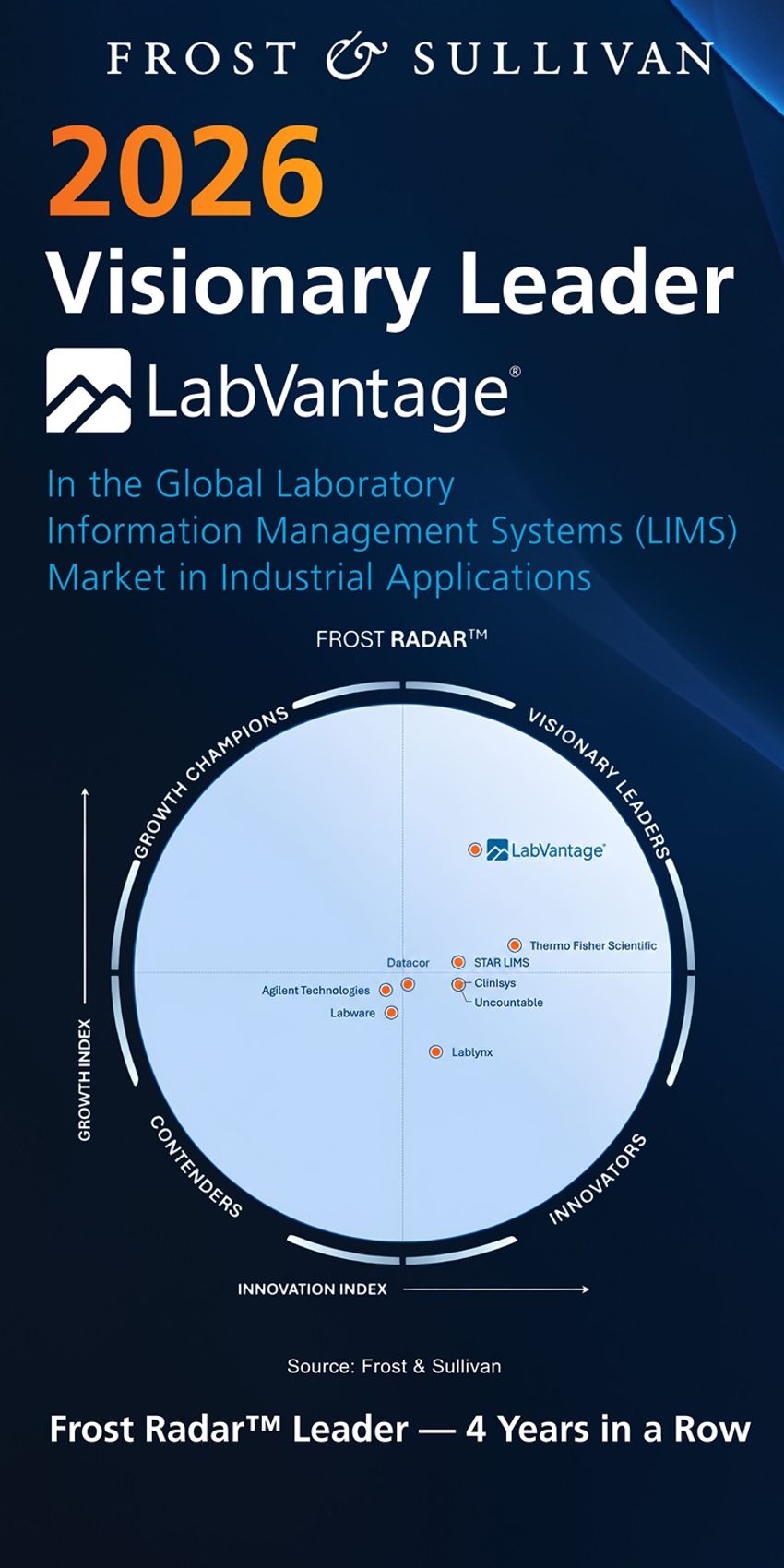
LabVantage Solutions addressed this by building LabVantage CORTEX as a cloud-native artificial intelligence (AI) layer that connects to the validated LIMS core rather than living inside it. That separation earned LabVantage a Visionary Leader designation in two 2026 Frost Radar assessments from Frost & Sullivan: one covering life sciences LIMS, one covering LIMS in industrial applications. The recognition, announced at LabVantage's Customer Training and Education Conference (CTEC) Europe 2026 in Paris, marks the company's fourth consecutive year of Frost Radar leadership.
Frost & Sullivan (2026)
How does the Frost Radar rank LIMS vendors?
Frost & Sullivan's Frost Radar plots vendors on two independent axes: a Growth Index measuring market share, revenue trajectory, pipeline, and strategic execution; and an Innovation Index evaluating product scalability, research and development investment, business model adoption, and customer alignment. Vendors that score strongly on both land in the Visionary Leader quadrant, the upper-right position on the map. For the 2026 life sciences assessment, Frost & Sullivan benchmarked 16 companies; the industrial applications assessment screened 50 vendors and plotted the top 10.
Anantharaman Viswanathan, Research Director at Frost & Sullivan, credited the dual placement to the CORTEX architecture specifically. "LabVantage is the first enterprise LIMS vendor to offer a comprehensive agentic AI framework," Viswanathan said. "By building LabVantage CORTEX separately from the validated LIMS core, the company allows AI capabilities to evolve quickly without disrupting regulated operations."
LabVantage CORTEX: architecture for a regulated AI layer
LabVantage CORTEX is a multi-tenant, cloud-native software-as-a-service (SaaS) layer that sits adjacent to the validated LIMS core, connected but architecturally independent. Because revalidation of a LIMS can take months in a regulated environment, keeping CORTEX architecturally separate lets new AI capabilities ship on a continuous delivery schedule without touching the validated core. Agentic AI agents within CORTEX can schedule reanalysis when instrument readings fall outside specification, route samples by workload and priority, and flag exceptions for scientist review without manual triggering at each step.
CORTEX logs every AI-assisted action with a full audit trail, recording which agent acted, what data it processed, and what outcome it produced. Laboratories configure human-in-the-loop approval workflows to set which decisions run autonomously and which require sign-off. Reported capabilities across both Frost Radar assessments include the following:
- Separated AI layer. Agentic AI framework kept separate from the validated LIMS core, enabling rapid iteration without compliance disruption
- Unified environment. Browser-based platform integrating LIMS, electronic laboratory notebook (ELN), laboratory execution system (LES), scientific data management system (SDMS), and advanced analytics
- Compliance governance. Audit trails and configurable approval workflows compliant with FDA 21 CFR Part 11 and equivalent frameworks
- Instrument connectivity. Internet of Things (IoT) integration for real-time environmental monitoring and predictive maintenance via digital twin technologies
- Customer retention. SaaS delivery with greater than 98 percent customer retention, according to LabVantage
- Cross-industry reach. Deployment across pharmaceuticals, biotechnology, food and beverage, oil and gas, forensics, and government laboratories
How the LIMS market is responding to AI demand
The global LIMS market reached USD 2.92 billion in 2025 and is projected to reach USD 8.55 billion by 2034 at a compound annual growth rate (CAGR) of 12.68 percent, according to Fortune Business Insights. North America holds the largest regional share, driven by pharmaceutical and biotechnology infrastructure, strict regulatory standards, and early SaaS adoption. Europe and Asia-Pacific follow, with demand growing from regulatory digitization programs and pharmaceutical manufacturing expansion.
LIMS historically served as a passive data management and sample tracking tool. A survey cited by LabVantage found that more than 75 percent of laboratories planned to implement AI or machine learning within two years, though LabVantage did not identify the survey's source. That pressure has pushed vendors toward AI-enabled positioning, and LIMS in drug discovery workflows now carries higher stakes as data integrity requirements tighten alongside AI capability.
Enterprise LIMS: a concentrated competitive field
The global enterprise LIMS market is served by a small number of established vendors, with market share concentrated among platforms that have built deep compliance expertise. In 2026, the criteria separating one platform from another have shifted: core sample management and data integrity are table stakes, and AI integration architecture has become the primary differentiator.
| Evaluation criterion | Key buyer question | Significance in 2026 |
|---|---|---|
| AI integration architecture | Is AI embedded inside the validated system or maintained as a separate, independently governed layer? | Determines whether new AI capabilities can be deployed without triggering full system revalidation |
| Compliance framework coverage | Does the platform support FDA 21 CFR Part 11, ICH Q10, ISO 17025, GLP, and GMP out of the box? | Regulated laboratories cannot adopt a platform that requires custom compliance engineering |
| Human-in-the-loop governance | Can approval thresholds be configured per workflow, or is oversight binary? | Laboratories need granular control to meet audit requirements without blocking routine automation |
| Deployment and SaaS maturity | Is the platform cloud-native, or is SaaS a retrofit of an on-premises architecture? | Cloud-native design affects update velocity, scalability, and the speed at which AI capabilities reach users |
| Industry vertical breadth | Does the platform serve only life sciences, or does it extend to industrial, forensics, and government environments? | Cross-industry deployments reduce vendor concentration risk and signal platform flexibility |
| Audit trail completeness | Does the system log AI-assisted actions with agent identity, data inputs, and outcome at the record level? | Regulators expect the same traceability from AI agents as from human operators |
Can agentic AI run in a regulated lab without compliance risk?
Whether it can depends on architecture. Agentic AI layered outside a validated LIMS core, with configurable oversight and full audit trails, can fit within good laboratory practice (GLP) and good manufacturing practice (GMP) frameworks; the same agents embedded inside a validated system would trigger revalidation requirements with every AI update, making continuous improvement impractical. Frost & Sullivan's 2026 industrial applications assessment highlighted LabVantage's "augmentation over full automation" approach as the design principle that navigates this constraint.
CORTEX treats human oversight as a configurable parameter rather than a fixed requirement. A food and beverage quality laboratory can route routine operations to autonomous execution; a GMP pharmaceutical environment running the same platform can require sign-off on the same actions, with no software change between them. The model shares ground with human-AI collaboration in aviation and radiology, where governance structures have proven as consequential as the underlying technology.
Mikael Hagstroem, CEO of LabVantage Solutions, tied the recognition to the laboratory partnerships that shaped the platform. He said, "Built in collaboration with leading global laboratories, CORTEX delivers relevant and impactful agentic AI that gives scientists trusted auditable automation without compromising compliance or data integrity."
What the industrial Frost Radar placement signals for CORTEX
The 2026 industrial applications Frost Radar placement puts LabVantage alongside vendors serving food and beverage, oil and gas, consumer goods, forensics, and government laboratories, sectors where compliance and traceability demands parallel those in pharma but where LIMS adoption has historically been lower. This marks the first time LabVantage has appeared on two simultaneous Frost Radar reports, extending its annual life sciences placement streak, which runs back to the inaugural 2023 report, into a second market segment. LabVantage has signalled plans to deepen CORTEX with expanded semantic AI capabilities and broader instrument integrations, though no specific release timeline has been set.
This article is based on a press release issued by LabVantage Solutions and was produced under Drug Discovery News' AI Editorial Guidelines.