June delivered one of the most concentrated bursts of biopharma dealmaking in years. Three acquisitions exceeding $10 billion each landed in a single week at the end of the month, capping a first half of 2026 that has already produced 33 deals worth $1 billion or more and $134 billion in total value — surpassing all of 2025 in roughly half the time.
The pace could be reflecting something structural: large pharma companies are deploying record cash reserves to fill pipelines faster than internal R&D can replenish them.
For drug developers, that context is worth sitting with, because the science being built today is what the next wave of M&A will be acquiring.
GSK acquires Nuvalent for $10.6B
GSK moved on June 9 to acquire Boston-based Nuvalent, securing three brain-penetrant lung cancer assets in a single transaction. The two lead programs, zidesamtinib (ROS1) and neladalkib (ALK), are both under FDA review with target decision dates in September and November 2026 and carry FDA Breakthrough Therapy Designation. A third asset, NVL-330, a HER2-selective inhibitor, is in Phase 1.
What makes this deal interesting is its mechanistic logic. Both lead assets were built around structure-based drug design, targeting resistance and tolerability limitations of earlier-generation kinase inhibitors. The acquisition suggests that large pharmaceutical companies are placing increasing value on differentiated follow-on molecules that can extend the clinical utility of established targets.
For discovery teams working in targeted oncology, the key message is that differentiation increasingly comes from solving the shortcomings of existing therapies rather than simply pursuing novel biology. Programs that address well-defined clinical failure modes are well positioned to attract investment and acquisition interest.
AbbVie acquires Apogee Therapeutics for $10.9B
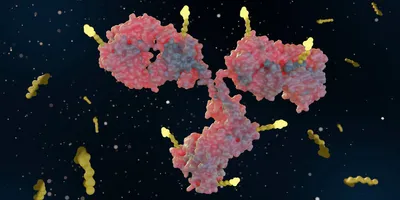
AbbVie's acquisition of Apogee centers on zumilokibart, a half-life extended IL-13 monoclonal antibody designed for quarterly to twice-yearly subcutaneous dosing in atopic dermatitis and asthma. Roughly two-thirds of Phase 2 patients achieved significant skin clearance at week 16, and the extended dosing interval sets it apart from IL-13 competitors already on the market.
More than a pipeline expansion, the acquisition reflects the value Abbvie places on antibody engineering that improves treatment convenience.
The deal is a bet that convenience and durability, engineered into the antibody itself at the molecular level, can drive market differentiation in crowded immunology indications. For researchers in antibody engineering and Fc biology, the commercial validation of half-life extension at this scale is a notable data point.
Merck KGaA acquires Bio-Techne for $11.3B
The largest deal of the month is also the most directly relevant.
Merck KGaA's acquisition of Bio-Techne brings together Merck's manufacturing and distribution infrastructure with a portfolio spanning cytokines, growth factors, antibodies, immunoassay kits, automated protein detection through ProteinSimple, and spatial biology tools including RNAscope, which is widely used in discovery-stage characterization of gene expression in tissue. The deal is Merck KGaA's largest acquisition since Sigma-Aldrich in 2014.
The strategic read matters a lot here. Life science tools companies have been under sustained pressure from reduced academic and biotech spending, but Merck KGaA is betting that the spatial biology and multi-omics infrastructure being built today sits at the center of where drug development is going.
Combining Bio-Techne's research tools with Merck KGaA's capabilities in cell and gene therapy manufacturing creates a more integrated platform for serving drug developers across the preclinical pipeline. For discovery teams, the practical implication is a more consolidated tools market in which fewer, larger vendors control more of the analytical infrastructure research depends on.
What June tells us about the rest of the year
The through-line across all three deals is a validated mechanism. GSK paid for kinase selectivity with clinical proof of concept. AbbVie paid for antibody engineering with Phase 2 efficacy data. Merck KGaA paid for tools infrastructure with decades of research adoption behind it. The common thread is evidence at the point of acquisition, and the willingness to pay a premium for it.
With biotech M&A already at $134 billion through June and the patent cliff still pressing, the second half of 2026 will bring more of the same. Programs with strong mechanistic differentiation, early clinical signal, and clear patient selection logic remain the most attractive acquisition targets.