Among people with non-small cell lung cancer (NSCLC) driven by EGFR (epidermal growth factor receptor) exon 20 insertions (ex20ins), treatment outcomes have long lagged behind those seen with classical EGFR mutations. First-generation and third-generation EGFR tyrosine kinase inhibitors (TKIs) transformed survival for people with exon 19 deletions or L858R substitutions, but exon 20 insertions confer a distinct structural topology that renders most TKIs largely ineffective. Real-world overall survival (OS) in ex20ins NSCLC reached a median of 16.2 months, with a five-year OS rate of roughly eight percent, closer to outcomes seen with nonspecific chemotherapy than with molecularly matched targeted therapy.
Final OS data from the PAPILLON Phase 3 trial, presented at the 2026 World Conference on Lung Cancer and released simultaneously by Johnson & Johnson, show a median OS of 34.3 months for people receiving amivantamab-vmjw (RYBREVANT) plus carboplatin-pemetrexed in the first-line setting, compared with 27.9 months for chemotherapy alone. The primary OS analysis did not reach statistical significance (hazard ratio [HR] 0.87, where a value below 1.0 indicates lower risk in the treatment arm; 95% confidence interval [CI] 0.66–1.14; p=0.307), a result substantially influenced by the 76 percent crossover rate from the control arm to amivantamab-containing regimens after disease progression.
PAPILLON trial design and OS analysis
PAPILLON (NCT04538664) enrolled 308 people with treatment-naive, EGFR ex20ins-positive NSCLC and randomized them one-to-one to amivantamab-vmjw plus carboplatin-pemetrexed or carboplatin-pemetrexed alone. The primary progression-free survival (PFS) analysis, published in The New England Journal of Medicine in 2023, showed 11.4-month PFS with the combination versus 6.7 months with chemotherapy (HR 0.40; p<0.001). These results established amivantamab-vmjw plus chemotherapy as a first-line standard in the United States and Europe, with final OS follow-up reaching 48.6 months.
One key factor complicates interpretation of the primary OS endpoint: 76 percent of people randomized to chemotherapy received amivantamab-vmjw-based therapy in subsequent lines, reducing the intent-to-treat analysis's ability to detect a survival benefit from first-line treatment sequencing. To address this, a crossover-adjusted analysis yielded an HR of 0.57 (95% CI 0.39–0.82; nominal P=0.003), indicating a more substantial benefit than the primary result reflects. The final OS data have not yet been submitted for peer-reviewed publication, and the crossover-adjusted analyses will require independent scrutiny before the clinical significance of the OS benefit is fully established.
The final analysis underscores both the durability of the OS signal and the tolerability profile that clinicians will need to manage with the combination regimen:
- Median OS: 34.3 months (amivantamab-vmjw plus chemotherapy) versus 27.9 months (chemotherapy alone)
- Primary OS HR: 0.87 (95% CI 0.66–1.14; p=0.307), not statistically significant
- Crossover-adjusted OS HR: 0.57 (95% CI 0.39–0.82; nominal P=0.003)
- 76 percent crossover from control arm to amivantamab-vmjw-containing regimens
- Paronychia in 60 percent of people in the combination arm
- Neutropenia in 60 percent of people in the combination arm
- Rash in 58 percent of people in the combination arm
Chul Kim, Director of Thoracic Oncology at MedStar Georgetown University Hospital, pointed to the durability of the response as a defining feature of the results. "We've come a long way in treating EGFR exon 20 insertion-positive lung cancer, and these results demonstrate the lasting impact RYBREVANT plus chemotherapy can have in helping patients live longer," Kim said. "Patients are continuing treatment years after they started, which speaks to the durability of this approach and its value as a first-line treatment for this disease."
How amivantamab targets EGFR exon 20 insertions
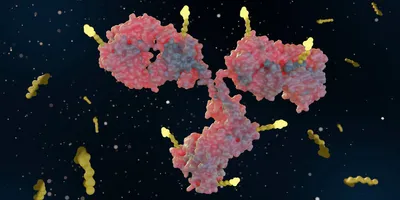
Amivantamab-vmjw is an EGFR-MET bispecific antibody that circumvents TKI resistance by acting extracellularly rather than at the kinase domain. By simultaneously targeting EGFR and MET through two distinct binding arms, it blocks ligand-dependent receptor activation and triggers receptor internalization and degradation from the cell surface. The antibody Fc region recruits innate immune effector cells through antibody-dependent cellular cytotoxicity (ADCC) and antibody-dependent cellular phagocytosis (ADCP), while a trogocytosis mechanism mediated by monocytes and macrophages physically strips EGFR and MET from the tumor cell surface.
Exon 20 insertions account for approximately 5 to 12 percent of all EGFR mutations detected in NSCLC. Unlike exon 19 deletions and the L858R point mutation, these insertions cluster just past the C-helix of the kinase domain, stabilizing the active conformation while occluding the drug-binding pocket. This structural difference confers TKI resistance, making first- through third-generation agents largely ineffective in this subgroup.
Treatment landscape in EGFR exon 20 insertion NSCLC
The treatment landscape for ex20ins NSCLC has broadened since PAPILLON's primary PFS results. Earlier ex20ins-selective agents that reached US accelerated approval have since been withdrawn after confirmatory trials did not demonstrate superiority over platinum-based chemotherapy. More recently, additional selective inhibitors targeting EGFR exon 20 received US Food and Drug Administration (FDA) accelerated approval in the previously treated setting, and several others are in Phase 3 development across first- and second-line indications.
Amivantamab-vmjw plus carboplatin-pemetrexed remains the established first-line standard for this population in the United States and European Union, supported by both PFS and OS data from PAPILLON. Parallel programs are evaluating a subcutaneous formulation to reduce infusion burden, alongside strategies to manage the dermatologic and hematologic adverse events observed in the combination regimen.
| Amivantamab program | Combination | Setting | Status |
|---|---|---|---|
| PAPILLON | Amivantamab-vmjw intravenous (IV) + carboplatin-pemetrexed | First-line ex20ins NSCLC | Approved (US, EU) |
| PALOMA-2 | Subcutaneous amivantamab-vmjw | First-line ex20ins NSCLC | Phase 3 |
| COPERNICUS | Subcutaneous amivantamab-vmjw + enhanced adverse event (AE) prophylaxis | First-line ex20ins NSCLC | Phase 2b |
Yusri Elsayed, Global Therapeutic Area Head of Oncology at Johnson & Johnson, framed the OS results in the context of the company's broader amivantamab program. "We have long believed RYBREVANT could transform the outlook for patients with EGFR-mutated lung cancer by addressing key drivers of disease progression and treatment resistance," Elsayed said. "With the longest survival seen in this patient population, these results add to the growing body of evidence across common, atypical and exon 20 insertion EGFR mutations and further establish the regimen as a backbone therapy."
Next steps for amivantamab in EGFR exon 20 NSCLC
The clinical significance of the PAPILLON OS data will be clarified as the crossover-adjusted analyses undergo independent peer review following publication. PALOMA-2 and COPERNICUS will add evidence on subcutaneous delivery and adverse event management to the amivantamab-vmjw evidence base. Regulatory submissions and updated approvals in additional markets will follow as these datasets mature.
This article is based on a press release issued by Johnson & Johnson and was produced under Drug Discovery News' AI Editorial Guidelines.