As mRNA vaccines and therapeutics continue to advance, researchers need analytical methods that can efficiently assess the quality and integrity of increasingly complex RNA molecules. Conventional approaches often require multiple assays to measure transcript length, degradation, aggregation, and impurities, consuming valuable sample and potentially introducing artifacts through denaturation or labeling.
Refeyn’s TwoMP mass photometer provides a streamlined approach to mRNA characterization by measuring individual molecules directly in solution. The technique can measure mRNA from approximately 200 to more than 10,000 bases, with less than five percent relative error, without labels or extensive sample preparation. This enables researchers to assess long transcripts and identify subtle truncations or degradation products that may be difficult to resolve with conventional sizing techniques.
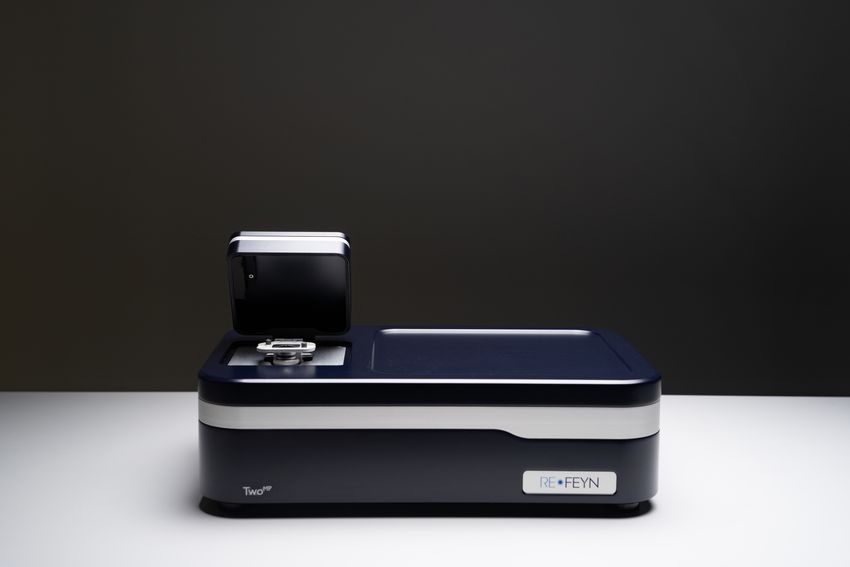
Refeyn’s TwoMP mass photometer enables rapid, label-free characterization of mRNA size, integrity, aggregation, and impurities using only nanograms of sample.
Credit: Refeyn
Because mass photometry operates under native conditions, it can also reveal molecular species that may be missed by denaturing methods. This native-state analysis can help researchers monitor degradation over time or across stress conditions, while preserving the molecular distribution of the sample.
A single measurement can provide information on mRNA integrity, aggregation, and degradation, helping researchers assess multiple critical quality attributes without relying on separate assays for each measurement. The approach can also be applied across different RNA modalities, including linear mRNA, circular RNA, and self-amplifying RNA, providing a consistent analytical approach for diverse RNA molecules. With a separate assay using the J2 antibody, mass photometry can be used to profile heterogeneous double-stranded RNA impurities.
The TwoMP requires only nanograms of sample and can deliver characterization data within minutes. This low sample requirement is particularly useful when material is limited during early development or when repeated measurements are needed to monitor changes in RNA quality. With single-molecule resolution and minimal sample preparation, the system supports rapid analysis across mRNA discovery, development, stability studies, and manufacturing workflows.